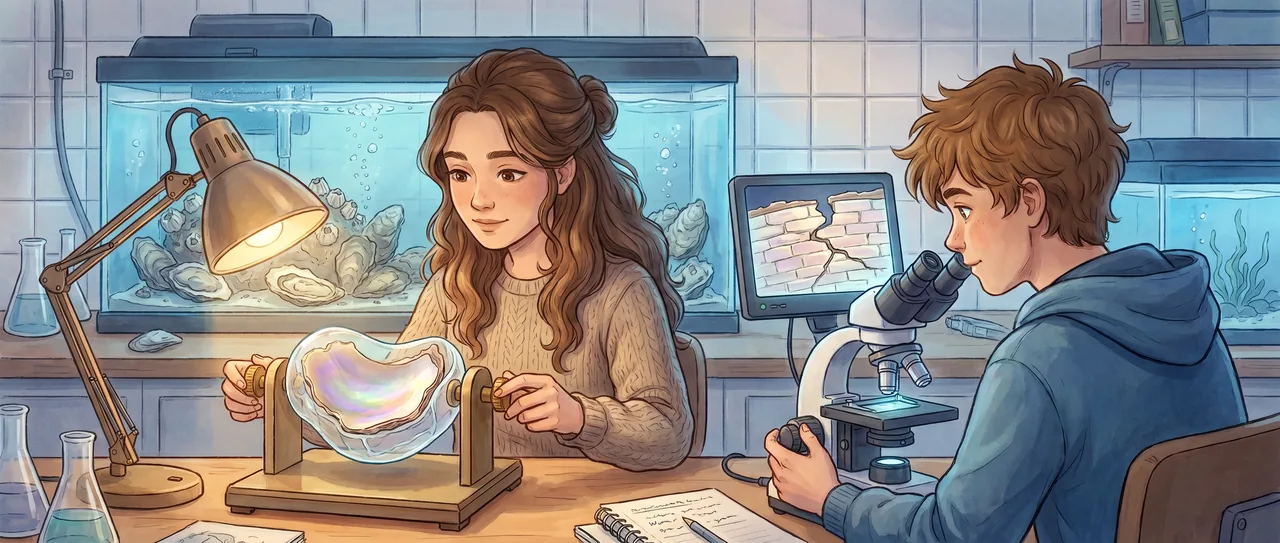
The Crack That Would Not Go Straight
The first tile broke before the museum opened.
It made a small, polite sound, more like a cracker than a catastrophe. The materials engineer stared at the two white pieces in her gloved hands.
Maya leaned closer. Soren stopped halfway through writing the date in his notebook.
The tile had been meant for tomorrow’s new exhibit. It was supposed to look like mother-of-pearl. It did not. It looked like a bathroom sink that had lost an argument.
The engineer sighed through her nose. She had a pencil stuck behind one ear, two pencils holding up her hair, and the expression of a person who had not eaten lunch on the correct day.
“Calcium carbonate ceramic,” she said. “Same basic stuff. Wrong behavior.”
Maya looked past the broken tile to the shallow aquarium tank along the wall. A row of oysters sat in filtered seawater, closed tight as secrets. One shell edge showed a thin place where the inside shone blue, then green, then nothing.
“Your color is sitting still,” Maya said.
The engineer blinked. “My color?”
“On the fake one. It stays where you put it.”
Soren tilted his head. “The shell color moves.”
The engineer picked up a painted sample from the bench. Pearly green paint gleamed under the lamp. She rocked it left and right. The green remained green.
“I know,” she said. “Pigment is easy. Pearl is rude.”
On the bench lay failed things. A smooth white slab. A painted slab. A printed ceramic strip with a crack through the middle. A small tray labeled oyster shell waste.
Soren read the label card taped to the exhibit mock-up. “Mother-of-pearl, also called nacre. Thin layers of calcium carbonate and organic material. Color from interference of light waves. About three thousand times tougher than a single crystal of the same material.”
He looked at the broken tile again.
“That sentence is embarrassing it,” he said.
The engineer gave a tired laugh. “Yes. Please do not tell the donors.”
She turned back to her screen, where a printer diagram glowed in slices. “I need a touch panel that shows shine and toughness by tomorrow morning. The printer gives me chalk. Paint gives me lies. Shell pieces are too irregular for the mount.”
“Irregular how?” Maya asked.
The engineer pointed without turning. “That tray. Sharp edges, cracks, odd curves. Pretty trash.”
Maya was already at the tray.
Soren followed, but he did not touch first. He breathed on his fingers to warm them, then picked up one broken shell piece by its dull outside. The inner surface flashed pink. When he tilted it, the pink ran away and blue took its place.
Maya smiled. “It dodges.”
“It is not on the surface like paint,” Soren said.
The engineer spoke from her screen. “Careful. Real nacre is built in layers thinner than you can see. The spacing is close enough to mess with visible light. Some wavelengths cancel. Some come back stronger.”
Maya held the shell under the lamp and turned it slowly. Nothing about the shell moved, except everything.
Soren set the piece under the bench microscope. Its image jumped onto the small display beside the tank. The shining inside vanished. The broken edge filled the screen.
Maya stopped moving.
From across the room, mother-of-pearl had looked smooth, like frozen moonlight. On the screen, it became a cliff made of stacked plates. Thin pale bricks lay one over another, not perfectly, not neatly, but with a stubborn repeating order. Dark hairline spaces ran between them.
“It’s a wall,” Soren said.
“It’s a sandwich wall,” Maya said.
The engineer rolled her chair over despite herself. “Brick and mortar,” she said. “Aragonite platelets, mostly. A little organic material between.”
Maya tapped the display, not hard enough to smudge it. A crack entered from the broken edge. It did not go straight. It jogged sideways, dropped down, ran along a layer, stopped, and began again somewhere else.
Soren opened his notebook, then closed it without writing.
“The crack keeps getting lost,” he said.
The engineer leaned in. “Deflected. It has to spend energy changing direction. Layers slide a bit. Pull apart a bit. Instead of one clean break, the damage spreads through a maze.”
She looked at the two halves of her printed tile.
“My tile gave the crack a hallway.”
Maya picked up the cracked shell piece again. “This one shows the trick because it broke.”
“It is ugly for the front panel,” the engineer said.
“It is doing both jobs,” Maya said. “Shine on this side. Maze on that side.”
Soren looked at the mount on the exhibit table. It had two empty clamps, one lamp, and a square where the fake tile was supposed to go. He turned the lamp toward the tank, then toward the microscope, measuring the angles with his hand.
“If people touch the fake panel, they learn that fake panels break,” he said. “If they turn the shell, they see the color move. If they press the button, the screen can show the crack not going straight.”
The engineer rubbed her forehead. “The exhibit was supposed to have one beautiful piece.”
Maya sorted through the waste tray. “Then it would hide the important part.”
There were many shell fragments. Some were chalky. Some were brown outside and cloudy inside. Maya rejected those quickly. Soren lined up three that had clean broken edges, then placed each under the microscope. The first was too thick for the clamp. The second shone well, but its fracture was a blank blur. The third was curved like a fingernail and had a crack that wandered in tiny steps across the edge.
“That one,” Maya said.
Soren did not answer immediately. He rotated it under the microscope, then under the lamp, then under the microscope again.
“That one,” he said.
They fitted it into the clear holder meant for the fake tile. It did not fit. One corner lifted. The curve made the clamp rock.
The engineer reached for it. “I can trim it.”
“No,” Maya said.
The engineer froze, one hand in the air.
Maya pointed to the curve. “The curve is why the light changes when you move.”
Soren had already found a strip of soft clear silicone from the gasket drawer. “We don’t need it flat. We need it held.”
The engineer looked at the clock, then at the silicone, then at the two broken halves of her tile.
“Fine,” she said. “No blood, no glue on the microscope, no putting shell in your pockets.”
They built a cradle instead of a frame. Silicone under the curved shell. Two gentle clips at the dull outer edge. A small turning knob from an unused lens mount. Soren adjusted the lamp so the beam struck the nacre at a slant. Maya taped a tiny arrow beside the knob, then removed it and replaced it crookedly because the straight arrow suggested the wrong thing.
When she turned the knob, the shell flashed violet. Then gold. Then green so sharp it seemed wet.
The engineer stopped tightening a screw.
“Again,” she said.
Maya turned it back. The colors fled and returned.
Soren pressed the microscope button. On the screen, the broken edge appeared. The crack wandered through the stacked plates like a path drawn by something that kept changing its mind.
The engineer picked up the painted sample. Under the same lamp, its green sat obediently in place.
She set it facedown.
A group of visitors passed in the hallway above them, their footsteps thumping softly through the ceiling. The aquarium pumps hummed. In the tank, an oyster opened a hairline and closed again.
The engineer looked at the exhibit label. She crossed out beautiful replacement panel with a black marker. Under it she wrote turn the shell.
“That is not the final label,” she said.
“It should be,” Maya said.
Soren pointed at the printed ceramic strip. “Could the printer make layers that small?”
“Not like an oyster,” the engineer said. “Not yet. People are trying. Layered ceramics. Tough composites. Materials that stop cracks instead of pretending cracks will never happen.”
She looked toward the tank, where the oysters sat in ordinary seawater, building what the machine could not quite copy.
Maya crouched until her eyes were level with the nearest oyster. Soren lowered the lamp. Inside the tank, the oyster closed once, slowly, and the edge of its shell flashed green.
Read the interactive version, listen to the narration, and earn a gold star →
A science-verified short story for curious kids · Curiosity Land