Four Hundred Doors
The chemist almost did not let Soren bring his notebook into the Scent Foundry.
"Paper sheds," she said, holding out a white glove. "Paper smells. Paper remembers lunch."
Soren hugged the notebook to his chest. It was bent at the corners. It smelled like dust, pencil wood, and the inside of his desk drawer on warm days.
"I won't open it," he said.
The chemist looked at the clock over the airlock door. She was small and quick, with silver sleeves rolled to both elbows and a strip of tape stuck to her shoulder. Behind her, glass tubes ran through the wall like clear roots. Little pumps clicked. Somewhere inside the room, something smelled faintly of orange peel and thunderstorms.
"Fine," she said. "If you smell pencil shavings in the moon orchard, I will know whom to blame."
Soren stepped through the air shower. Clean wind climbed up his ankles and sleeves. The room beyond was not like a kitchen or a greenhouse, though it was trying to be both. Along one wall stood rows of sealed vials, each no bigger than his thumb. Their labels said things like WARM BREAD EDGE, SNOW ON WOOL, OLD PINE STAIR, and CITY RAIN, VERSION SIX.
At the far end sat a chair with a glass half-mask attached to a flexible silver arm.
"Sit," the chemist said. "I need one more nose before I lock the recipe. Children notice different things. Usually inconvenient things."
Soren sat.
"What is it for?" he asked.
"The first orbital garden for children born above Earth," she said, fitting the mask gently over his nose and mouth. "The trees will be real. The soil will be real. But the rain will be recycled mist, and mist by itself smells like almost nothing. So we are giving the garden weather."
Soren held very still.
He knew water did not smell like rain. Rain was pavements waking up, gutters cooling, leaves bruised by drops, dirt opening its mouth. At least, that was his current list.
The chemist touched the screen.
A soft breath came through the mask.
Soren waited for rain.
He got a box.
Not a cardboard box exactly. A box stored beside rubber bands. A box that had once held coins. There was wet stone under it, and something green far away, but the box sat on top of everything.
The chemist watched his face fall.
"No," Soren said.
She shut off the mask. "No what?"
"It's wearing a box."
The chemist pinched the bridge of her nose. "The chemical balance is correct. The instrument passed it twice."
"The instrument has never stood under the bus shelter by the library," Soren said.
"Neither has the orbital garden," she said, but she turned to the screen anyway. "Describe it."
Soren swallowed. This was the part people disliked. Not because he could not answer. Because he answered too much.
"Wet pavement. Good. Cold leaf stem. Maybe. But also coin box. Tape. Warm dust. The box is louder than the rain."
The chemist stared at him.
"You said one smell," she said.
"It is one smell. It has pieces."
For the first time, she smiled as if he had said something useful by accident.
"Come here."
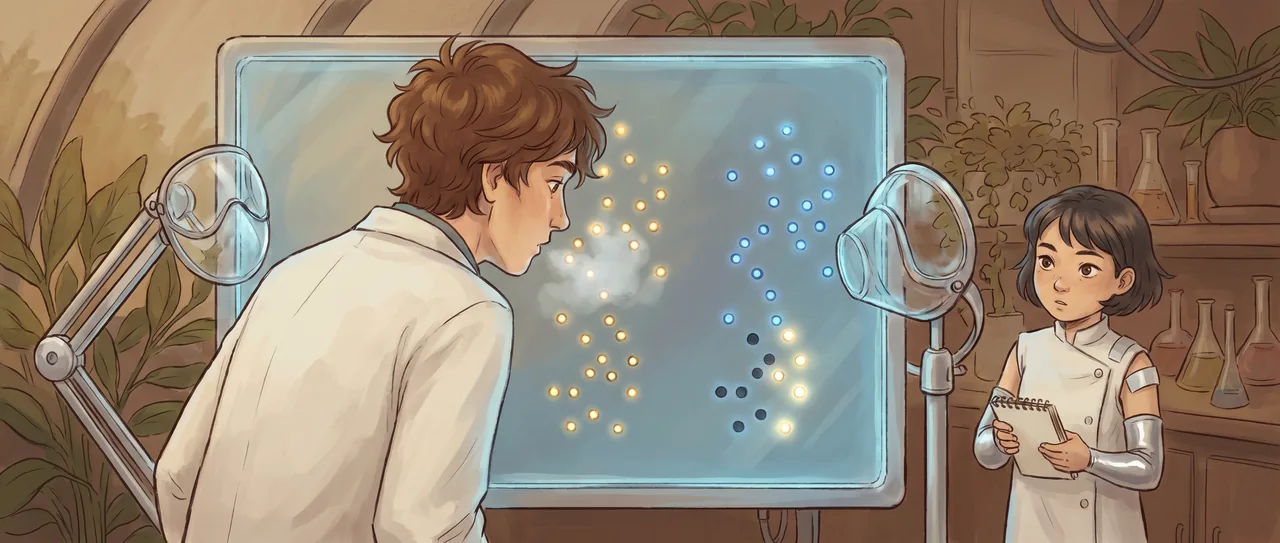
She led him to a glass table. Under it, tiny wells were arranged in a grid that went on and on, hundreds of them. Each held a clear droplet. A camera hung above them like an eye.
"These are not noses," the chemist said. "Not really. But each well carries one kind of human smell receptor protein. About four hundred kinds. Your nose has cells using them. When odor molecules fit them, even weakly, we can make the well glow."
She slid the rain vial into a port.
The pumps clicked.
On the dark screen, lights appeared.
Not one light. Not RAIN in bright blue letters. A scattered pattern bloomed across the grid. Some points flashed strong. Some only breathed. Some stayed black.
The chemist tapped another command, and a stored pattern appeared beside it. The two patterns were almost twins, but not quite. A small cluster near the lower edge glowed on Soren's sample where the stored one stayed dim.
Soren leaned closer until his breath fogged the glass.
"That part," he said.
"Maybe noise," the chemist said. She said it quickly, like someone shutting a drawer.
"Can I smell the empty one?"
"The empty what?"
"The thing that holds the rain. Without rain."
The chemist looked at the clock again. Then she gave a tiny groan and loaded a blank capsule.
A breath came through the mask.
Soren shut his eyes.
Box.
Just box, thin and sneaky, pretending to be air.
"There," he said.
The chemist put the blank capsule through the receptor table.
The same little cluster lit.
She stopped tapping the screen.
The pumps clicked three times in the silence.
"Storage sleeve," she said. "New polymer. Approved as odorless."
"Not odorless," Soren said.
"Not to you."
He looked at the screen again. The blank capsule had not made much of a pattern. Just a few lights. But those few lights had landed exactly where the rain needed to be quiet. A whisper in the wrong place had changed the whole word.
The chemist took the tape from her shoulder and stuck it to the edge of the table. "All right, paper notebook. What else is wrong?"
Soren liked her better then.
They remade the sample in a glass capsule that had been baked clean. The box vanished. The rain got clearer.
Still wrong.
Soren breathed through the mask three more times because three was the smallest number that made him trust himself.
"Too flat," he said.
The chemist lifted both hands. "It is not contaminated now."
"I know. It's flat anyway. Like a picture of soup."
"Soup. Excellent. Very measurable."
Soren pointed to the vial rack. "What is that one?"
The label said EARTH AFTER DRY SPELL, TRACE.
"Geosmin," the chemist said. "A molecule made by soil bacteria. Humans smell it in extremely tiny amounts. Too much and the whole garden smells like someone drowned a beet."
"Did you use it?"
"Of course. Carefully."
"Can I smell the careful version and the less careful version?"
The chemist gave him the look adults gave before deciding whether a child was wasting time or saving it. Then she loaded two strips into the mask, one after the other.
The careful one was polite. The less careful one opened the ground.
Soren gripped the chair.
For half a second, he was not in the foundry. He was at the edge of the playing field after summer heat, when the first drops hit dust and everyone ran for cover except him, because the air had become enormous. Not empty air. Crowded air. Molecules rising from stone, soil, leaves, coat sleeves, old puddles, warm railings. Invisible pieces striking invisible doors inside his nose, hundreds of doors, and behind them his brain making a place.
He opened his eyes.
The screen still showed lights. Four hundred possible kinds, not labels, not tidy shelves. A smell was a chord with more notes than his hands could hold. Change one note, and the chord leaned somewhere else. Change a few, and a street became a forest, or a box became weather, or a memory became almost but not quite true.
"There can't be only a few smells," he said.
The chemist was watching the screen too.
"No," she said. "Not a few. The estimates go very high. Around one trillion that humans may be able to tell apart. Maybe more, depending on how you count."
Soren thought of all the times someone had said, It just smells like rain. He thought of his notebook pages where he had written basement rain, road rain, apple-tree rain, rain before snow, rain on hot wires, rain on his father's coat. He had wondered if he was adding things that were not there.
On the screen, the two geosmin samples shone differently.
"They are there," he said.
"Yes," the chemist said, softer now. "They are there."
They did not make City Rain, Version Seven.
The chemist deleted the label entirely.
After that, Soren built three samples with her watching and not interrupting. One had the sharp green edge of leaves struck hard. One had warm pavement and a low mineral smell. One had soil rising so strongly that the chemist made him dilute it twice, and he made her put back one drop.
They tested each on the receptor table. The patterns did not match. They were not supposed to.
The chemist brought out a tray of empty glass capsules. There were twenty slots.
"The orbital garden can carry twenty weather smells for the first year," she said. "We were going to choose twenty famous ones. Rain. Snow. Sea. Forest. Easy words."
Soren looked at the empty slots. Twenty was suddenly a very small number. The vials behind him clicked in their racks. Pumps breathed through tubes. The air held orange peel, cold leaf stem, clean glass, and a thousand things without names waiting close enough to touch.
He picked up the printed label that said RAIN.
Soren turned it over, wrote WHICH RAIN, and slid it into the first empty slot.
Read the interactive version, listen to the narration, and earn a gold star →
A science-verified short story for curious kids · Curiosity Land