Every Clever Thing Is a Bet
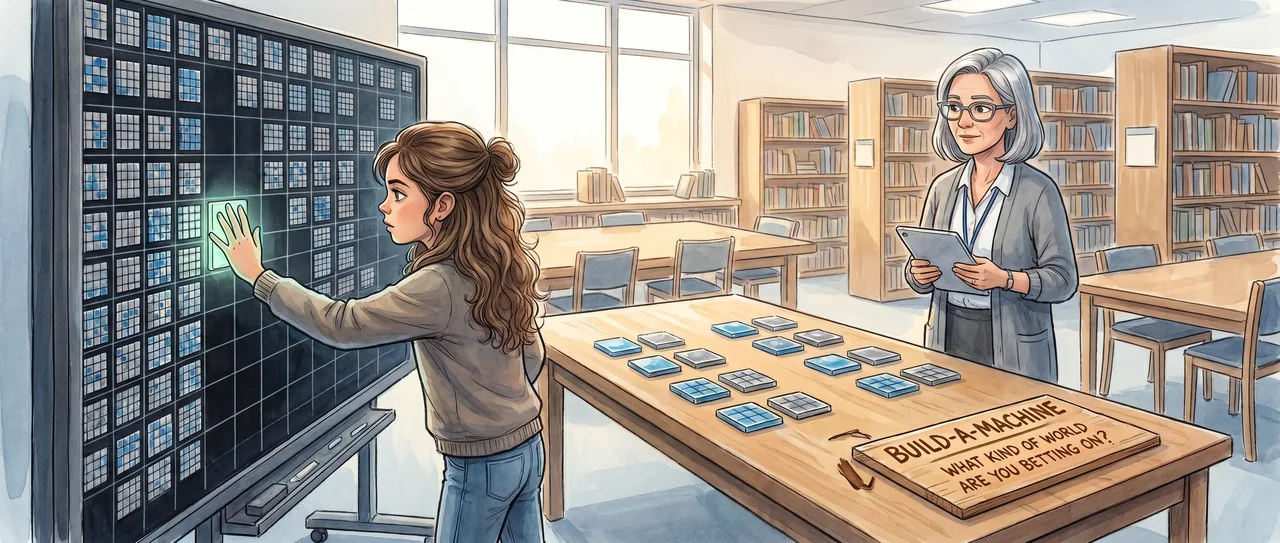
The sign over the library lab said BUILD A MACHINE THAT LEARNS ANYTHING.
Maya hated the sign before she knew why.
It was too shiny. Too round at the edges. The kind of sentence adults made when they wanted the universe to stand still for photographs.
On the table below it sat a square screen divided into sixteen tiles. Some tiles hid water. Some were dry. A little rover program could test one tile at a time. After each test, it had to choose where to look next.
The adult in charge of the lab had silver glasses, three tablets, and a voice that kept starting new sentences before the old ones were finished.
“Simple,” the adult said. “You make a learner. It tries worlds. It improves. The trustees arrive at four, and we show them the best one.”
Maya touched the corner of the screen.
A world bloomed open. The water tiles made a cluster, like spilled ink.
“Too easy,” Maya said.
She built a rover that loved neighbors. If it found water, it checked the tiles beside it. It did beautifully on puddle worlds.
Then she fed it stripe worlds, where every other column hid water. Her rover wasted half its steps hugging empty neighbors.
Maya changed it. First it tested corners. Then middle. Then it compared left to right, top to bottom, near to far. If the first few answers smelled like a cluster, it became a cluster hunter. If they smelled like stripes, it became a stripe hunter. If they alternated, it hopped like a checkerboard frog.
The adult leaned over just long enough to say, “Adaptive. Good word for the poster.”
“It is not for the poster,” Maya said.
But the rover did look good.
On cluster worlds, it found water fast. On stripe worlds, faster. On checker worlds, it made the screen blink blue so quickly that the adult stopped walking past and actually watched.
“That one,” the adult said. “That is our best learner.”
Maya should have liked that.
Instead, something joined the list in her head. The sign. The word anything. The way her rover looked clever only after she decided what kinds of worlds deserved names.
The adult tapped a menu with a finger. “Final test. All worlds.”
The screen went black, then filled with tiny grids. Not one world. Rows and rows of them. More than Maya could count before they flowed into smaller rows behind the first ones.
“Those cannot all fit,” Maya said.
“Sixteen tiles,” the adult said. “Each tile wet or dry. The computer can generate every arrangement.” The adult glanced toward the glass doors. “Wonderful visual, isn’t it?”
Maya stared.
Every arrangement meant puddles. Stripes. Checkerboards. L shapes. Corners. Smiles. Almost-smiles. Broken stripes. Worlds that looked like a mistake. Worlds that looked like another mistake pretending to be a pattern. Worlds where the first wet tile meant the next tile was wet, and worlds where the first wet tile meant absolutely nothing.
Her rover began.
On the first world, it was brilliant.
On the next, clumsy.
On the next, brilliant in a different way.
Then foolish. Then lucky-looking. Then wrong in a way that made Maya’s teeth touch.
At the end, the score appeared.
It was tied with COIN ROVER.
The adult laughed once, not happily. “That cannot be right.”
Maya did not answer.
The adult ran it again. Same result.
“Maybe the scoring module,” the adult said. “I can hide that test. The visitors only need the fun worlds.”
“No,” Maya said.
The adult looked at her over the glasses. “Maya, I have eleven minutes.”
“I need two.”
She took the glass tiles from the side tray. They were for younger children, big enough to hold, blue on one side for water and gray on the other for dry. She made a tiny four-tile world first.
Blue, gray, gray, gray.
Her rover always tested the upper left tile first. That was not in the program as a rule she had meant to write. It was just where the first test began. Every rover had to begin somewhere.
On this world, upper left was perfect.
Maya flipped only that tile to gray and flipped the lower right to blue.
Gray, gray, gray, blue.
Same first move. Terrible now.
She made a stack of worlds where loving neighbors helped. Then, beside each one, she made a world where that same love hurt. Water beside water in one. Water avoiding water in the other. A stripe world. A stripe trap. A checker world. A checker trap.
The adult stopped tapping the tablet.
Maya did not explain. She kept pairing them.
For every clever guess, she could build a world that punished it.
The table seemed to tilt, though it did not move.
It was not that her rover had stopped being clever. It was that clever had a shape. Her rover leaned toward worlds where nearby things mattered, where early clues kept mattering, where patterns stayed themselves long enough to be used.
But all possible worlds included worlds that hated every lean.
Maya looked back at the screen full of tiny grids. The rows no longer looked like a test. They looked like a sky with too many constellations, most of them refusing to be constellations at all.
The adult said, quietly, “So there is no best learner.”
“There is no best for everything,” Maya said.
The adult looked at the sign over the lab.
Maya was already pulling it down.
It came off with a sticky sigh.
The adult made a sound. “Please do not destroy library property.”
“I am improving it.”
On the back of the sign, Maya wrote with a thick marker. Not a sentence for photographs. A question with corners.
WHAT KIND OF WORLD ARE YOU BETTING ON?
The trustees arrived while the ink was still wet.
The adult began to speak, then stopped, because Maya had already started the rovers.
Three worlds glowed on the big screen. In the first, water formed a puddle. The neighbor-loving rover won. In the second, water made stripes. The stripe rover won. In the third, the water tiles had been scattered by the all-world generator, with no pattern waiting kindly inside it. Coin Rover did just as well as the beautiful ones.
A visitor laughed when Coin Rover won one round.
Maya did not laugh. She reset the round and let it win again, then lose, then tie.
The adult, who had wanted one best machine, moved the tablets aside and began handing visitors the glass tiles.
“Make a world,” the adult said. “Then choose what kind of learner deserves it.”
Maya watched hands turn blue and gray tiles. Puddles appeared. Stripes appeared. Mazes appeared. Traps appeared by accident. Some visitors tried to fool the rovers. Some tried to help them. The lab grew louder, not with cheering, but with arguments about what the next hidden tile ought to be.
Maya stood at the edge of the table.
At school, people sometimes told her to stop jumping ahead. Start at the beginning. Show every step. Do not guess before you know.
But every rover guessed before it knew. Every learner stepped into the dark with a preference hidden in its first footstep. The careful ones guessed too. They only guessed more politely.
The next world on the screen was blank, sixteen dark squares waiting for tests.
The adult put a fresh marker in Maya’s hand. “We need labels for the rovers.”
Maya wrote NEIGHBORS MATTER under one. She wrote STRIPES MIGHT under another. Under Coin Rover, she paused, then wrote NO PROMISES.
The adult read it and smiled with one side of their mouth. “That one will worry the trustees.”
“Good,” Maya said.
The all-world generator was still open on the corner screen. Tiny grids poured past in perfect rows. More worlds than anyone in the room could try. More ways to be wrong than there were chairs, windows, ceiling lights, breaths.
And somewhere inside the room, the rovers kept finding water.
Maya took one clear world chip from the tray and held it between her finger and thumb. The blank grid lit her fingers pale green. Maya slid the blank world into the slot and pressed Start.
Read the interactive version, listen to the narration, and earn a gold star →
A science-verified short story for curious kids · Curiosity Land