Choose One Repair
The warning on the planning screen was red enough to make the whole bench look embarrassed.
CHOOSE ONE REPAIR STRATEGY.
The lab manager sighed through her mask. She was trying to unpack pipette tips, answer a parent's question about snacks, and stop the liquid-handling robot from playing its startup song for the fourth time.
“It is being dramatic,” she said. “The demo is simple. Same Cas9 cutter. Same guide. Two cell-culture cartridges. In one, we turn a gene off. In the other, we fix one letter. The planner wants one repair strategy, but we need both outcomes by seven o'clock.”
Maya leaned closer to the screen. “Same cut, different endings.”
“That is the idea,” said the lab manager. “CRISPR cuts. Editing happens. Usually the children cheer.”
Soren had already opened his paper notebook, which made the tablet on the bench look offended. “Usually is hiding something.”
The lab manager pointed at the sealed cartridges in the rack. They were no bigger than crackers, each with tiny wells under clear plastic. “No opening these. No touching cells. You can change the plan, not the biology. If you make the software stop arguing with itself, call me.”
She hurried away to rescue a tower of wobbling glove boxes.
Maya read the goals aloud from the screen. “Cartridge A. Stop the blue signal gene. Cartridge B. Repair the blue signal gene. That sounds rude.”
“It is a training gene,” Soren said. “Blue is just easy to measure.”
“Still rude.”
He tapped the first diagram. A long strip of letters ran across the screen. The guide RNA matched a short stretch near the middle. Cas9 would cut both strands there. The animation showed the DNA snapping open like a broken zipper.
Then the animation waited.
“That is strange,” Maya said.
“What?”
“It stops at the interesting part.”
Soren selected the results from last month's demo. The screen filled with rows of letters from Cartridge A. None matched exactly. Some had one letter missing. Some had three extra. Some had a chunk gone. Beside most rows, the blue signal was dark.
Maya smiled quickly. “It worked by making a mess.”
Soren did not smile yet. He counted changes with his pencil tip, not touching the screen. “Different messes. Same cut site. Missing two. Added one. Missing five. Missing one.”
“Good messes,” Maya said.
“For turning something off,” Soren said.
He opened the old results from Cartridge B. The first few rows looked like the same jagged mess. The blue signal was still wrong or missing. Far down the list, one row had the corrected letter. Its signal glowed blue.
“Only a few,” Soren said.
Maya rocked back on her heels. “So the cutter is not the editor.”
Soren looked at the waiting animation. “The cut is the question.”
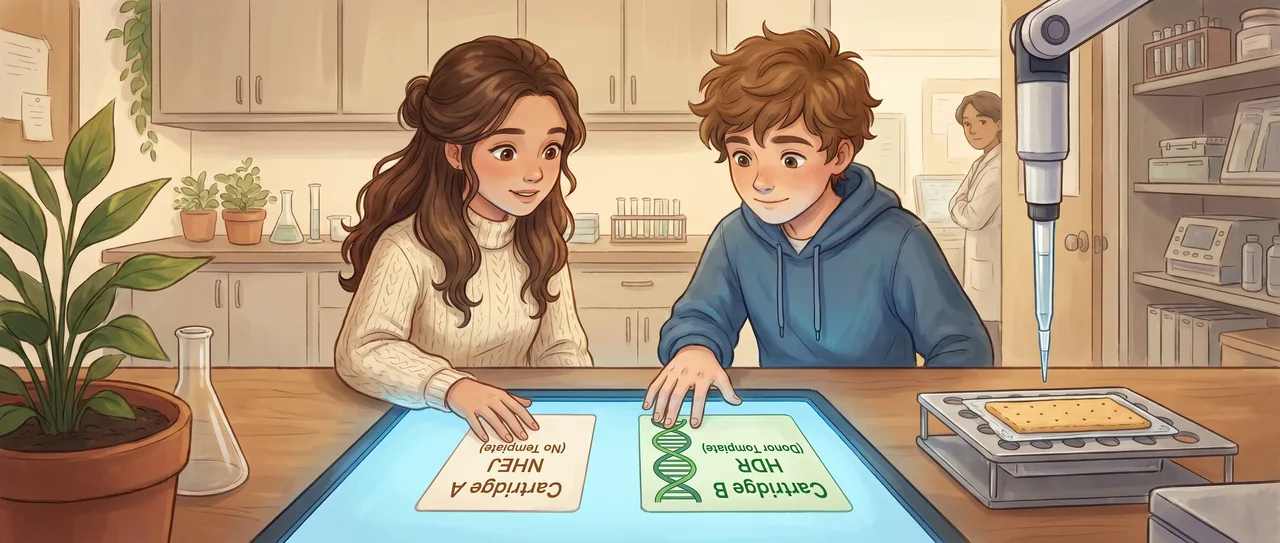
On the bench beside the keyboard were plastic cards for the demonstration. The lab manager had probably meant them for younger kids. One showed Cas9 as a pair of silver scissors. One showed a guide RNA as a strip with matching letters. One showed a DNA template, a little ladder with the corrected sequence printed in green.
Maya picked up the template card. “For B.”
“Maybe for both,” Soren said. “If we want one plan.”
Maya placed the template card under Cartridge A. The planner flashed yellow.
DONOR TEMPLATE MAY PRODUCE PRECISE REPAIR.
“Bad,” Maya said. “Precise is bad for A.”
Soren moved the template card under Cartridge B. The yellow vanished.
“For B, precise is good,” he said.
Maya slid the no-template card under Cartridge A. The rows from the old results rearranged themselves into a bar chart. Most bars were labeled with tiny insertions or deletions. Most had no blue signal.
The software stopped flashing for that half.
Maya pointed at the strange little scars. “The cell is fixing it fast.”
Soren pulled up the help window, but he did not let it cover the data. “Non-homologous end joining,” he read. “Joins broken DNA ends directly. Often makes small insertions or deletions.”
“That name is too long for a thing that panics,” Maya said.
“It may not be panic.” Soren looked at the sealed cartridge. “If your DNA is broken in two, fast is useful.”
Maya did not argue. She was looking at the old rows again. The same cut had become thirty different repairs. Not random like spilled beads. Random like every cell had reached for the break in its own small hurry.
The room seemed louder for a moment, full of hidden mending. Skin cells. Leaf cells. Yeast in bread. The invisible work of staying alive, happening without applause.
Soren turned to Cartridge B. “Precise repair needs the template.”
Maya held up the green-lettered ladder card. “Give it the sentence we want it to copy.”
He selected donor template. The planner still flashed yellow.
HDR LOW IN NON-DIVIDING CELLS.
Maya made an impatient sound. “It wants another thing.”
Soren searched the options. “Homology-directed repair. Uses a matching DNA template. More active when cells are preparing to divide.”
“So pick the dividing batch,” Maya said.
“There are batches?”
She pointed at the corner of the screen. Three tiny icons sat beside Cartridge B. Crescent, circle, doubled circle. The doubled circle had been ignored because it was not first in the list.
Soren opened it. The old data changed. More blue rows appeared, still fewer than the messy repairs in A, but clean. The corrected letter sat in place again and again.
The planner went quiet.
For a second neither of them spoke.
The screen now showed two plans side by side.
Cartridge A had the guide and no template. Let the quick repair close the break. Break the word enough that the blue signal stopped.
Cartridge B had the same guide, the green-lettered donor template, and cells from the dividing batch. Give the repair machinery something exact to copy.
Maya touched the air above the two columns, not the screen. “Same scissors.”
“Different repair,” Soren said.
Behind them, the robot finally stopped singing. The lab manager returned with a box of gloves under one arm and a strip of labels stuck to her sleeve.
“Please tell me the red warning has become a friendlier color,” she said.
Soren stepped aside.
The lab manager looked at the screen. Her eyebrows climbed. “You split the workflow.”
“The software wanted one repair strategy,” Maya said. “The cells did not.”
The lab manager read the settings, lips moving slightly. “No donor for the knockout. Donor template for the correction. Dividing cells for the precise repair.” She looked from one cartridge to the other. “That is annoyingly better than my plan.”
Maya grinned. “It was arguing because it was right.”
Soren waited for the lab manager to press approve, but she folded her arms instead.
“You changed the plan,” she said. “You approve it.”
The button was green now. It said QUEUE TRAINING RUN.
Maya looked at Soren.
Soren looked at the two cartridges, the same cut waiting inside both, and the two different futures they had chosen for the break.
They pressed the button together.
The robot woke with a soft clack. Its arm slid left, collected a rack of clear pipette tips, and paused above Cartridge A.
On the screen, the planner opened a new window. It showed a third sealed cartridge with no goal written beside it. Only the guide sequence was filled in. The repair strategy box was empty.
Maya reached for the no-template card. Soren reached for the green-lettered ladder.
The robot arm clicked awake, lifted a clear pipette tip, and moved toward the unmarked cartridge.
Read the interactive version, listen to the narration, and earn a gold star →
A science-verified short story for curious kids · Curiosity Land