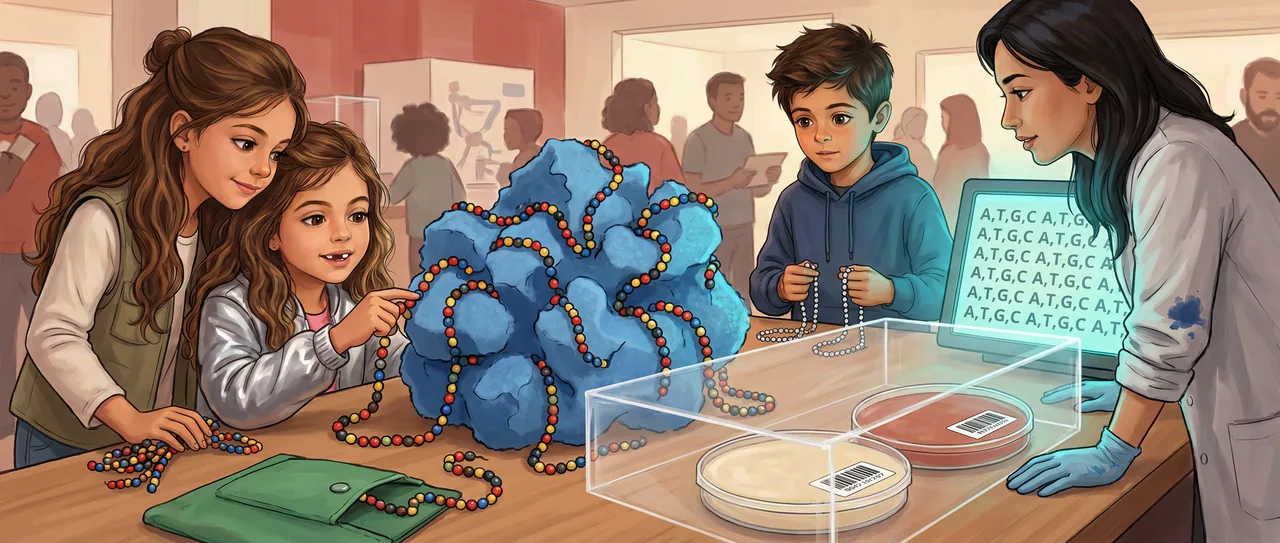
The Shape That Copied Itself
The first thing Soren said was wrong.
"They switched the plates."
Maya was already leaning over the table, her nose almost touching the clear plastic shield. Inside were two sealed dishes of yeast, each dish covered with tiny round colonies. One dish was pale cream. The other was dusty red, like brick powder.
Both dishes had the same barcode.
Behind them, the Genome Foundry hummed for its Saturday open house. A robot arm moved tiny drops from one tray to another. A screen showed spirals of DNA turning slowly, blue and green and gold. At the next table, a boy was trying to print his name in bacterial ink while his father took too many pictures.
Dr. Lio rushed past carrying a box of gloves under one arm and a half-eaten banana in the other hand.
"You two are on the protein table," she said. "Easy job. Kids scan the barcode, see the gene, build the chain, fold the chain. Please do not start with the prion part. It makes grown-ups ask dramatic questions."
"The plates have the same barcode," Soren said.
"Same strain," Dr. Lio said. "Sealed. Safe. Nobody opens anything. I have to rescue the bacterial printer before it writes on the floor."
She vanished behind a banner that said YOUR GENOME IS NOT A DESTINY, which Soren thought was probably too large a sentence for a banner.
Maya tapped the shield beside the red colonies.
"Same strain," she said.
"Same code should make the same protein," Soren said. "Same protein should do the same thing."
"Should," Maya said.
Soren took the scanner. It chirped when he passed it over the cream plate. The screen showed a row of letters, A, T, G, C, too long to read all at once. He scanned the red plate.
The same row appeared.
He scanned both again.
The same.
Maya smiled a little.
"That is a bad smile," Soren said.
"It is a good problem."
"It is a broken exhibit."
"Better."
Visitors were beginning to gather. Dr. Lio shouted from across the room, "Start them with the code cards! The folding magnets are for after!"
Maya had already opened the bin of folding magnets.
Inside were bead chains, each one exactly alike. Red bead, yellow bead, black bead, blue bead, repeated in the same order. Each bead had hinges, and some had tiny magnets hidden in their sides. There were also two foam shapes. One was a neat green pocket. The other was a crooked blue clump with flat sides.
Soren picked up a bead chain and laid it next to another.
"Identical," he said.
"Fold one," Maya said.
He bent the first chain carefully. Red bead to red notch. Blue bead tucked under. Yellow bead snapped into the green pocket with a soft click.
"Protein," he said.
"Again."
He folded a second chain the same way. It clicked into the same tidy shape.
Maya took a third chain and pressed its middle against the crooked blue clump.
The magnets caught.
The chain did not settle into the green pocket. It flattened along one side of the clump, kinked, and stuck there. When Maya touched a fresh chain to it, the fresh chain bent into the same crooked angle and locked on.
Click.
Soren put down the scanner.
Maya handed him another chain.
He did it more slowly. The beads were in the same order. His fingers had not changed the chain. The blue clump had given it a different posture.
Click.
The fourth chain joined the stack.
A little girl in a silver jacket had come to watch. She had a missing front tooth and a serious face.
"Is it supposed to do that?" she asked.
"Yes," Maya said.
"No," Soren said at the same time.
The girl looked pleased.
The little girl pressed both hands against the table edge.
"The DNA is the same?"
Soren pushed the scanner toward her. She scanned the cream plate. Chirp. She scanned the red plate. Chirp.
The same letters filled the screen.
"The scanner can only see the letters," Soren said.
Maya held up the crooked stack of bead chains.
"This sees the shape."
Dr. Lio arrived, slightly breathless, with a smear of blue bacterial ink on her sleeve.
"Why is everyone at the prion end?" she asked.
"Because the code is telling the truth," Maya said. "And it is not enough."
Dr. Lio opened her mouth, shut it, and looked at the two yeast plates. Then she looked at the crooked stack of chains in Maya’s hand.
"That is the part I usually save for older visitors," she said.
"They are here now," Soren said.
More people had gathered. Someone in the back said, "So one dish is sick?"
"No," Soren said. He did not say it loudly, but the room quieted anyway. "This yeast is a safe demonstration strain. It is showing that protein shape can be copied. Human prion diseases are different and serious. We are not opening anything."
Maya slid two identical chains across the table to the little girl.
"Make them match," she said.
The girl folded one into the green pocket. She folded the other into the green pocket too. Both clicked neatly.
Maya put the crooked blue clump between them.
"Now touch one to this."
The girl hesitated.
Her mother said, "It is just a model."
"I know," the girl said. "I am waiting to see if I am right."
She touched the chain to the blue clump.
Click.
The green fold came apart and flattened along the crooked side.
The girl did not smile. Her eyes widened, and for a moment she looked almost offended, as if the table had moved under her feet.
Soren knew that look. It was the look people got when the universe refused to stay inside the box it had been given.
He took two more fresh chains from the bin. He did not hand them to anyone yet.
"One bad copy makes bad copies," said the father with the camera.
Maya shook her head.
"Not bad like that," she said. "Wrong shape for one job. Strong shape for copying itself."
Dr. Lio leaned against the table. She was listening now, not rushing.
"Proteins wiggle," she said. "They are not little statues. Most fold into the shapes that let them work. But sometimes a shape appears that is stable in another way. With prions, that shape can recruit others."
"Recruit," the little girl said, tasting the word.
Soren placed a fresh chain beside the scanner screen. Letters on one side. Beads on the other.
For the first time that morning, his notebook stayed closed in his back pocket. The table was already writing it down.
Visitors took turns. A child with red glasses tried to fold the chain without touching the blue clump, then touched it anyway and jumped at the click. A grandmother scanned both yeast plates three times, just as Soren had, and laughed once, very softly, when the letters refused to change. A teenager asked whether inheritance always meant DNA, and Dr. Lio got the expression of someone watching her careful schedule dissolve into something better.
"In biology," Dr. Lio said, "always is a dangerous word."
Maya grinned at Soren.
"Good banner," she said.
He nodded. "Smaller font."
The little girl in the silver jacket had not left. She stood at the edge of the table, staring at the unopened bag of bead chains. They were all identical, red-yellow-black-blue, red-yellow-black-blue, waiting in clear plastic.
"Could it start by itself?" she asked. "If there was no blue clump yet?"
Dr. Lio drew in a breath, the kind adults take before making something smooth.
Maya answered first.
"Sometimes," she said. "Rarely. A protein can fold wrong without being told. Then it can become the thing that tells."
Soren picked up the crooked blue clump. Its flat sides were crowded with chains now, all bent into the same strange posture.
The little girl pushed one clean bead chain across the table until it touched the edge of the blue stack.
Click.
Read the interactive version, listen to the narration, and earn a gold star →
A science-verified short story for curious kids · Curiosity Land