The Second Grain
The first universe they made looked like spilled sugar.
Maya hated it immediately.
The black cloth on the planetarium table had disappeared under a glittering layer of clean beach sand. The grains shone under the work lamp. They made little dunes where Soren’s sleeve had brushed them. They looked bright and crowded and busy, like a tray of candy sprinkles.
The director hurried past with a coil of blue cable over one shoulder and a smear of silver paint on her wrist.
"Excellent," she said. "A touch table. People love touch tables. Put a sign on it before seven. The donors arrive at seven fifteen. No wet sand, no live crabs, no one climbing into the telescope display."
She was gone before Maya could say anything.
Soren bent close to the table. He blew gently. A valley opened in the sand and filled again.
"It’s wrong," Maya said.
"It is sand," Soren said. "It is many grains. The fact card says there are more stars in the observable universe than grains of sand on all Earth’s beaches."
"Then why does it look small?"
Soren took the fact card from the table. It was printed in cheerful letters beside a cartoon galaxy. He read it twice, because cheerful letters could still be telling the truth.
Outside the glass doors, the actual beach was turning gray under the evening. Waves dragged at the shore with a sound like someone slowly tearing paper. The planetarium had been built where the dunes ended, so that school groups could look at tide pools in the afternoon and Saturn after dark.
Maya scraped one finger across the cloth. Black appeared beneath the sand.
"Space is mostly that," she said.
"Black cloth?"
"Don’t be circular. Empty. Mostly empty."
Soren opened his notebook on a clean page. He made one dot near the top left corner.
Maya leaned over. "That’s not a universe. That’s lint."
"It’s the Sun," Soren said.
He wrote smaller than most adults could read. Sun diameter. Distance to nearest star. Four light-years, a little more. Light crossed one year, then another, then another, then a bit more, just to get from one star to the next.
Maya picked up one grain of sand and held it under the lamp. It was not round. It was a tiny chipped thing, almost clear at one edge, tan at the other, sharper than something that small had any right to be.
"Use this," she said. "Sun."
Soren nodded and did not ask why. He knew Maya’s voice when it had found a crack in something.
He measured the grain with the plastic magnifier from the fossil cart. Half a millimeter, close enough. Then he did the scale backward, muttering numbers under his breath. Not slowly. Carefully.
"If the Sun is this grain," he said, "the next star is not on this table."
"Obviously."
"Not in this room."
"Good."
"Not in the building."
Maya stopped scraping sand.
Soren’s pencil moved across the page. "The Sun is about twenty-seven million times smaller than the distance to Proxima Centauri. If the Sun is half a millimeter, then the space to the next star is more than thirteen kilometers."
The work lamp hummed.
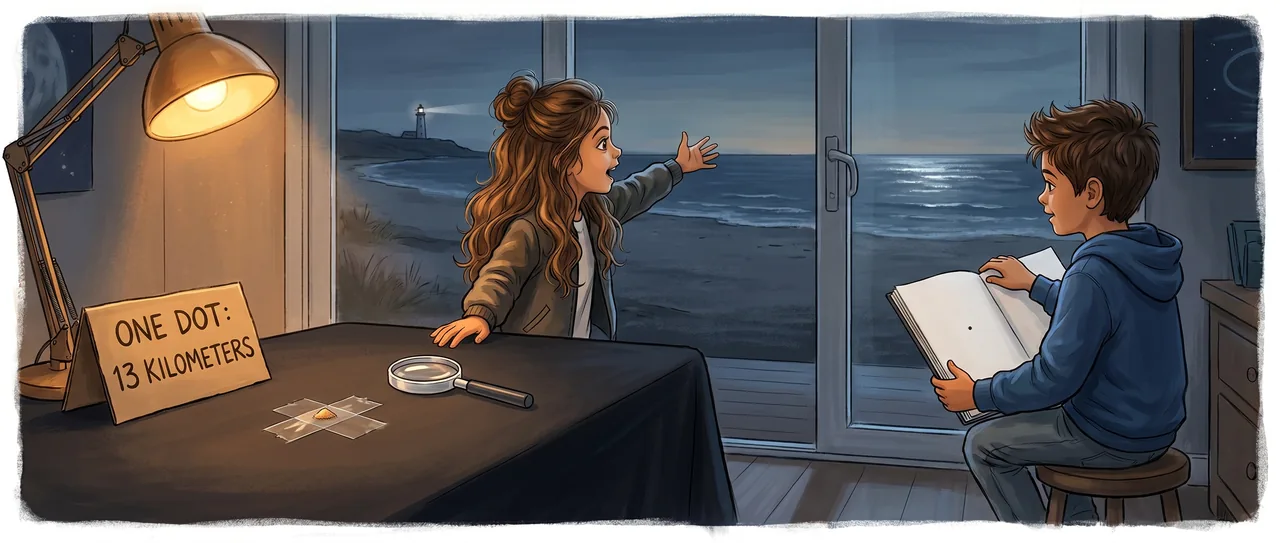
Outside, the lighthouse at Harrow Point blinked on. It was a tiny white flash at the far curve of the coast, beyond the darkening beach, beyond the fishing pier, beyond the place where the road turned inland and came back again.
Maya looked at the grain in her palm. Then she looked at the lighthouse. Then at the table buried under sand.
"The second grain goes there," she said.
Soren looked too. His mouth opened, but no sound came out at first.
The planetarium dome above them was full of painted stars, thousands of them, stuck close enough to make pictures. Swan. Hunter. Scorpion. The old shapes people had drawn because human eyes could not bear to leave bright points alone.
On Soren’s notebook page, there was one dot and a vast white emptiness around it. For once, his page did not look unfinished. It looked difficult to argue with.
The director came back carrying a cardboard Saturn with one dented ring.
"Why is the universe on the floor?" she asked.
Maya had swept most of the sand off the table into the bucket. Soren had taped a single grain to the center of the black cloth with a square of clear tape. Beside it sat the magnifier. The rest of the table was empty.
"This is the Sun," Soren said.
The director stared. "It is a speck."
"Yes," Maya said.
"The opening is in forty minutes. I asked for stars. Plural."
"We have plural," Maya said. "The next one is at Harrow Point."
The director blinked. She was the kind of adult who could arrange a hundred chairs while talking on the phone, but not the kind who enjoyed sentences that arrived without stairs.
Soren turned his notebook around. He did not explain everything. He showed the dot, the scale, the line of numbers, and the map of the coast he had sketched from the emergency evacuation poster.
"At this scale," he said, "another sand-grain star belongs near the lighthouse. If we put it on this table, we are making the stars too close. Very too close."
"Very is not a measurement," the director said.
"Thirteen kilometers is," Soren said.
Maya put the bucket of sand on the table with a thump. "And there are more stars than all the grains on all the beaches. But if you try to show how many, you hide how far. If you show how far, you only get one grain. Maybe two if you have a lighthouse."
The director looked at the table. She looked at the bucket. She looked through the glass doors toward the beach, where sand continued in both directions until darkness took it.
"People will think we forgot to finish," she said.
"Some people," Maya said.
Soren picked up the fact card with the cartoon galaxy. He turned it over and wrote on the blank side in large letters, much larger than his usual writing. Then he propped it beside the magnifier.
The sign said: Touch one star. Walk thirteen kilometers for the next.
The director read it. A smile started and got trapped halfway, as if she had not scheduled time for one.
"No one is walking thirteen kilometers during donor night," she said.
"Not tonight," Maya said. "But they can know where to go."
The doors opened at seven. People came in smelling of cold air and rain jackets. They leaned over the black table. Some laughed. Some frowned. One man said there must be a mistake. A woman bent so close her hair brushed the cloth, and when she found the grain under the tape, she whispered, "Oh."
That was the sound Maya had wanted.
The director did not replace the sand. She stood near the Saturn display, telling people not to touch the dented ring, and kept glancing toward the empty black table as if it had become larger than the room around it.
When the crowd moved into the dome show, Maya and Soren slipped outside with the second grain.
The beach wind pushed at their jackets. The path to Harrow Point ran silver under the moon, then vanished behind the dunes, then appeared again where the lighthouse flashed.
Maya held out the small corked tube. Soren dropped one pale grain inside and pushed the cork tight. They mounted their bikes at the edge of the planetarium lot, and the lighthouse blinked once, far down the coast.
Read the interactive version, listen to the narration, and earn a gold star →
A science-verified short story for curious kids · Curiosity Land