The Pieces With No Edges
The wooden sphere sat in the clamp like a planet that had agreed to be ordinary.
Maya did not agree.
The museum builder had taped a card to the workbench. It said: BANACH-TARSKI PARADOX. MAKE ONE SPHERE INTO TWO. NO STRETCHING. NO RESIZING. ONLY TURNS AND SLIDES.
Beside the card were two empty bowls, exactly the same size as the sphere.
The builder was under the table with a coil of cable in his teeth.
"The donors come at ten tomorrow," he said around the cable. "If the theorem is real, we need the trick. If the trick is fake, we need a different sign. Preferably before midnight."
"It is real," Maya said.
"Then cut it."
He slid a tiny saw across the bench without looking up.
Maya picked up the sphere. It was smooth and red and heavy enough to make her hand serious.
She already knew the sentence. A sphere can be taken apart and put back together into two identical spheres, each the same size as the first, using only rotations and translations.
She hated that sentence. She loved that sentence. It behaved like a locked door humming.
She marked the sphere into wedges first, because that was what a sphere seemed to want. Orange slices. Planet sections. Reasonable pieces with reasonable edges.
The saw whispered. Red dust fell.
When Maya set the wedges into the two bowls, each bowl held a sad little half-world.
"Not enough sphere," the builder said from under the table.
"I know."
"Try smaller pieces."
Maya tried smaller pieces.
The sphere became chips, then crumbs, then red powder in the cracks of her fingernails. No matter how she slid the bits or turned them, the bowls accused her. One bowl could be full, or both could be half full, or both could be messy. Nothing became twice itself.
The builder climbed out and looked at the powder.
"Maybe the paradox means very clever cutting," he said. "Like those wooden puzzles where a square becomes a triangle."
Maya stared at the bowls.
"Squares do not become bigger by being clever."
"Good point," he said. "Bad for us."
He hurried away to argue with a projector that kept flashing upside down.
Maya stayed with the powder.
The first thing on her list of things that did not make sense yet was this: every cut she made behaved too well.
A piece had a top and a bottom. A piece had a place where paint stopped and air began. A piece could be held. If it could be held, it could be measured. If it could be measured, it brought its amount of sphere with it wherever it went.
She scooped red dust into one palm, then poured it into the other.
Turn. Slide. Same dust.
The theorem did not say carve. It said decompose.
The word sat there politely, wearing a false mustache.
Maya went to the exhibit computer. The search box glowed on a black screen. She typed Banach-Tarski pieces.
The museum database answered with sentences that looked harmless until they opened their teeth.
Not physical pieces.
Non-measurable sets.
Depends on the axiom of choice.
Cannot be constructed as ordinary solids.
Maya read them twice. Then a third time, not because she was slow, but because the words kept changing size in her head.
The projector flashed behind her. For one second, the wall showed a bright red sphere. Then the image flipped upside down and became a red moon sinking through the ceiling.
"Sorry," the builder called. "The ceiling is not part of the exhibit."
Maya did not answer.
She opened the animation program and made a sphere out of points, thousands of red pinpricks hanging in black space. Then she tried to color chunks of it. A blue cap. A yellow belt. A green core.
All ordinary. All measurable. All doomed.
She deleted the colors.
The theorem’s pieces were not chunks. They were more like secret memberships. A point here, a point far away, another point somewhere that looked unrelated, all belonging together because rotations could carry one toward another through the deep rules of three-dimensional space.
No edge to follow.
No skin to touch.
No volume for a bowl to complain about.
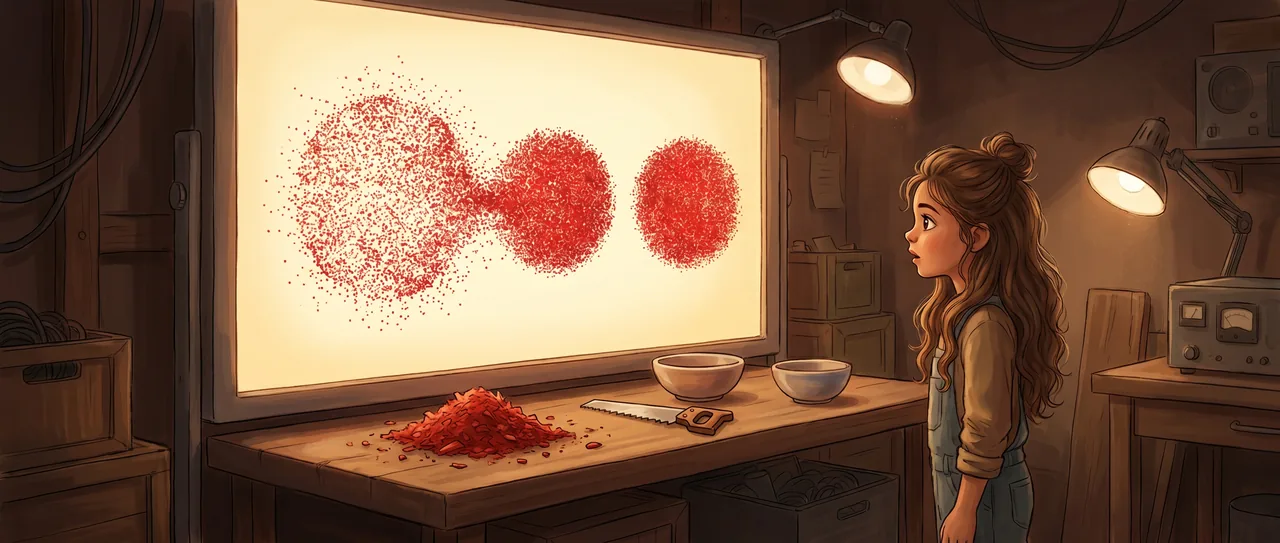
Maya made the program stop trying to draw surfaces. She made it show only sparks. Red sparks for the original sphere. Then she assigned the sparks into a few groups, not as a proof, not as the actual impossible pieces, but as a way to keep the exhibit from lying with wooden wedges.
Each group looked like spilled pepper through the whole sphere.
She pressed PLAY.
The first group rotated. The second slid. The third turned in a different direction. The fourth moved as if it had always been waiting for that particular motion.
The red cloud loosened.
For a moment, the sphere was not one thing. It was rules wearing the shape of one thing.
Maya stood very still.
The workshop had always been large. It had ladders, screens, cables, crates, and half-built stars for the astronomy room. But now the space behind the space opened. There were the objects you could weigh, and there were the objects you could prove. There were pieces a hand could hold, and pieces that had no edge, no thickness, no amount, yet still belonged exactly where mathematics said they belonged.
The builder came back carrying a mug that smelled like old coffee and panic.
"Please tell me the sphere has become two spheres," he said.
"The wooden one cannot."
"That sounds like no."
"It is a better no."
He leaned over her shoulder.
On the screen, the scattered groups moved only by turns and slides. No spark grew. No spark stretched. The cloud divided and gathered into two red spheres, side by side, each the size of the first.
The builder’s mouth opened.
"That cannot be right," he said.
Maya pointed at the crushed wooden dust on the bench.
"That cannot do it."
Then she pointed at the screen.
"That can be true."
He watched the animation again. This time he did not blink when the one sphere became two.
"But visitors will ask where the real pieces are."
"Good."
"Good?"
Maya picked up the uncut demonstration sphere from the spare materials crate. It was red and whole and innocent.
"Put this in a locked case," she said. "Put the saw beside it. Put the two empty bowls beside that. Then the screen."
"And the label?"
Maya took the thick black marker from his apron pocket before he could object. On the blank display card she wrote: IF YOU CAN CUT IT, YOU CANNOT DOUBLE IT.
The builder read it aloud. His eyebrows moved the way projector legs moved when they had not been tightened.
"That is not friendly."
"It is honest."
"Can we add something friendly under it?"
Maya thought of the pieces that could not be measured. Not broken pieces. Not missing pieces. The only pieces strange enough for the theorem to pass through.
She wrote a second line.
SOME TRUTHS LIVE WHERE MEASURING STOPS.
The builder was quiet for long enough that the upside-down projector clicked twice.
"I am going to pretend I supervised this," he said.
"You can tighten the projector."
"Also that."
By morning, the exhibit stood at the entrance of the mathematics wing. The wooden sphere waited inside glass. The saw rested beside it, clean and useless. Two empty bowls shone under white lights.
The first group arrived in a squeak of sneakers.
A small voice at the front asked, "Where are the pieces?"
Maya pressed the button.
On the screen, the red sphere came apart without edges, turned without stretching, slid without growing, and gathered itself into two red spheres side by side.
Read the interactive version, listen to the narration, and earn a gold star →
A science-verified short story for curious kids · Curiosity Land