The Note Too Fast to Count
The planetarium director had made the dead star blink like a polite bicycle light.
Tick.
The white dot flashed on the dome.
Tick.
It flashed again.
Maya sat halfway down the empty theater with her knees pulled up and her chin on them. The show was supposed to open in twenty-three minutes. Soren sat beside her with a pencil behind his ear and his paper notebook open, because he said screens made it too easy to lose where a thought had been.
On the dome, words appeared under the blinking dot.
Neutron star. Spins up to seven hundred times each second.
Tick.
Maya put up one hand.
The director, who was standing at the control desk with three wires in her mouth and two badges clipped to her sweater, did not turn around.
“If it is about the typo on slide six, I know,” she said. “Meteorite has one more e than I gave it.”
“It’s lying,” Maya said.
The director took the wires out of her mouth. “That is worse than a typo.”
Soren tapped his pencil on the notebook once, then stopped because the tick on the dome was slower than his tapping. “It says seven hundred times each second,” he said. “But it is blinking about once a second.”
“Children cannot see seven hundred flashes per second,” the director said. “No one can. This is a friendly version.”
Maya looked at the dot.
Tick.
“It’s too friendly,” she said.
The director rubbed her forehead with the end of a cable. She was not unkind. She was simply in a hurry, and the hurry had filled all the space around her. “The donors arrive in twenty minutes. The school group arrives in eighteen. I need the projector to stop turning Saturn purple. Please do not touch the radio console.”
“What can we touch?” Soren asked.
The director pointed without looking. “Prop table. Speakers. Old demonstration junk. Not the radio console.”
Maya was already moving.
The prop table had a wooden spoon, a metal teaspoon, a foam ball painted white, a toy motor, a bicycle wheel, magnets, a cracked salad spinner, two flashlights, a box of washers, and a label that said ONE TEASPOON OF NEUTRON STAR MATERIAL WOULD WEIGH ABOUT A BILLION TONS ON EARTH.
Soren picked up the label carefully. “That part is good.”
“No,” Maya said, taking the teaspoon. “That part is impossible in the wrong way.”
She set the teaspoon in the center of the table. It was ordinary. Scratched. Slightly bent. The kind of spoon someone’s little brother would use to tunnel through cereal.
Soren looked at it for a long moment. “A billion tons is a trillion kilograms,” he said.
Maya held the teaspoon between two fingers. “This much.”
“On Earth,” Soren said. “Weight depends on gravity. The mass would still be enormous anywhere.”
Maya turned the spoon over. It made a tiny silver sound against her fingernail.
The director called from the control desk, “If either of you can make the spoon feel like a billion tons without breaking my stage, I will give you both my emergency chocolate.”
“She thinks that was a joke,” Maya said.
Soren had found the toy motor. It had a little plastic arm with a bead glued to the end. He clipped it to a battery pack, and the arm spun into a blur.
“How fast?” Maya asked.
“Not seven hundred,” Soren said. “Maybe twenty times a second if it’s lucky.”
The bead shot off.
It pinged against a cardboard model of Mars, bounced once, and rolled under the front row.
The motor kept whining, lighter without the bead.
Maya stared at the empty spinning arm.
Soren turned off the battery. “Ordinary stuff leaves.”
Maya grinned so suddenly that Soren leaned back.
“That,” she said.
“The bead escaping?”
“The lie escaping.”
Soren’s pencil was already moving. “If the star is really rotating hundreds of times each second, it cannot be made of loose bead stuff. It has to be crushed together. A collapsed core. City-sized. More mass than the Sun, but squeezed until a spoonful weighs about a billion tons here.”
Maya picked up the bead from under the row and put it beside the teaspoon.
“Show the failure,” she said. “Then the star.”
“The star cannot be shown.”
“Good.”
Soren looked at her.
Maya pointed at the speaker stack. “Can it be heard?”
The sound board had a frequency generator, dusty but labeled. Soren did not touch the radio console. He followed the cable from the generator to the speaker, checked the volume, then set the dial.
“Seven rotations each second first,” he said.
The speaker clicked seven times, fast enough to hurry the room but slow enough to count.
“That is the friendly lie,” Maya said.
Soren turned the dial to seventy.
The clicks became a rough buzz. The seats seemed to have insects in them.
Maya’s shoulders rose.
Soren turned the dial again.
At seven hundred times each second, the clicks vanished.
A clear, thin note filled the theater.
Maya did not move.
It was not loud. That made it stranger. It came from one black speaker by the stage, but it made the dome feel as if it had a wire stretched through it from one side of the sky to the other.
Soren checked the number on the dial twice. Then a third time.
“It is counting,” he said. “We just cannot hear the spaces anymore.”
Maya looked up at the fake sky. The white dot was still blinking once a second, slow and harmless. The note passed straight through it.
“Turn off the blink,” she said.
Soren did.
There was only darkness and the note.
The director stopped arguing with Saturn. She came down the aisle with a cable looped around her elbow. “What did you do to my theater?”
“Made it less friendly,” Maya said.
Soren held up both hands. “Not the radio console.”
The director listened. Her face changed in small pieces. First annoyance left her eyebrows. Then the hurry left her mouth. Then she looked at the metal teaspoon on the table.
“That is seven hundred cycles per second?” she asked.
Soren pointed to the dial.
“For a model with one pulse each turn,” he said. “Some pulsars give radio flashes as they rotate, like beams sweeping past us. We can turn those signals into sound. This is not space making noise. It is the timing made audible.”
The director’s mouth opened, then closed. “The donors are going to ask why the star does not fling itself apart.”
Maya picked up the toy motor with the missing bead. “Let them ask.”
When the school group came in, the director began as planned. She welcomed them to the sky. She made the dome fill with stars. She sent them past the Moon, past Mars, past the rings of Saturn, now correctly yellow-white instead of purple.
Then she put the white dot on the dome.
“This,” she said, “is the remnant of a dead star.”
Tick.
The dot blinked.
Maya stood at the front beside the prop table, holding the toy motor. Soren stood by the sound board with one finger on the dial.
The director said, “Or at least, that is the version I was going to show you.”
Maya switched on the motor.
The little plastic arm spun. The replacement bead, taped badly on purpose, flew off at once into a padded box.
Several children laughed.
Maya held up the empty spinner.
“If it is made like this,” she said, “it leaves.”
Soren turned the speaker to seven clicks per second.
“Too slow,” Maya said.
He turned it to seventy.
Some children covered their ears and then uncovered them.
“Still too slow,” Soren said.
He turned the dial to seven hundred.
The note appeared.
The laughter stopped.
On the dome, the white dot shrank until it was only a pinprick.
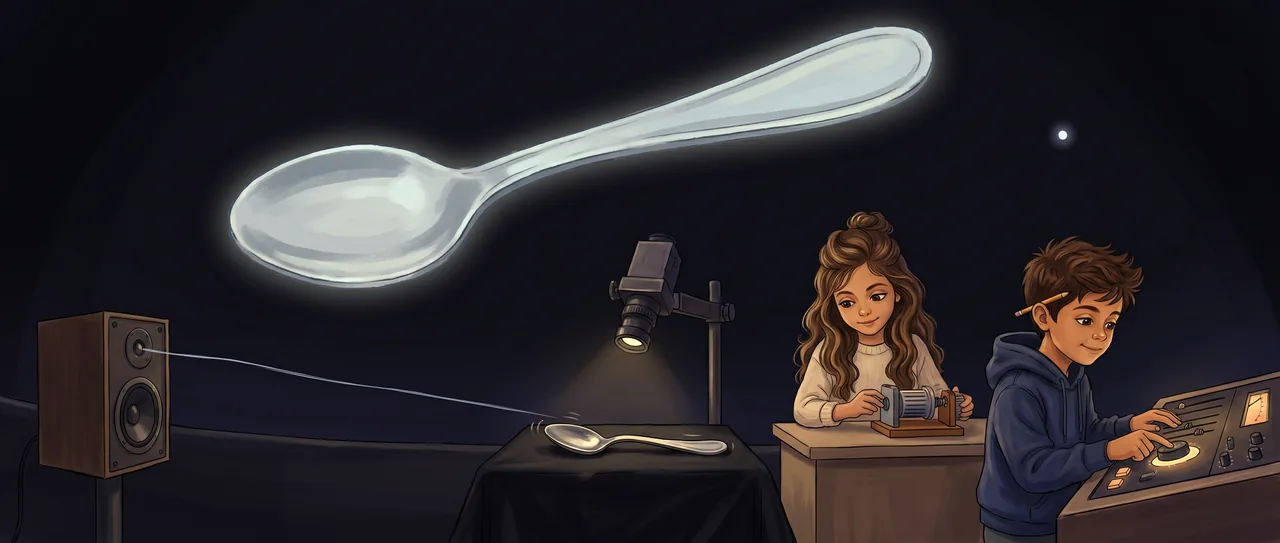
The director placed the metal teaspoon under a camera. Its image appeared above them, huge as a boat.
“A teaspoon of neutron star material,” she said, very quietly, “would weigh about a billion tons on Earth.”
No one laughed at the spoon.
A child in the second row whispered, “That little?”
Maya answered without looking away from the dome. “That much.”
Soren lifted the label and set it beside the real teaspoon under the camera. His hand shook just enough to make the projected words tremble.
The director did not take over. She stood beside the console with her emergency chocolate unopened in one hand.
After the show, the visitors spilled into the lobby, loud in the way people are loud when they do not want to admit they have been quiet. The director stayed behind and unlocked a drawer beneath the sound board.
Inside was a folder of archived pulsar recordings and a list of names with numbers beside them. Eleven times each second. Thirty. One hundred ninety-three. Six hundred forty-two. Seven hundred sixteen.
Soren touched the edge of the list, not quite picking it up. Maya set the metal teaspoon on the black cloth in front of the speaker.
On the black cloth, the teaspoon shivered toward the speaker one bright millimeter at a time.
Read the interactive version, listen to the narration, and earn a gold star →
A science-verified short story for curious kids · Curiosity Land