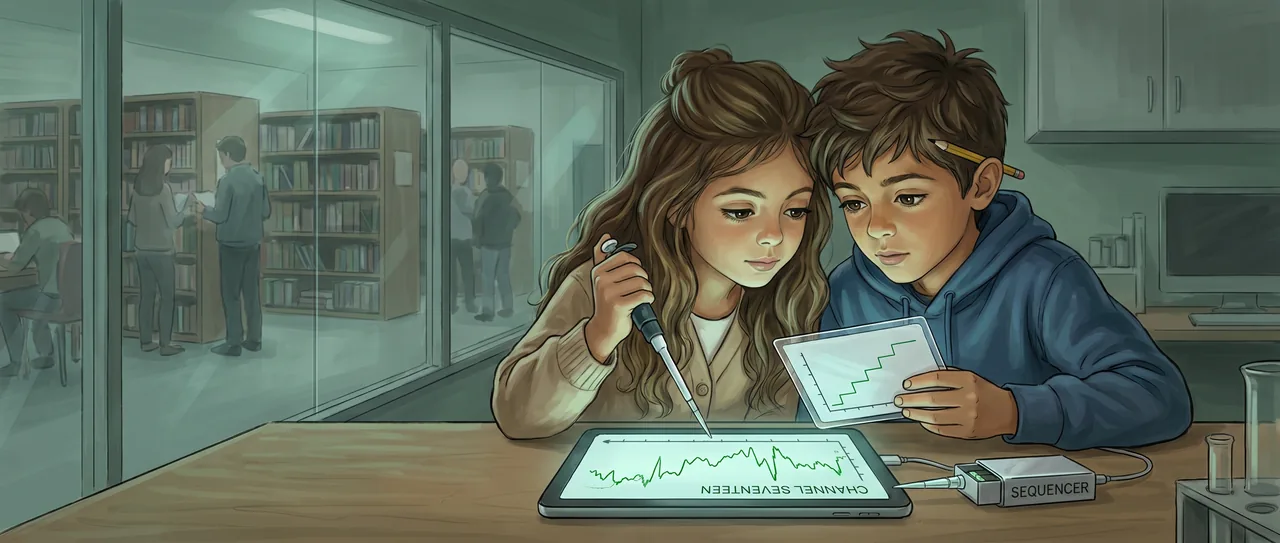
The Line That Dipped
The first problem was that the genome machine would not make letters.
The genomics volunteer tapped the tablet with one finger, then with two, then with the corner of her badge. On the screen, the place where A, C, G, and T should have appeared stayed stubbornly gray.
Outside the glass wall, families were already hanging coats on chairs. Someone had brought cupcakes shaped like leaves. A paper sign said TONIGHT: READ THE DNA OF OUR LIVING WALL.
The volunteer looked at Maya and Soren. She had glitter on her safety goggles and the desperate smile of someone whose demonstration had just escaped.
“The basecaller is frozen,” she said. “We may have to show last month’s run instead. People like the colored letters.”
Maya leaned over the bench. “But the sequencer is working.”
“It is producing raw current,” the volunteer said. “Raw current is not a show.”
On the tablet, twenty little windows crawled with green lines. Most were flat. A few shivered.
Soren had already opened the paper instruction sheet, the one everyone else ignored because it was folded badly and full of tiny print. He did not write anything down. His pencil rested behind his ear, unused.
“Flat line means open pore,” he said. “Ions going through. No DNA.”
“Exactly,” the volunteer said, already turning toward the storage cabinet. “And the audience did not come to see plumbing.”
Maya did not move. “It’s not plumbing if something passes through.”
The sequencer was smaller than a chocolate bar. Inside it, under a cover they were not allowed to remove, a membrane held thousands of protein pores, tiny ring-shaped doors made by living things and borrowed by engineers. A voltage pulled charged pieces through. Salt ions moved. DNA, if it found a pore, would be tugged through too, helped by a motor protein that fed it forward one step at a time.
Soren read the next line of the sheet. “When DNA occupies the pore, the current is partially blocked.”
Maya said, “So the letter is the blockage.”
“Sort of,” Soren said. “A few bases affect it at once. Like a chord.”
The volunteer had two small tubes in a rack. One cap had a blue dot. One cap had a blue smear, as if someone had touched it with a wet glove.
“This is the other problem,” she said. “One is the living wall sample. One is the control DNA. The labels got damp. If I load the wrong one, we sequence the control and pretend it is a fern, which I refuse to do in a library.”
Maya smiled. “Good.”
“That was not the cheerful part,” the volunteer said.
Soren lifted the tubes without taking them from the rack. Both held clear liquid. Both looked like nothing pretending to be something.
The volunteer checked the clock. “The room opens in six minutes. I’m going to find the backup tablet.” She pointed at the sequencer. “Do not waste the flow cell. Do not invent a new form of biology. If the software wakes up, call me.”
When she left, the gray door swung shut behind her.
Maya picked up the pipette. “We can tell which tube has DNA.”
“Both have DNA,” Soren said. “Control and leaf.”
“Then we can tell which one is too neat.”
Soren looked at the shivering windows. “Control DNA has a known pattern.”
Maya pointed at a laminated card taped inside the kit box. It showed a sample squiggle from the control run, a repeated row of steps like a tiny staircase built by ants.
“You verify,” she said.
“You leap,” Soren said.
“I land sometimes.”
“Most times.”
Maya loaded a drop from the tube with the blue dot into the sample port. She did it carefully, thumb slow, pipette tip touching the little crescent of liquid already waiting there. The sequencer made no sound, but the tablet had a speaker setting, and Soren tapped it on.
A hiss filled the room, soft as rain behind a window.
In channel three, the green line fell from its flat path and began stepping. Low, high, low, low, higher. Channel eight followed. Then channel twelve.
The speaker crackled in little pulses.
Maya bent closer. “Something is in the doors.”
Soren held the laminated card beside the screen. His eyes moved between the printed staircase and the living one.
“Again,” he said.
The pattern repeated.
“Again.”
It repeated again, not perfectly, but close enough that his mouth made the shape it made when a lock turned.
“That is the control,” he said.
Maya had already capped the tube. “Too neat.”
They waited for the channels to clear, then Soren rinsed the port the way the sheet said, slowly enough that Maya made a small impatient sound but did not grab the pipette. He loaded the second tube himself.
At first, nothing happened.
Outside the glass, a little kid pressed both hands to the window. The cupcakes waited under a clear plastic lid. The volunteer was visible near the front desk, talking to someone who was shaking a different tablet like a maraca.
Then channel seventeen dropped.
Not in steps. In a long uneven sag, then a jump, then a jittery shelf. Channel four joined with a different shape. Channel nine made a low buzzing growl through the speaker, not like rain now, more like a mosquito trapped in a jar. The lines did not match one another. They tangled and broke and began again.
The volunteer came back just as Maya whispered, “Messy.”
“Failed?” the volunteer asked.
Soren did not look up. “No.”
Maya pointed to the flat lines, then the shivering ones. “The smooth ones tell us nothing.”
Soren said, “The useful part is where the current gets interrupted.”
On the tablet, the frozen gray box blinked. The basecaller woke with a tiny chirp, as if embarrassed. Letters began to gather in a narrow strip beneath channel seventeen, not in tidy classroom rows, but in bursts. A few were pale, marked uncertain. Some changed as more current arrived.
The families came in quietly at first, then not quietly at all.
The volunteer reached for the microphone, then stopped. The screen filled with matches from the library database.
Plant chloroplast.
Fungus.
Bacterium.
Another plant sequence.
Unclassified.
The volunteer lowered the microphone. “That leaf was washed.”
Maya said, “Not enough to make it alone.”
Soren watched the word unclassified stay on the screen while more letters poured in above it. The machine was not reading a book that had already been written for them. It was feeling its way along molecules, letter by letter, chord by chord, turning tiny interruptions into names, and sometimes into no name at all.
The volunteer whispered, “We only promised them a fern.”
Maya looked through the glass at the living wall, at the green leaves tucked into felt pockets, at the damp dark places behind them.
Soren took the root-wash cartridge from the rack. Its label was dry and perfectly readable. The volunteer saw it and did not say no.
Maya held the new prepared cartridge steady while Soren fitted the pipette tip into the port. He pressed the plunger to the first stop, waited, and pressed to the second. On the tablet, channel seventeen went flat, trembled, and dipped.
Read the interactive version, listen to the narration, and earn a gold star →
A science-verified short story for curious kids · Curiosity Land