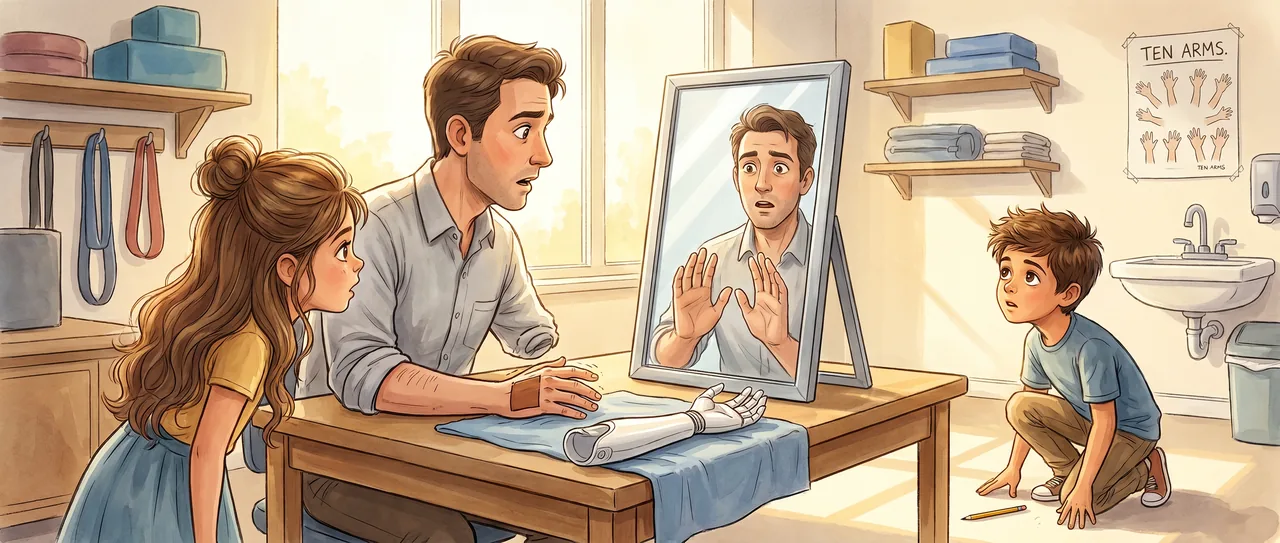
The Hand in the Glass
The hand opened when there was no hand.
That was the part Soren could not put in his notebook, because his pencil had stopped moving.
The mirror stood upright on the table, silver side facing Maya’s uncle. On one side of it lay his right hand, brown and square and trembling a little. On the other side lay his left sleeve, folded flat and empty below the elbow.
In the mirror, his right hand became a left hand.
In the mirror, the missing fingers uncurled.
Maya was standing so close her breath made a pale cloud at the glass edge.
“Again,” she said.
Her uncle looked at the mirror. He opened his real hand. The reflected hand opened too, exactly where the missing hand ought to have been.
He made a sound that was not quite a laugh and not quite a cough.
Half an hour earlier, nobody had been looking at the mirror at all.
They had come to the rehabilitation lab because Maya’s uncle was being fitted for a new prosthetic hand with tiny motors in the fingers. The hand rested on a blue cloth like a sleeping animal made of white plastic and silver joints. When the engineer pressed a button, the fingers tapped one by one against the table.
Maya loved it at once.
Soren loved it after he had counted the joints.
The engineer loved it most of all. She had red glasses, a coffee cup with cold coffee in it, and the air of someone whose brain had three rooms open at once.
“Pressure sensors in the fingertips,” she said. “Grip patterns. Thumb rotation. We are getting closer every year.”
Maya’s uncle smiled, but only with his mouth. His left sleeve twitched against his side.
Maya saw it and looked away quickly, because staring at pain felt worse than staring at a missing arm.
The engineer fastened sticky sensor pads to his forearm. “Try to close your hand,” she said.
“I am,” he said.
The prosthetic fingers did not move.
“Try gently,” the engineer said. “Think close, not crush.”
His face tightened.
Soren’s pencil moved. Think close, not crush.
Maya watched the empty sleeve. It had twitched again.
“Does it hurt?” she asked.
The engineer glanced up, annoyed for half a second because Maya had interrupted the calibration.
Maya’s uncle swallowed. “My left hand is clenched.”
Soren looked from the empty sleeve to the man’s face.
“The one that isn’t there?” he asked.
“The one that isn’t there,” Maya’s uncle said.
He tried to smile again. This time it did not work. “Thumb is digging into my palm. Fingers too. Like I made a fist and forgot how to stop.”
The room became very quiet.
There were machines humming in the walls. There was sunlight on the floor. There was a shelf of foam blocks, straps, tape, and a dusty mirror with a cardboard back.
Maya counted the poster above the sink because the poster was wrong in a way that pulled at her. Ten drawn arms lined the paper. Eight glowed orange from wrist to fingertip.
Eight out of ten.
“That many?” Maya said.
The engineer followed her eyes. “Phantom limb pain. Very common.” She pulled a wire loose with her teeth because both hands were full. “The brain keeps a map. Sometimes the map keeps sending signals after the limb is gone.”
Maya’s uncle shut his eyes.
“Nobody can see it,” he said. “That is the maddening part.”
Soren looked at the poster again, at the eight orange arms.
“That is still a measurement,” he said.
Maya’s uncle opened his eyes.
Soren’s ears went red, but he did not look away. “If eight people out of ten feel it, then invisible is not the same as imaginary.”
The engineer softened. “No. It is not.” Then her tablet beeped, and she frowned at the screen. “The sensor signal is noisy. Give me two minutes.”
She turned toward the cabinet of cables.
Maya did not turn.
The dusty mirror leaned on the shelf like it had been waiting to be accused of something.
“What is that for?” she asked.
“Mirror therapy,” the engineer said, already digging through a drawer. “We use it sometimes. The reflection can help the brain see the missing hand move. Simple, but surprisingly powerful. We can schedule a session with the therapist.”
Maya had already picked up the mirror.
“It is now,” she said.
The engineer turned back. “Careful. The setup matters.”
“So tell us the setup,” Soren said.
The engineer opened her mouth, then the tablet beeped again. From somewhere behind the wall, a printer began making a grinding noise.
“Mirror along the middle,” she said quickly. “Hide the missing side. Reflect the intact hand so it looks like the missing one. Slow movements. No forcing. I need to stop that printer before it eats the socket map.”
She hurried through the side door.
Maya put the mirror on the table, but the angle was wrong. It reflected the ceiling lights, then Soren’s chin, then nothing useful.
“Middle of him,” Soren said.
“I know.”
“His middle, not the table’s middle.”
“I know that now.”
Maya slid the mirror closer to her uncle’s chest. Soren crouched until his eyes were level with the table.
“Your right hand goes here,” he said, tapping one side. “Left sleeve behind the mirror. You have to see the reflection where the left hand would be.”
Maya’s uncle hesitated.
“This is silly,” he said.
“Yes,” Maya said. “Do it anyway.”
He looked at her.
She did not blink.
He placed his right hand on the table.
The mirror made a left hand.
Not a pretend one. Not exactly. It was his hand and not his hand, ordinary and impossible, lying beside an empty sleeve.
Soren shifted the mirror by a finger’s width.
“There,” he said.
Maya’s uncle inhaled sharply.
“What?” Maya asked.
“It lined up,” he said.
Maya looked at the reflection. The knuckles matched the place where knuckles should have been. The wrist began where the sleeve ended. The table seemed to be holding two hands.
“Can you unclench it?” Soren asked.
“My real hand?”
“Both,” Soren said. “Move the right one. Ask the left one to come with it.”
Maya’s uncle gave him a look.
Soren held up both hands, palms down, and slowly opened them on the table. “Like this. Maybe the looking part matters.”
Maya’s uncle stared at the mirror.
His right hand opened.
The reflected left hand opened.
His shoulders lifted, then dropped.
“Again,” Maya said.
He closed his right hand gently. The mirror hand closed. He opened it. The mirror hand opened.
Soren had stopped writing. He was watching the empty space behind the mirror as if something might lean out of it.
Maya’s uncle opened and closed the reflected hand again. His mouth fell open.
“The thumb,” he whispered.
“What about it?” Maya asked.
“It moved.”
Maya leaned forward.
“Not the mirror one,” he said. “Mine.”
Soren’s pencil rolled off his notebook and onto the floor. He did not pick it up.
The engineer came back with a cable looped around her wrist. “I stopped the printer. How are we doing?”
Nobody answered.
Maya’s uncle opened his right hand one more time, slowly, slowly, until every finger in the mirror stretched flat.
His face changed.
It was not happiness. Not at first. It was the look of someone hearing a faraway door click open in a house he thought was empty.
“It’s gone,” he said.
The engineer stood still.
“The pain?” she asked.
He nodded once, without looking away from the mirror.
The prosthetic hand sat on the blue cloth, its motor fingers curled and ready. The mirror stood beside it, catching light. One invention waited to move in the world. One had moved something no one could see.
Maya reached for Soren’s fallen pencil and set it on the table beside his notebook.
He did not touch it.
“If eyes can change a hand that is not there,” he said, very quietly, “what else is the brain drawing?”
Maya did not answer. The list in her head had become too large for words.
“Can we try one more thing?” she asked.
Soren set his right hand beside the mirror. Maya slid her left hand behind the glass, and in the silvered surface a hand that was not hers opened over the empty table.
Read the interactive version, listen to the narration, and earn a gold star →
A science-verified short story for curious kids · Curiosity Land