The First Cup
The courthouse records room smelled like warm dust and copier ink. Soren liked both smells separately. Together they made him think of a dragon that had swallowed a library.
The scanner made a coughing noise and stopped with half a page sticking out of its mouth.
His aunt slapped the side of it with two fingers. She was not a patient slapper. She wore a badge on a blue string and had three pencils stabbed through her hair.
"No," she said to the scanner. "Not today. Today there are visitors. Today we are cheerful about public records."
Soren stood beside a table covered with boxes, handouts, and one empty poster board. Across the top, in courthouse-blue letters, someone had written: Can Numbers Testify?
Below that, nothing.
"The chart file is gone," his aunt said. "Or hiding. Or renamed by someone who thinks Final Final New is a useful file name. The seventh graders arrive in seventeen minutes."
Soren touched the corner of the blank poster. "What chart?"
"First digits," she said. "Fraud detection. Benford something. The exhibit about the contractor trial. I had a beautiful bar graph. The one was huge. The nine was tiny. Very dramatic."
"That sounds wrong," Soren said.
"Exactly," his aunt said. "That is why people look at it."
She bent over the scanner again. The stuck page wrinkled.
On the table were two stacks. One was tied with red string and labeled Training Copies, Contractor Claims. The other was a battered cardboard box labeled City Payments, Public, Nineteen Eighty Nine to Nineteen Ninety Three.
Soren pulled his notebook from his pocket.
His aunt looked up. "You brought paper to a room full of paper?"
"Different paper," Soren said.
She made the scanner cough again. "If you can make me anything that looks like a graph before the children get here, I will sign a certificate saying your paper was essential to justice."
"I need nine containers," Soren said.
"For what?"
"For beginnings."
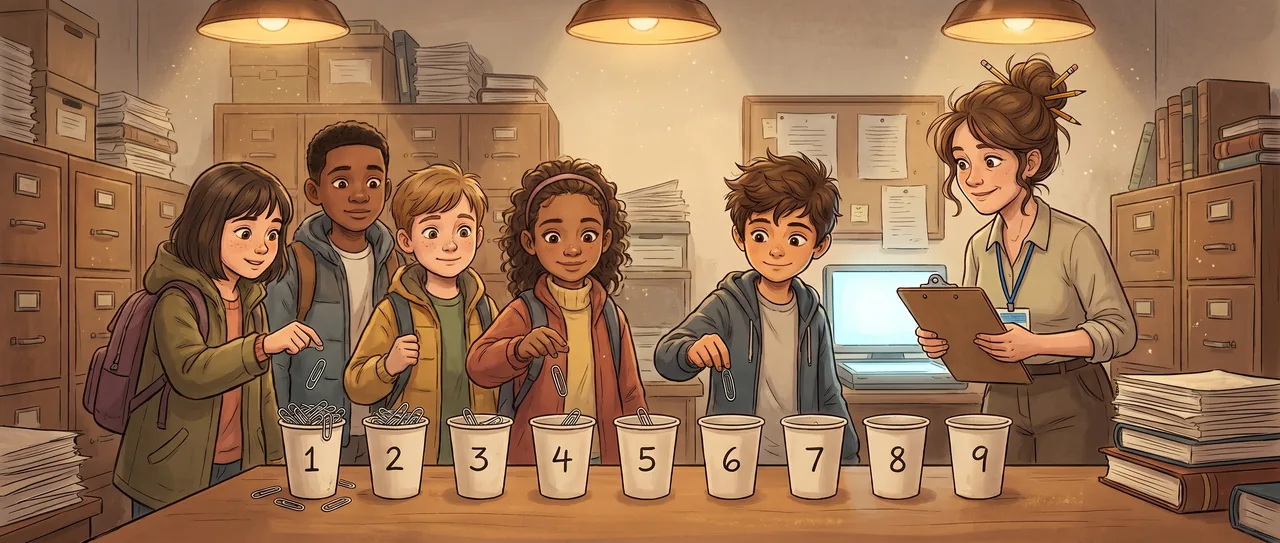
His aunt stared at him for half a second, then swept nine paper cups from the refreshment table and set them down. "Do not spill courthouse coffee on history."
Soren wrote the digits one through nine on scraps and taped one scrap to each cup. The cups looked like they were waiting for teeth.
He opened the city payment box first. The first record was for two hundred thirteen dollars for winter salt. He dropped a paper clip into the cup marked two.
The next was one thousand forty dollars for library shelves. One.
Seventy eight dollars for window repair. Seven.
One hundred ninety six dollars for envelopes. One.
Three thousand eight hundred dollars for a streetlight control box. Three.
He did not read every word after that. He found the amount, found the first digit that was not zero, and dropped the paper clip.
Tin in cup. Tin in cup. Tin in cup.
The scanner hissed behind him. His aunt muttered at it in a voice that suggested the scanner had disappointed generations of her family.
After fifty records, the cup marked one had more paper clips than any other. After eighty, it was not even close.
Soren stopped.
The cups were not fair. They were not tidy. They leaned.
At school, when he made a graph and one bar climbed away from the others, someone always said, Check your scale. Make it neater. Are you sure?
He picked up the cup marked one. It was heavy in a way a paper cup was not supposed to be heavy.
"That one is enormous," his aunt said without turning around.
"It is supposed to be," Soren said, but quietly, because the sentence had only just arrived.
He turned to the training copies. These were not originals, only examples for visitors, copied from a real case file after private information had been blacked out. A note on the folder said the digit pattern had been one piece of evidence in court, not the whole case.
Soren liked that note. Numbers could testify, but they could not be the judge all by themselves.
He emptied the cups into two separate piles so he could count them later, then started with the contractor claims.
Four thousand six hundred dollars for gravel.
Eight thousand two hundred dollars for gravel.
Six thousand nine hundred dollars for gravel.
Seven thousand four hundred dollars for gravel.
"That is a lot of gravel," Soren said.
"People love roads," his aunt said.
Tin. Tin. Tin.
This time, the cups filled differently. The ones did not run away. The fours, sixes, sevens, and eights got loud.
Soren frowned at the cups.
His aunt finally freed the page. She held it up like a captured fish. "Victory. What have you got?"
"Not enough records. But maybe enough for the open house."
"Is the fake-looking one the fake one?"
"Not fake," Soren said. "Suspicious. Maybe. It is not a guilty machine."
His aunt smiled. "Good. Say that loudly near the lawyers."
Soren did not smile yet. Something bothered him. If numbers liked starting with one, why did locker numbers not do it? Why did page numbers in a book march evenly? Why did phone numbers have rules that ruined everything?
He grabbed a stack of file folders from the end of the table and began sorting their case numbers by first digit.
One, two, three, four, five. Almost flat.
He tried the room numbers printed on a courthouse map. Also flat, except there were too many threes because this was the third floor.
He crossed both out in his notebook so hard the paper dented.
His aunt saw his face. "Bad news?"
"Assigned numbers do not count," Soren said. "They are names wearing number costumes."
"That is a sentence," she said.
"Measurements," he said. "Amounts. Populations. Lengths. Things that grow or shrink across sizes."
He opened a courthouse atlas that had been used to prop up a projector. Rivers of the state were listed in miles. He took the first digit of each length.
One came first again.
His aunt stopped fixing the scanner.
Soren found a printed sheet from another display, town populations from the last census. The towns were tiny, medium, crowded, and almost-city. Their first digits leaned too.
The room changed without moving. The boxes were still boxes. The cups were still paper cups. But the same slant had stepped out of money and into rivers, then into towns. It had been hiding in things that had never met each other.
Soren put three paper clips in the one cup, one after another, and listened to them land.
"Why?" his aunt asked.
It was not an adult question. It was a real one.
Soren took a clean handout and drew a line of numbers from one hundred to nine hundred ninety nine.
"If something grows by multiplying," he said, "it spends a long time with first digit one. From one hundred to one hundred ninety nine is almost doubling. But from nine hundred to nine hundred ninety nine is just a little stretch before it turns into one thousand and starts with one again."
His aunt leaned closer.
"So the ones get more space," he said. "Not because people choose them. Because scale does."
The first group of visitors clattered in the hallway. Sneakers squeaked on polished stone. Someone laughed too loudly, the way people laugh in buildings where judges work.
His aunt looked at the blank poster. "We still have no beautiful chart."
Soren lined up the cups at the front of the table. He put the heavy one at the beginning and the almost-empty nine at the end. Then he placed the city records beside them, and the contractor copies beside a second row of cups.
"Better," he said. "They can hear it."
His aunt read the cups, then read the empty poster, then took a marker and wrote under the title: Drop the first digit here.
The visitors came in a bunch. The room filled with backpack zippers and wet coats and the careful hush of children being told not to touch government things.
Soren did not give a speech. He handed the first student a public payment record and a paper clip.
"Find the first digit of the amount," he said. "Not a zero. The first real one."
The student dropped the clip into the one cup.
Tin.
Another student got a street repair bill.
Tin.
A third got a park bench invoice and dropped the clip into the two cup.
Tin.
The visitors leaned closer. The graph built itself in sounds.
When they switched to the contractor copies, the music changed. The middle cups began to chatter. The one cup waited too long between hits.
Nobody said guilty. Nobody said magic. Nobody said random should be flat.
Soren watched the cups answer questions that no one had spoken yet.
At the back of the table, the scanner finished its stack and beeped. A new box sat beside it, still sealed with dry brown tape. The label was half peeled away, but Soren could read the words Campaign Donations, Public Archive.
Read the interactive version, listen to the narration, and earn a gold star →
A science-verified short story for curious kids · Curiosity Land