The Empty Square
Soren met Starlite as an egg.
On the museum screen, a man in a suit held up an ordinary egg. Half of it had been painted with a pale, lumpy coating. A blowtorch roared blue-white against the shell.
Soren leaned forward until his nose almost touched the tablet.
The torch stopped. The man cracked the egg into a bowl.
Clear white slid out. Yellow yolk followed, round and loose.
The museum technician paused the video. She had a pencil stuck through her bun and a strip of silver tape on one sleeve. Every pocket of her apron bulged with screws.
"That," she said, "is the problem. The exhibit opens tomorrow, and our centerpiece is a thing we do not have. A heat shield invented by Maurice Ward, an amateur chemist, shown off in the nineteen nineties, reportedly tested under flashes hotter than the surface of the sun, and then, very inconveniently, not sold, not published, and not left behind when he died."
Soren looked at the frozen egg on the screen.
"More than ten thousand degrees Celsius," he said.
"Some reports say that," the technician said. "Which is exactly why people will come. And exactly why I cannot put a blowtorch in the hands of fourth graders."
On the workbench sat six little metal squares. Each had been painted with a grayish paste. Beside them were a heat lamp, two thermometers, a box of chocolate buttons, safety goggles, and a sign that read TRY A MODERN HEAT-FOAM COATING.
"Not Starlite," Soren said.
"Absolutely not Starlite," the technician said. "We say that three times on the sign. This is ordinary classroom chemistry. Warm it, it puffs, it insulates, everyone goes oooh, nobody sues us. Except it is not puffing. It is peeling, smoking, and making a smell like burnt soup."
She pushed goggles toward him.
"You like writing down failures, right? Write down these. I have to fix the comet display, which is currently convinced that Halley comes every twelve minutes."
Then she was gone, already calling, "Do not discover fire."
Soren put on the goggles.
He did not like writing down failures exactly. He liked failures because they were the part of the machine that spoke first.
The first square curled at the corners.
The second cracked down the middle and lifted off like old paint.
The third made one perfect black bubble, then collapsed.
Soren wrote: thick coat cracks. Edge puffs. Middle peels. Smell worse when wet.
He touched the bench, not the metal. The lamp hummed. The chocolate buttons waited in their little paper cups, softening just from the room.
On the wall above the bench was the Starlite exhibit panel. There was a photograph of Maurice Ward, smiling stiffly, with hair combed high and neat. The caption said he had not been a university chemist. He had worked outside the places where world-changing materials were supposed to come from.
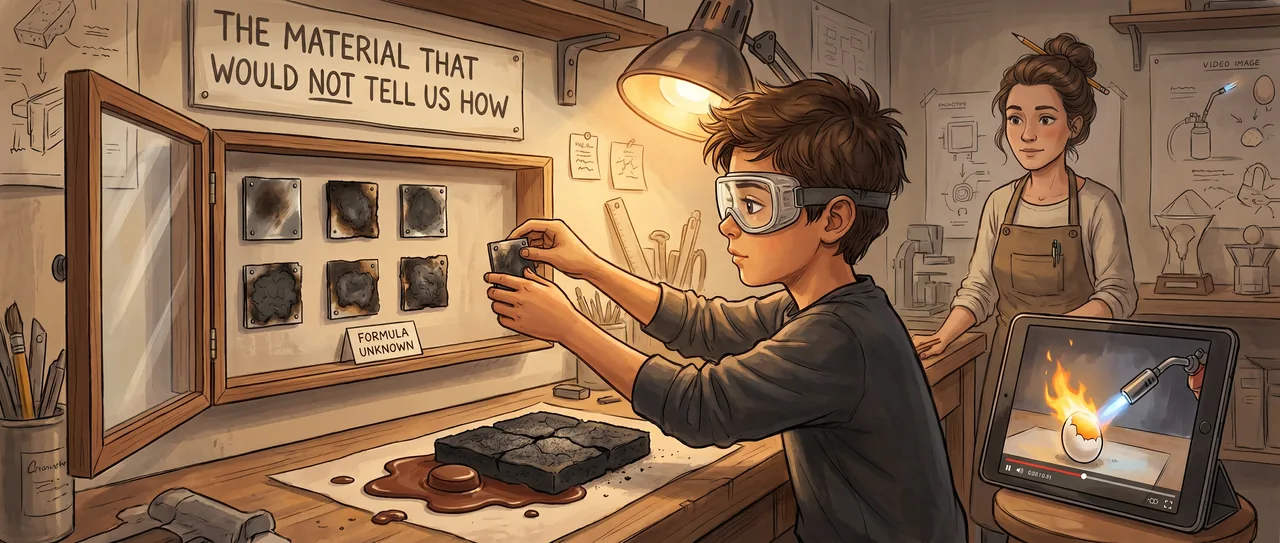
Under the photograph was an empty glass case.
Inside the case sat a small white card.
FORMULA UNKNOWN.
Soren stared at it longer than he meant to.
At school, when he used his paper notebook, people asked why he did not just record everything on his sleeve screen like everyone else. When he wrote down the temperature of the lunchroom windows or the number of seconds between a flash of lightning and thunder, they looked at him as if he had brought a fossil to a spaceship.
But the hottest thing in the room was an empty square where somebody had not written enough down.
The fourth metal square blistered only at the thinnest place, where Soren's thumbnail had accidentally scraped the paste before it dried.
He stopped the timer.
He made a new square.
Not thick. Thin.
He spread the paste with a plastic card until he could see faint lines of metal through it. He set it under the small fan. While it dried, he made another, then another, changing only one thing each time. One layer. Two layers. Three very thin layers. Fan. No fan. Ten minutes. Twenty.
The comet display shouted from the next room, "Welcome back, Halley!"
The technician shouted, "I heard that!"
Soren did not answer.
He warmed the one-layer square. It browned and cracked.
He warmed the two-layer square. It darkened. Tiny bubbles rose, not shiny like boiling sugar, but dull and dry. The surface wrinkled into a black crust full of little caves.
The thermometer on top climbed fast.
The thermometer underneath climbed slowly.
Soren slid a chocolate button under the coated square and one under a bare square. He turned on the lamp.
The bare chocolate slumped first. It lost its rim, then its shine, then its shape.
Under the coated square, the chocolate kept its small round shoulders.
The technician came back carrying a cardboard comet with one bent tail.
"Please tell me that smell means success," she said.
"It means carbon foam," Soren said. "Maybe. The heat makes the coating make a char layer. The char has holes, so heat has a harder time getting through. The wet ones burst. The thick ones peeled. Thin dry layers stay attached. Mostly."
"Mostly is my favorite museum word," the technician said.
She bent close to the two chocolates.
The bare one had become a puddle.
The covered one had softened only at one edge.
"That will do," she said.
Soren looked at the empty case.
"No," he said.
The technician blinked. "No?"
"If we put only the working one out, it looks like we know the trick. We don't. We know one tiny trick that is not the trick."
He lined up the failed squares. Curling. Cracked. Peeled. Collapsed bubble. Wet stink. Thin char.
Then he tore six small labels from scrap card.
TOO THICK.
NOT DRY.
PEELED.
ONE BUBBLE.
TWO LAYERS.
STILL NOT STARLITE.
The technician read them with her mouth twisted to one side.
"Visitors like answers," she said.
Soren placed the melted chocolate beside the chocolate that still had its shape.
"They can have this answer," he said. "And that question."
The technician tapped the pencil in her bun. It fell out, bounced on the bench, and rolled under the heat lamp.
"I hate that you are right during installation week," she said.
She unlocked the empty case.
The glass door made a small sigh when it opened.
Soren carried the failed squares one by one, as carefully as if they were beetles. The black crust on the best square was so light it looked as though a breath might lift it away. Up close, its surface was not smooth at all. It was a landscape, ridges and pits and caves made by heat trying to get in and chemistry making a wall out of almost nothing.
The technician placed the old video beside the case. In it, the torch flame waited on pause, pointed at the egg.
"We should add Maurice Ward's name bigger," Soren said.
"Bigger than NASA?" the technician asked.
Soren looked at the empty card.
"He made them test it."
The technician was quiet for once. Then she peeled the old title off the panel and printed a new one.
THE MATERIAL THAT WOULD NOT TELL US HOW.
The first visitors came before the glue on the title had fully dried. A small crowd gathered at the heat lamp. Someone pressed the button. The lamp glowed. The bare chocolate sagged into a brown coin. Under the charred foam square, the other chocolate held.
A kid near the front whispered, "Do it again."
So Soren reset the chocolates.
They did it again.
And again.
Each time, people looked from the little blackened square to the paused torch on the screen, then to the glass case with all the failures inside.
Nobody said oooh exactly.
They got quieter than that.
At closing, Soren stood in front of the case while the workshop lights clicked off one row at a time.
He set one fingertip on the glass beside the label that read FORMULA UNKNOWN.
Read the interactive version, listen to the narration, and earn a gold star →
A science-verified short story for curious kids · Curiosity Land