The Detector That Stayed Silent
At seven minutes before the doors opened, the detector that was supposed to stay silent began to click.
Click.
Click click.
Maya stopped with one hand inside the box of visitor badges.
Soren stopped with his pencil above his notebook.
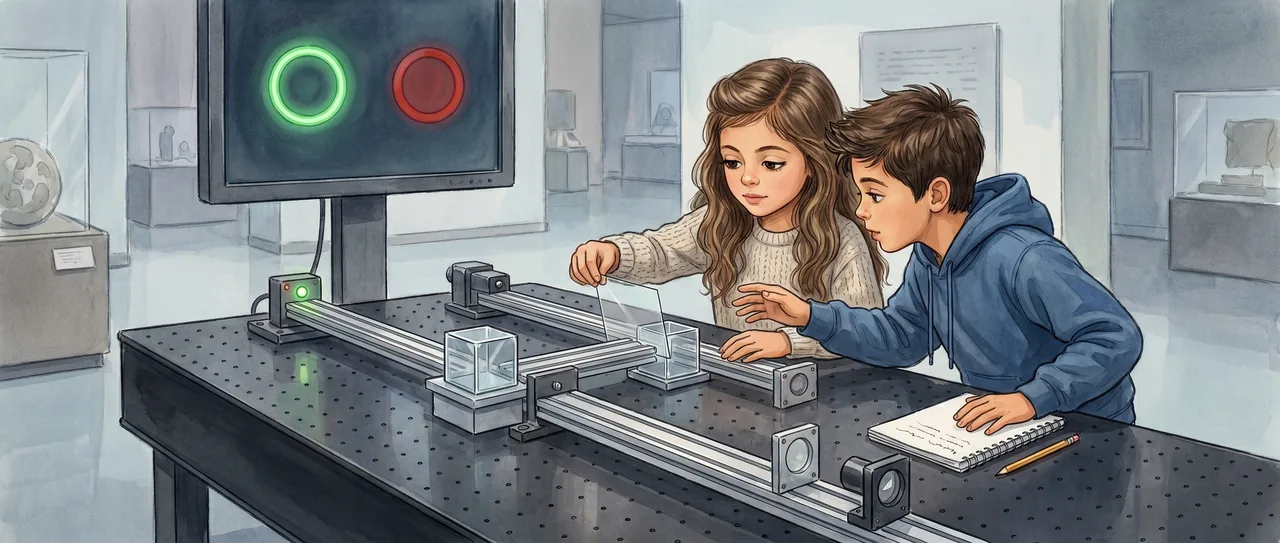
On the black optical table, under a clear cover, silver rails made a tiny city for light. A single-photon source blinked at one end. Two small glass cubes sat in the middle, beam splitters, Dr. Ilyas had called them. They looked too plain for the job of dividing the world.
The screen above the table showed two circles. One circle was labeled bright port. The other was labeled dark port.
The bright port had a green ring around it.
The dark port was flashing red.
Click.
Dr. Ilyas turned around so fast her lanyard hit her chin.
“No, no, no,” she said. “Not now.”
She was wearing one purple shoe and one black shoe. Maya had noticed this twelve minutes ago and put it on her private list of things that did not make sense yet.
“It’s alignment,” Dr. Ilyas said. “It is always alignment when trustees are coming.”
She crouched near the table, then stood again when someone called her name from the hall.
“Do not touch the mirror screws,” she said. “Do not breathe on the mirror screws. Do not think about the mirror screws too loudly.”
Then she hurried out, still talking to someone Maya could not see.
The detector clicked again.
Soren wrote down the count numbers from the screen.
Maya said, “Too even.”
“What is?” Soren asked.
“The wrongness.”
He looked at the screen. The green circle had counted forty-two. The red circle had counted forty-one.
Soren nodded once. “If a mirror drifted, maybe. But that is very even.”
The exhibit sign beside them said, One photon enters. Two paths are open. One detector stays dark.
Below that, in smaller letters, it said, A qubit can hold zero and one before it is measured.
The sign had annoyed Soren all afternoon. At school, zero and one were answers you circled. Here they were metal paths on a table. The upper path had a white sticker that said zero. The lower path had a white sticker that said one.
Maya leaned close to the clear cover. “Run the block test.”
“We’re allowed?” Soren asked.
“The block cards have handles. Handles mean visitors are allowed.”
This was one of Maya’s rules. It was not always true, but it was true often enough to be useful.
Soren slid the black card into the slot that blocked the upper path. The source blinked. The screen counted.
Click. Click. Click.
Both circles flashed.
He wrote the numbers. Then he blocked the lower path instead.
Click. Click click.
Both circles again.
“When either path is alone, both detectors can click,” Soren said.
Maya nodded. “But when both paths are open, the red one should shut up.”
Soren removed the card. Both paths were open again.
The red detector clicked immediately.
Maya made a small sound in her throat. Not a word. A door sound.
“They are not meeting,” she said.
“They meet at the second beam splitter,” Soren said.
“The table says they do. The photons disagree.”
Soren looked through the cover at the second cube. The two paths entered it from different sides. After that, two paths left toward the detectors. Nothing was broken. Nothing was smoking. There was no spark, no dramatic quantum crackle. Just small patient clicks from a thing too small to see.
He put his notebook down and followed the rails with one finger on the outside of the cover.
Source. First beam splitter. Upper path. Lower path. Second beam splitter. Detectors.
Maya was staring at the upper arm.
“What?” Soren asked.
“Clear isn’t always nothing.”
There was a thin rectangle clamped across the upper path, almost invisible unless the room lights caught its edge. It looked like plastic from a package. It looked like air pretending badly.
Soren checked the lower path. No rectangle.
Maya opened the drawer marked Light Tricks and pulled out two square pieces of polarizing film. The museum used them for an exhibit where children made windows go dark by turning one square in front of another.
She held one square over the mystery rectangle. Soren held the other above it and rotated slowly.
At one angle, the rectangle stayed pale.
At another, it went black.
“Polarizer,” Soren said.
Maya was already unclipping it from the upper path.
“Wait,” Soren said.
She froze.
“If it changes only the upper path,” he said, “then the two paths are different when they get to the second cube. The photon leaves a kind of tag.”
Maya looked at the red circle on the screen.
“So the machine can tell which way,” she said.
“Could tell,” Soren said. “Even if nobody looks.”
The red detector clicked as if agreeing with nobody.
Maya removed the polarizer.
The next photon clicked green.
The next one clicked green.
The next one clicked green.
The red circle stayed dark.
Soren did not write anything. His pencil rested against the paper and did not move.
Maya slid the black card into the lower path.
The red detector woke up.
She pulled the card out.
The red detector went silent.
In. Clicks.
Out. Silence.
Soren touched the edge of the slot, not blocking anything, just feeling where the empty path began.
A photon came one at a time. It never made half a click. It arrived whole at one detector or the other. But when the lower path was open and empty, the red detector obeyed it. When the lower path was blocked, the red detector ignored the rule it had followed a second before.
Maya whispered, “It needs the path it doesn’t take.”
Soren looked at her.
She frowned. “That’s not right.”
“It’s not wrong enough to throw away,” he said.
Dr. Ilyas rushed back in with a paper cup of coffee and no lid.
“Please tell me the dark port stopped being dramatic,” she said.
Maya held up the thin rectangle.
Dr. Ilyas stared. “That is from yesterday’s polarization workshop.”
“It was in the upper arm,” Soren said.
Dr. Ilyas shut her eyes. “I put it there to keep it flat. I put a which-path marker in my own interferometer.”
The red detector stayed silent.
Dr. Ilyas opened her eyes and laughed once, very softly. “That is embarrassing in a beautiful way.”
The first visitors entered in a wave of damp coats and loud shoes. A man with a shiny badge came straight to the quantum table.
“So,” he said, pointing at the stickers. “Does the photon go through zero or one?”
Dr. Ilyas opened her mouth.
Maya put the polarizer back into the upper path.
The red detector began to click.
Soren lifted the polarizer out.
The red detector stopped.
The man looked at the screen, then at the table.
“That does not answer my question,” he said.
“No,” Maya said. “It shows what your question does.”
Soren picked up the small exhibit card that said qubit. It had been lying beside the table, waiting to be placed under either zero or one.
He did not put it under either.
Maya pressed the start button once. Under the clear lid, the two silver paths met at the cube, and the detector that could have clicked did not.
Read the interactive version, listen to the narration, and earn a gold star →
A science-verified short story for curious kids · Curiosity Land