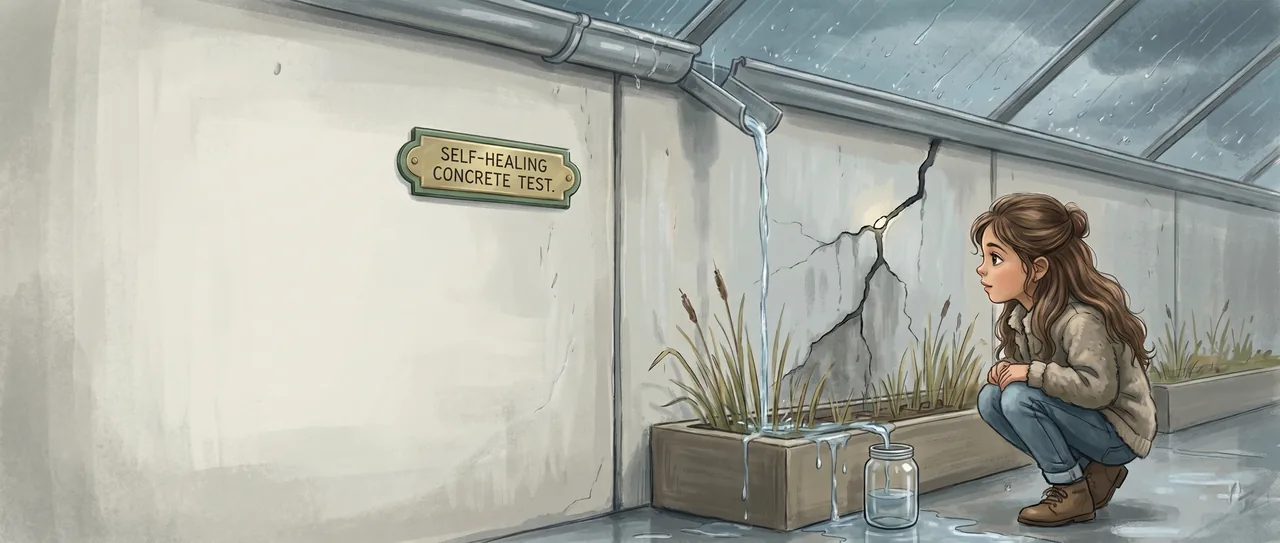
The Crack That Woke
Maya was told not to feed the wall.
The maintenance chief said it while holding a coil of orange hose like a captured snake. Rain ticked on the glass roof of the test garden. Beyond it, the harbor lifted and lowered its gray shoulders.
"No water on the concrete panels today," he said. "The city council is coming. Cracks look bad enough without damp streaks. Dry is tidy. Tidy looks safe."
Maya looked at the wall.
It was not a wall exactly. It was eight thick panels of pale concrete, each taller than a grown-up, standing in a row along a shallow channel of seawater. Little brass labels were screwed to the bases. Some said ordinary concrete. Some said self-healing concrete. The oldest label was green at the edges.
Poured twenty-nine years ago.
Maya put that on her inside list. Concrete older than she was. Concrete with a birthday. Concrete people were worried about hurting with a hose.
A thin crack ran down the oldest panel, crooked as a lightning bolt drawn by someone who had changed their mind halfway. At the bottom, a glass jar waited under a drip. Plink. Plink. Plink.
"If it heals itself," Maya said, "why is it leaking?"
The maintenance chief made a face. He was the kind of adult who liked bolts tight, signs straight, and words to mean what they had meant when he learned them. "That is exactly what I keep asking. The engineer says not to patch it. The mayor says call it a feature. I say a crack is a crack."
Across the garden, the engineer was arguing with a display screen that would not brighten. She had silver dust on one sleeve and a phone tucked between her shoulder and cheek.
"Excuse me," Maya said.
The engineer turned only halfway. "If this is about the leaking panel, it is supposed to do that for a while. The bacteria need water."
"The wall has bacteria?"
"Spores," the engineer said. "Sleeping. Packed inside when the concrete was mixed. They can stay dormant for decades. Water enters a crack, they wake, multiply, and make calcium carbonate. Limestone. It seals tiny cracks. If the crack is too wide, no. If it dries too fast, no. If someone scrubs off the mineral before it builds, also no."
The screen flashed, died, and flashed again.
"Please do not touch anything," the engineer said, and hurried away with the phone still clamped to her ear.
Maya did not touch anything.
She put her nose close to the oldest panel.
The crack was dark near the bottom where seawater had climbed it. Higher up, under the glass roof, the crack was pale and dusty. Along the damp part, a white line had gathered in the groove. Not paint. Not chalk. It looked like the crust inside a kettle, or the rim left by a tide pool after sun.
Plink.
The jar caught another drop.
On the next panel, an ordinary concrete panel, a crack wore rust-colored stains below a metal fitting. The maintenance chief had set a fan in front of it.
"Water gets in," he said from behind her. "Metal rusts. Concrete flakes. That is what water does."
Maya kept looking at the white seam.
"Not always," she said.
"Always enough."
He dragged the hose toward a drain and began winding it tighter.
The public demonstration was supposed to happen in one hour. There would be speeches on the walkway, and a gate would open, and harbor water would fill the shallow channel so everyone could see which panels leaked. The maintenance chief had already arranged blue cones in a perfect line. He had also placed a tall sign in front of the oldest self-healing panel.
PLEASE EXCUSE HISTORIC TEST CRACK.
Maya moved her head left. The sign hid the white line almost completely.
That went on her list too.
The oldest panel was the only one with a jar under it. The only one allowed to be embarrassing. The only one old enough to have been waiting longer than Maya had been alive.
The rain strengthened. Water ran down the outside of the glass roof, collected in a gutter, and poured through a pipe into a floor drain. It made a clean, useless waterfall one meter from the pale, dry upper crack.
Maya followed the pipe with her eyes.
The gutter had a little hinged spout, folded upward and tied with twine. When lowered, it would send roof water into a long planter full of reeds. The planter sat against the base of the old panel. Its soil was damp at one end and dry at the other, exactly matching the crack, dark below, pale above.
"Why is that tied up?" Maya asked.
The maintenance chief did not look. "Keeps water off the display."
"But the display is self-healing concrete."
"The display is for people in clean shoes."
Maya stood very still.
At school, when she stood still like that, people thought she had stopped listening. Usually she had stopped listening to them, which was different. The world became louder. Plink in the jar. Hiss in the drain. Rain on glass. The almost-sound of water not going where it needed to go.
The engineer’s words lined themselves up without asking permission.
Water enters a crack.
They wake.
If it dries too fast, no.
The maintenance chief started toward the ordinary cracked panel with a scraper and a rag. "White crust on the old one comes off before the speeches," he said. "Looks messy."
Maya stepped in front of the self-healing panel.
"Don’t scrape it."
He blinked. "Excuse me?"
"That’s the wall making rock."
"It is making a stain."
"Limestone is a stain if you don’t need it," Maya said. "A seal if you do."
The engineer, still holding the dead display remote, looked over.
Maya pointed to the crack. "Bottom part got wet. It has white stuff. Top part stayed dry. No white stuff. Your jar is still dripping because the crack is only being fed at the bottom. The roof water is going into the drain instead of the planter."
The maintenance chief looked at the tied spout. Then at the jar. Then at his rag.
"We are not flooding the garden before the council arrives," he said.
"Not flooding," Maya said. "Feeding the crack. Slowly. Like it’s designed for."
The engineer came closer now. Her phone was silent. Her sleeve left a silver smear on the remote.
"How long has the planter been cut off?" she asked.
"Since yesterday," the chief said. "For tidiness."
The engineer closed her eyes for half a second. "Untie it."
The chief did not move.
Maya was already at the pipe. The twine was swollen from rain and pulled tight. She worried it with her fingernail, found the knot’s soft belly, and loosened it one loop at a time. The spout dropped with a hollow clack.
Rainwater leaped from the gutter into the planter.
It did not gush. It threaded through the reed stems, darkening the dry soil. A minute later, the pale upper crack drank a thin line of water and turned the color of storm clouds.
Nothing dramatic happened.
No sparkle. No hum. No instant closing like a door.
The jar still said plink.
The maintenance chief folded his arms.
Maya waited.
The council arrived with umbrellas and shiny shoes. The mayor practiced saying innovative three times. The engineer made her dead screen behave by slapping its side with the flat of her hand. People gathered along the channel.
When the gate opened, seawater slid in, green and cold. The ordinary cracked panel began leaking at once, a nervous trickle down its face. The old self-healing panel dripped into its jar, slower than before. Plink. Then a long wait. Plink.
Maya watched the wet upper crack instead of the speeches.
At first there was only dark concrete. Then, at the edge of a tiny bend in the line, something pale caught the light. A grain. A fleck. A beginning so small the mayor talked right over it.
The engineer crouched beside Maya.
"That panel was poured when I was still in university," she said softly. "Those spores have been asleep nearly thirty years."
Maya did not answer.
The fleck whitened the sharpest corner of the crack, not enough to seal it, not enough for a speech, only enough to make the stone look less like stone.
Inside the concrete, something that had waited through summers, winters, storms, paint crews, pigeons, and people calling it broken had met rainwater and begun.
The maintenance chief set down his scraper.
"How long?" he asked.
"For a hairline crack? Days, maybe weeks," the engineer said. "We measure. We wait. We do not scrub."
Maya looked along the row of panels. Some were ordinary. Some were sleeping. Some had no cracks yet. The harbor pressed gently against the channel wall, trying every seam with one wet finger.
After the speeches, people left damp footprints on the walkway. The mayor forgot a blue umbrella. The engineer placed a small clear cover over the jar so no one would bump it.
Maya picked up the spray bottle the maintenance chief had abandoned beside the cones. She set the cone aside, placed the nozzle against the next hairline crack, and squeezed once. A dark thread ran into the concrete and disappeared.
Read the interactive version, listen to the narration, and earn a gold star →
A science-verified short story for curious kids · Curiosity Land