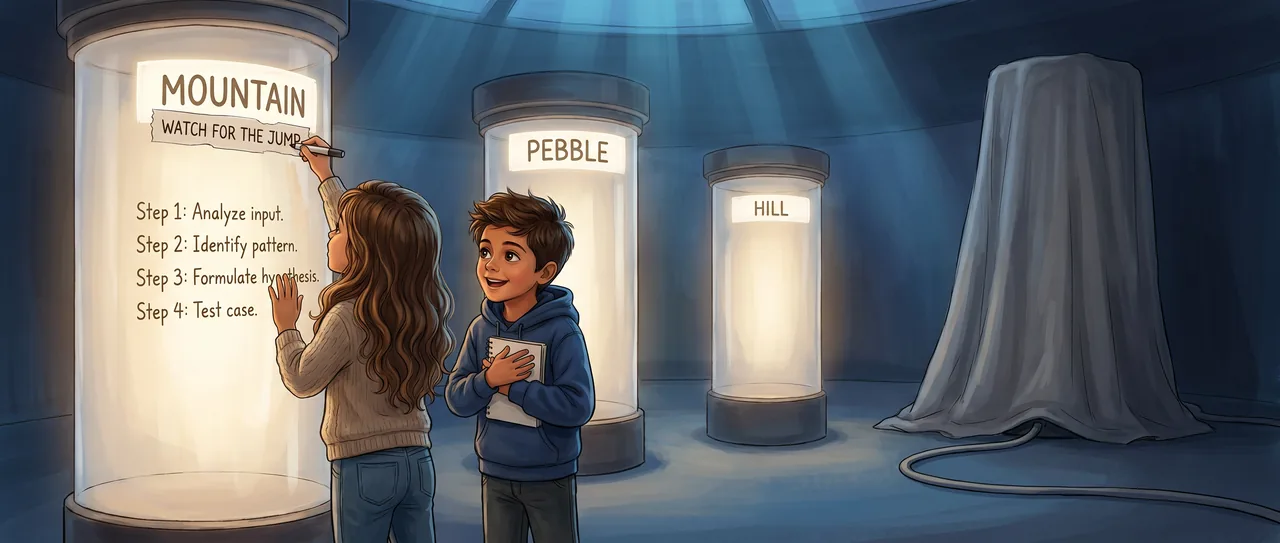
The Cliff in the Machine
The first thing the largest machine said was wrong.
Maya liked that immediately.
The museum exhibit was supposed to open in the morning. Three glass columns stood in a row under soft blue light. Each column held a language model, though the real machines were in a cooled room below the floor, humming behind locked doors.
The columns were named Pebble, Hill, and Mountain.
Pebble had millions of adjustable numbers inside it. Hill had billions. Mountain had many more. The sign above them said, Bigger Models, Better Answers.
Soren stood with his paper notebook pressed to his chest. Someone had laughed at it when they came in, not meanly, exactly, but with the surprised sound people made when they saw a horse in a kitchen.
The curator was on a ladder, taping a corner of the sign that kept curling down.
“You two are here because eleven-year-olds do not ask the questions adults practiced for,” the curator said. “Please do not make anything catch fire.”
“We don’t do fire,” Maya said.
“Mostly,” Soren said.
Maya typed into Mountain’s console.
If four moon beetles each carry three silver seeds, and then half the seeds split into two seeds each, how many seeds are there?
Mountain answered, Seventeen.
Soren blinked.
“Twelve seeds,” he said. “Half of twelve is six. Six split into two, so that makes six extra. Eighteen.”
Maya leaned closer to the glass. “It said seventeen fast.”
The curator climbed down, frowning at the screen. “That is not opening day behavior.”
“Ask it to show its working,” Soren said.
The curator shook her head. “Visitors do not want working. They want magic.”
Soren looked at the wrong answer. “I want working.”
Maya typed the same question again, then added, Use a scratchpad and show each step.
Mountain paused.
On the screen, words began to arrive in small careful pieces.
Four beetles times three seeds is twelve seeds.
Half of twelve is six.
Those six seeds split into two each, making twelve seeds where there were six.
The other six stay single.
Twelve plus six is eighteen.
Answer: eighteen.
The curator stared at it. “Why did it need to be asked that?”
Soren opened his notebook. “Because some problems don’t fit in one jump.”
Maya was already looking at the other columns. “Try all three.”
The curator checked her wrist display. “I have six minutes before the robotics people need me. If it breaks, write down how you broke it.”
“We are not breaking it,” Maya said. “We are finding the edge.”
Pebble answered the beetle problem with a poem about moons.
Hill answered, “Twelve,” then, when asked to show steps, produced four lines that looked like steps until the numbers wandered away from each other.
Mountain got it right only when Soren gave it room to walk.
“That’s not a slope,” Maya said.
The sign above them still said, Bigger Models, Better Answers.
Soren drew three boxes in his notebook. Pebble, Hill, Mountain. Under them he put marks for wrong, wrong, right. Then he crossed them out.
“One question is bad science,” he said. “Also, perfect answer scoring makes cliffs look steeper. If Hill almost gets it, we wouldn’t see that.”
Maya nodded, which meant hurry up.
So they built a ladder.
Not a real ladder. The curator already had one of those and kept leaving it in the wrong place. Their ladder was a set of questions that no model could have memorized, because Maya made up the words while Soren made up the rules.
Maya invented flen, which meant two, and tro, which meant three. Soren decided that miv meant add, and kest meant multiply. Then Maya made pel mean do the next thing twice, because she liked traps.
Soren wrote the rules on the console where all three models could see them.
Then they asked Pebble: flen miv tro.
Pebble said, “The answer is a bright forest.”
Maya put one finger in the air. “That one is not near.”
Hill got flen miv tro right. Five.
Hill got flen kest tro right. Six.
Hill failed when pel arrived. It answered quickly, confidently, and differently every time.
Mountain got the small ones right. Then it reached pel and stopped.
The pause was not like a person thinking. It was just absence. A blank screen. The hum below the floor. The soft tick of cooling vents in the walls.
Maya’s face changed.
Soren had seen that face when she found a cracked tile that repeated every seven steps in the subway station. It meant some part of the world had failed to line up, and she was delighted at it.
“Ask for steps,” she said.
Soren typed, Use a scratchpad. Do not skip the middle.
Mountain wrote the invented rules back to them. It did not know the words. It used them anyway.
flen is two.
tro is three.
miv means add.
kest means multiply.
pel means do the next thing twice.
For pel flen miv tro, do flen miv tro twice.
Two plus three is five.
Five plus three is eight.
Answer: eight.
Soren stopped writing.
Maya whispered, “It crossed.”
The room had not changed. The glass columns stood in the same blue light. The machines below the floor kept humming the same note. But the space around the columns seemed suddenly badly measured, as if the walls were farther away than the museum had admitted.
Pebble had not contained the trick. Hill had held pieces of it, bright and useless. Mountain had become something else while still being made of the same kind of parts.
The curator came back carrying a coil of cable over one shoulder. “Please tell me the exhibit still speaks human languages.”
“It speaks ours,” Maya said.
“We made a temporary one,” Soren said.
The curator read the screen. Her mouth opened, then closed. She looked up at the sign.
“It cannot say that,” she said.
“It did,” Maya said.
“No, I mean the sign.” The curator pointed. “Bigger Models, Better Answers. That is not what you found.”
Soren looked at Hill’s wrong answers. They were not nonsense in the same way Pebble’s answers were nonsense. They were almost paths. Broken bridges. Stairs that ended in air.
Maya was pulling the loose corner of the sign down.
The curator made a small wounded noise. “That vinyl cost more than my first bicycle.”
“It’s lying politely,” Maya said.
Soren tore a blank strip from the backing paper and stuck it across the word Better.
Maya took the marker from the curator’s ladder tray.
The curator sighed. “I am pretending not to see this until I decide whether I admire it.”
On the sign, Maya wrote, WATCH FOR THE JUMP.
Soren added, SAME KIND OF MACHINE. MORE SCALE. NEW TRICKS.
Then he paused and added, SOMETIMES.
Maya did not cross it out.
For the public test, they needed one last question. Not too easy. Not a trick with a hidden answer. A bridge Mountain could either build or not build.
Soren drew a little table.
If dax turns red things blue, and nola turns blue things green, what does nola after dax do to a red marble?
Maya shook her head. “Too small.”
He added more.
If every green marble makes two yellow marbles, and only yellow marbles can open silver doors, how many silver doors can three red marbles open after dax, then nola, then the green rule?
Maya smiled. “Mean.”
“Fair,” Soren said.
Pebble sang about marbles.
Hill said three, then six, then apologized for the confusion.
Mountain asked for a scratchpad before answering.
The curator made a sound halfway between a laugh and a gasp.
Mountain wrote the path slowly, one line at a time, using their words as if they were stepping stones laid across dark water. Red became blue. Blue became green. Three green marbles each made two yellow marbles. Six yellow marbles opened six silver doors.
At the bottom it wrote, Answer: six.
Nobody spoke for a moment.
Then Maya looked past Mountain.
Behind the three lit columns stood a fourth column under a gray cloth. It had not been part of the tour. A cable ran from its base into the floor.
“What is that?” she asked.
The curator followed her gaze and winced. “Not ready.”
“For tomorrow?” Soren asked.
“For anyone,” the curator said. “It is a research system. Larger. Unlabeled. Untested for visitors. It may fail in extremely boring ways.”
Maya was already at the console.
The curator held up both hands. “No. Absolutely not. Also, I did not say it was connected.”
Soren looked at the gray cloth. Then he looked at the question on Mountain’s screen.
“Mountain can do this one,” he said.
Maya nodded. “So we need a different one.”
They made it together, without talking much. Soren added rules that depended on earlier rules. Maya added an exception that only happened if the answer became a color that had not appeared at the start. Soren checked that the question still had one path through it. Maya checked that the path had a place where you wanted to jump and would be wrong if you did.
The curator watched them and forgot to object.
At last Soren typed the question into Mountain.
Mountain filled the screen with steps. Then it stopped halfway down and wrote, I cannot determine a consistent answer from these rules.
Maya took the printed strip of paper from the console.
She walked to the covered column.
The curator said, “Maya.”
Maya slid the strip under the gray cloth.
Under the cloth, the silent printer clicked once.
Read the interactive version, listen to the narration, and earn a gold star →
A science-verified short story for curious kids · Curiosity Land