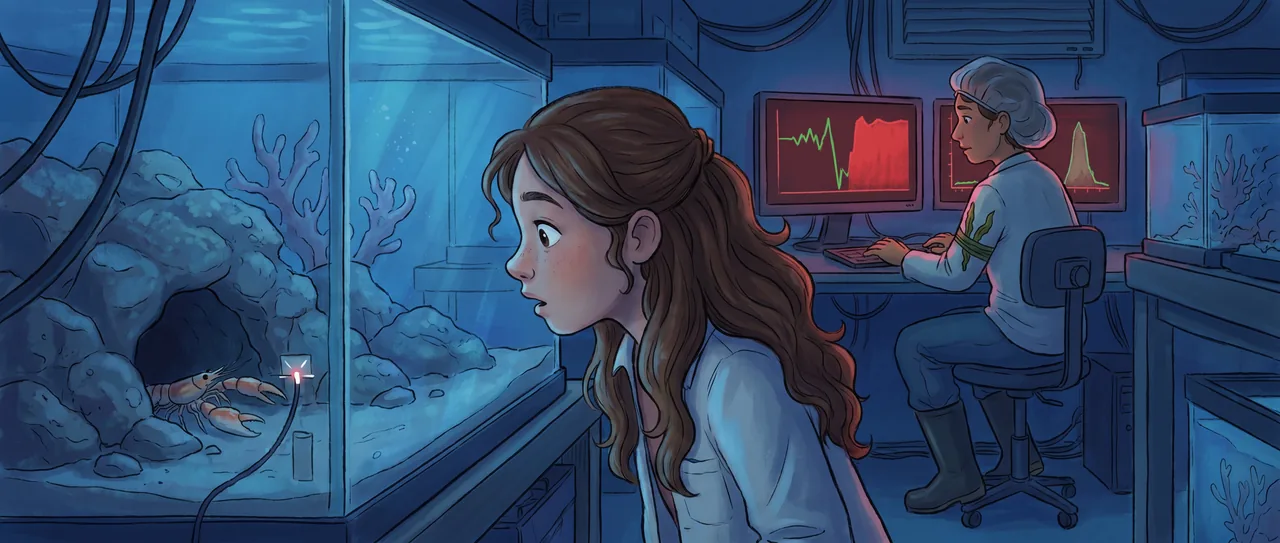
The Bubble That Cracked the Reef
The quiet room was the loudest place in the lab.
A paper sign on the door said QUIET RECORDING IN PROGRESS. Inside, seawater pumps hummed behind foam walls. Air tubes whispered. A blue tank light made the coral racks look like a city after bedtime.
Then the tank cracked.
Not the glass. The sound.
Snap.
Maya's shoulders jumped. On the monitor, a green line leaped into a red wall.
The aquarist groaned from under the table, where only her rubber boots showed. She had a wrench in one hand and a strip of seaweed stuck to her sleeve.
"Again," she said. "Every time I almost get a clean reef track."
Snap. Snap.
The green line slammed red twice more.
Maya looked at the tank. No fish big enough to make that sound. No crab waving claws. Just coral nubs on white plugs, a rock with holes in it, a goby hovering like a comma, and a cave no wider than Maya's thumb.
"It's not clean if you erase the loud part," Maya said.
"It's not useful if the loud part breaks the recording," the aquarist said. She rolled out from under the table and sat up too fast. Her hairnet was crooked. "I need a dawn chorus for the north reef frames. Fish grunts, urchin scrapes, water movement. Not pistol shrimp wrecking my levels."
Maya looked at the red wall on the screen.
She had read the pistol shrimp label earlier because the cartoon on it was wrong. It showed a shrimp wearing a boxing glove. The words underneath said the claw did not punch. It snapped shut so fast that water shot forward and tore open a vapor bubble. The bubble collapsed with a shockwave, sometimes a flicker of light, and heat around four thousand seven hundred degrees Celsius in a space smaller than a grain of sand.
Nearly as hot as the surface of the Sun.
Maya had stood in front of the sign for a long time, annoyed at the boxing glove.
Now the invisible cave cracked again.
Snap.
The aquarist rubbed her forehead. "Little stowaway came in with the live rock. Wonderful animal. Terrible timing."
"If it's wonderful, why is it terrible?"
"Because the recorder hears it like thunder. The quiet stuff disappears. I filter out the snaps, but then the whole track sounds dead." She pointed at the screen. "See that? Red means too loud. Too loud means lost."
Maya did see. The line did not look like a sound. It looked like a cliff.
On the table were two hydrophones, one black and one yellow. The black one hung in the coral tank. The yellow one lay coiled beside a mug of cold tea.
"Is that one broken?" Maya asked.
"Backup," said the aquarist. "Not calibrated. Don't drop it. Don't knot it. Don't let it touch the heater. I have six minutes before the tide truck leaves."
That was not yes. It was not no.
Maya picked up the yellow hydrophone.
The aquarist opened her mouth, then the phone on her belt buzzed. She looked at the message and made a noise like a gull swallowing a battery. "If you put it in, keep it away from the pump intake."
Maya lowered the yellow hydrophone into the far end of the tank, near the glass where the goby floated. The goby flicked one fin and did not leave. Its eyes sat high on its head, watching everything.
On the second monitor, a new line appeared. Smaller. Wobblier. Not red.
Maya turned the yellow recorder's knob down until the line barely twitched.
"You'll miss the fish," the aquarist said, reading another message.
"Maybe," Maya said.
She took the feeding pipette from the rack. The aquarist had told her the coral babies got powdered food, but the fish in this tank got tiny brine shrimp. Maya squeezed a cloudy drop into the water.
The goby darted forward. Something moved in the cave behind it. A pale feeler, then the edge of one huge claw.
Maya stopped breathing through her nose.
The claw opened.
It did not look powerful. It looked badly designed, too big for the animal, like someone had glued a door hinge to a comma.
The claw shut.
Snap.
The black recorder hit red.
The yellow recorder made a narrow mountain that fit on the screen.
At the same instant, the light sensor taped to the tank blinked once.
Not the tank light. Not the ceiling light. A single white tick on a tiny square of equipment, there and gone before Maya could blink back.
The aquarist forgot her phone.
Maya leaned closer to the glass. The shrimp had vanished. The goby settled again outside the cave, fins stirring. A stunned brine shrimp spun slowly downward.
The list in Maya's head changed shape.
Small animal. Huge sound. Bubble, not punch. Heat too brief to warm the water. Flash too quick for eyes. A cave with a Sun inside it, opening and closing.
"Do it again," the aquarist whispered.
Maya fed one more drop, farther from the cave this time.
No snap.
The goby ate. The pumps hummed.
Maya moved the pipette a little closer to the cave entrance.
Snap.
The black line broke red. The yellow line held.
The aquarist pushed the cold tea aside and pulled the yellow recorder toward her. "Lower gain for the shrimp. Higher gain for everything else. Two tracks."
"Not two tracks," Maya said.
The aquarist looked up.
Maya pointed first at the black line, full of fish mutters and pump hush and tiny gravel sounds. Then at the yellow line, where the snaps stood whole instead of chopped flat.
"One reef," Maya said. "Two listening sizes."
The aquarist's face did the thing adults' faces did when they were about to explain back the thing you had just said, only slower. Maya watched her decide not to.
"Show me where the snaps belong," the aquarist said.
Maya fed, waited, marked the time when the yellow mountain rose, and matched it to the broken red cliffs on the black track. Again. Again. The shrimp did not snap every time. It snapped when food passed close enough, or when the goby flicked back and the cave stirred, or when another tiny thing wandered into the wrong bit of water.
It was not noise sprinkled over the reef. It was an animal making decisions from inside stone.
The aquarist played the filtered version first through the small waterproof speaker in a bucket. It sounded smooth. Pretty. Empty in a way Maya disliked immediately.
Then she played Maya's matched version.
Water hissed. A fish grunted once, low and wooden. Something scraped like a fingernail on a shell.
Snap.
The bucket seemed larger than the room.
Snap. Snap.
The aquarist stood very still.
Outside the open door, the tide truck honked twice.
"Take that one," Maya said.
The aquarist grabbed the recorder, the speaker, and the wet coil of cable. She was halfway out before she turned back. "You coming?"
Maya was already coming.
They crossed the pier at a run, past stacks of coral frames and buckets labeled with places Maya had never been. The sea below was turning copper with late sun. Under the boards, water knocked against pilings covered in barnacles and soft green weed.
The aquarist climbed into the truck bed to pack the recorder. Maya stayed by the ladder with the speaker in both hands. It was heavier than it looked.
"Just keep it wet," the aquarist called. "Thirty seconds."
Maya knelt on the warm boards.
At the pier ladder, Maya lowered the little speaker until seawater closed over her fingers.
From the black stones below came three sharp snaps.
Read the interactive version, listen to the narration, and earn a gold star →
A science-verified short story for curious kids · Curiosity Land