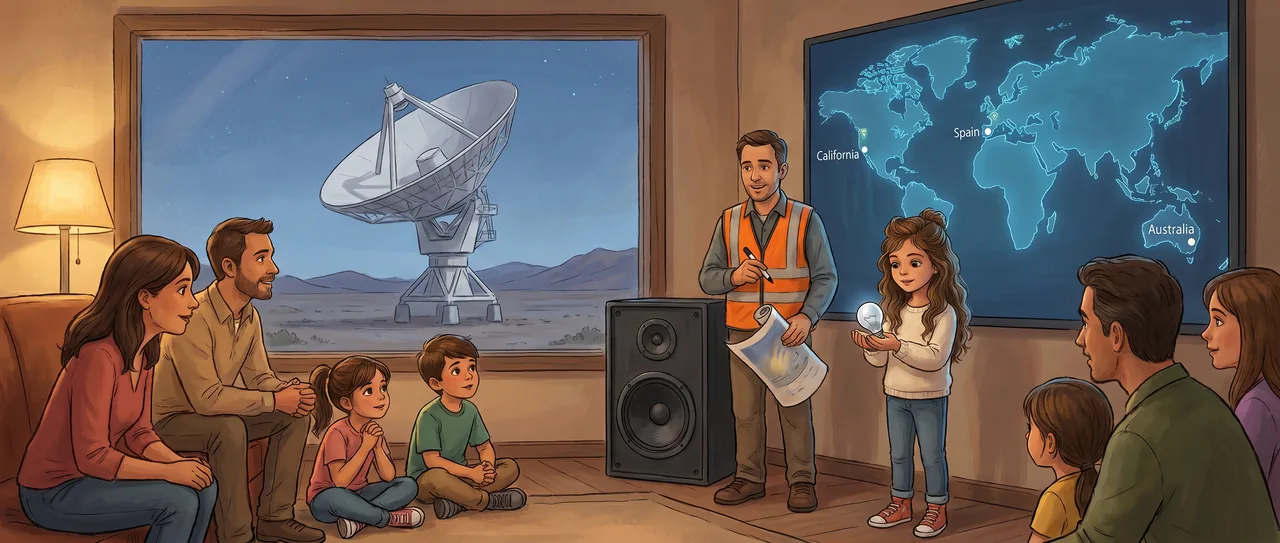
The Biggest Listening
Maya came to Goldstone looking for the loudest thing humans had ever made.
She had pictured a room with warning stripes on the door. Inside would be a machine that could shout past Mars, past Jupiter, past all the cold black places where comets slept. It would have coils as thick as tree trunks. It would hum in her teeth.
Instead, the visitor center smelled like dust, carpet glue, and coffee. A man in an orange vest was taping paper stars to the wall while trying to balance a huge black speaker on a folding table.
The speaker was taller than Maya.
Across the room, behind glass, sat a model of Voyager one. It had a silver dish, a long boom, and spidery arms that looked too thin to hold anything important. A small sign said it had launched in nineteen seventy-seven.
Maya stopped in front of it.
Nineteen seventy-seven was old enough that even adults called it old. The model did not look like something that should still be doing anything.
The man in the orange vest climbed down from a chair with a roll of tape stuck to his wrist.
"You here for the Voyager show?" he asked.
"I want to know how loud it is," Maya said.
"Perfect," he said. He slapped the side of the speaker. "We are going to make space talk. Big sound. Kids love big sound. Last year I tried a quiet program about orbital mechanics and three people fell asleep, including one parent standing up."
Maya looked back at the little spacecraft.
"Not the speaker," she said. "Voyager."
The man followed her look and smiled the smile adults used when they were about to make something smaller so it would fit.
"Ah. Voyager’s transmitter is about twenty-three watts," he said. "Less than this old refrigerator bulb."
He picked up a stubby glass bulb from the table. It was cloudy and ordinary and had a tiny wire curled inside it.
Maya waited for the rest.
There was no rest.
"That’s wrong," she said.
The man blinked. "No, it’s actually one of our best facts. The bulb is twenty-five watts. Voyager’s radio transmitter is less."
"Not the fact," Maya said. "The show."
On the wall behind him, a poster read: VOYAGER: A VOICE LOUDER THAN SPACE.
The man looked at the poster. He looked at the giant speaker. He looked at the line of families already gathering by the door.
"It is not a science paper," he said. "It is a hook."
Maya disliked hooks. Hooks were what people used when they thought the real thing would not hold.
A woman at the front desk called, "Five minutes."
The man jabbed a cable into the speaker and pressed a button.
The speaker made a sound like a sick robot clearing its throat. Then it died.
He pressed the button again. Nothing happened.
He crouched behind the table and began pulling cords with the expression of someone bargaining with furniture.
The families came in. Small children sat cross-legged. Parents stood behind them. A few people drifted toward the model of Voyager, but most stared at the dead speaker because it was the biggest object in the room.
"We can still do it," Maya said.
The man had a cable in his mouth. "Do what?"
"The show."
"Without the sound?"
Maya picked up the refrigerator bulb. It was heavier than it looked.
"That is the show," she said.
He took the cable out of his mouth. "You are very confident for someone not wearing a badge."
"Your speaker is broken," Maya said.
The man looked at the waiting crowd. He looked at the bulb in her hand.
"Two minutes," he said. "If they riot, I am blaming you."
Maya walked to the front of the room. The floor gave a tiny squeak under one shoe. She held up the bulb.
"This uses more power than Voyager one uses to talk," she said.
A little boy in the front row said, "That?"
"That," Maya said.
She pointed through the window. Far outside, beyond the parking lot and the scrubby desert plants, a white antenna dish rose over the fence. It was so large it did not look large at first. It looked like a piece of the moon had been lowered onto metal legs.
"Voyager is more than twenty-three billion kilometers away," Maya said. "It talks with less power than this. So the question is not how loud can we make it."
The man in the orange vest had stopped fighting the cords.
Maya turned to the public screen mounted near the glass case. It showed a map of Earth and three places marked with antennas: California, Spain, Australia. Lines and labels changed quietly. One line said Voyager one. Another said receive.
"The question is," Maya said, "what would you have to build to hear it?"
No one answered. That was better than an answer.
The room changed. Not because anything moved very much. Parents stopped whispering. A child’s sneaker stopped squeaking against the floor. The air conditioner clicked off, and in the sudden gap the desert pressed its silence against the windows.
Maya set the bulb on the table in front of the dead speaker.
"It does not get here right away," the man said, quieter than before. He came to stand beside the screen. "The radio signal takes more than twenty-one hours to cross the distance from Voyager to Earth."
Maya looked at the word receive.
More than twenty-one hours.
The green mark on the screen was not now in the ordinary way. It was a thin piece of yesterday, arriving late and still on time.
Maya pictured a radio wave leaving a machine older than her parents, spreading outward in every direction until Earth was not even a target, only a moving blue speck that happened to know how to listen. Most of the wave went everywhere else. A tiny part touched a dish in the desert, or in Australia, or in Spain, and people had made the dishes large enough, and the clocks steady enough, and the math patient enough, to catch it.
The bulb sat on the table, not glowing.
It did not need to glow.
The little spacecraft behind glass had been speaking in a voice almost too small to be called a voice, and the whole planet had built an ear.
The man slowly peeled the poster off the wall. The tape made four small ripping sounds.
"Okay," he said. "Not louder than space."
He found a marker and turned the poster over.
"What do I write?" he asked.
Maya looked at the dead speaker, the bulb, the model with its thin arms, and the screen where Voyager one kept being received.
"The biggest listening," she said.
He wrote it in block letters. His handwriting slanted downhill.
A parent raised a hand. "Can Voyager hear us?"
The man capped the marker. "When we send commands, we use much bigger transmitters from Earth. The spacecraft’s answer comes back tiny. That is the part we are showing tonight."
"What does it say?" asked someone else.
The man rubbed the back of his neck. "Mostly engineering. Temperatures. Power. Instrument data. I arrange chairs and break speakers, so that is the elegant version."
Maya stayed by the screen.
On the map, Earth kept turning. The labels did not care about the broken speaker or the poster or the people leaning forward now as if leaning could shorten space.
The signal on the screen had left Voyager before Maya woke up that morning. Before the visitor center opened. Before the man put up the wrong poster. Before anyone in the room had decided to listen.
Outside, the desert had gone blue with evening. Maya held the warm refrigerator bulb in both hands. Beyond the fence, the white dish turned one careful degree.
Read the interactive version, listen to the narration, and earn a gold star →
A science-verified short story for curious kids · Curiosity Land