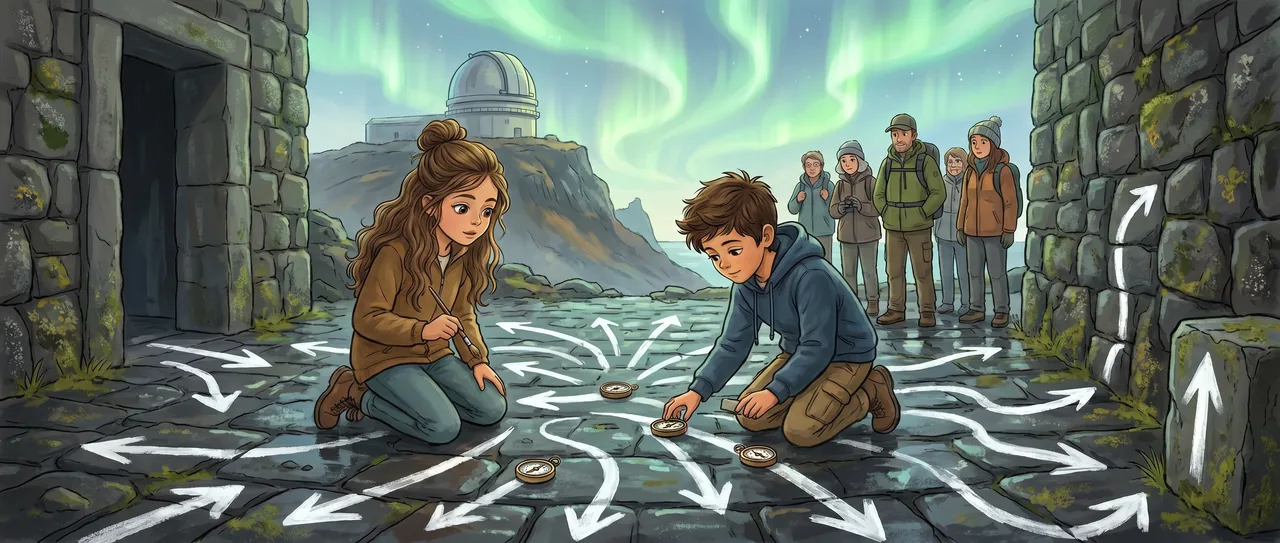
The Arrows That Would Not Stand Still
They were not supposed to paint wonder.
They were supposed to paint one arrow.
The director gave Maya a tin of white paint, gave Soren a crate of pocket compasses, and pointed across the black stone courtyard toward the observatory dome.
“Straight from the visitor door to the sky room,” she said. “Red tips south, same as always now. Make it clean. I have six tour groups arriving, three antenna repairs, and one mayor who thinks auroras can be scheduled.”
She hurried away with a coil of cable over one shoulder.
Maya dipped the brush. “Same as always now,” she said.
Soren opened the first compass. The red needle wobbled, hunted, and settled toward the sea.
South.
That still felt backwards, even though all their maps had been printed that way since before they were born. In old pictures, red compass needles pointed north. Then the reversal had begun its long crossing. Not in a day. Not in a lifetime. Thousands of years of Earth changing its magnetic mind. Now the field was thin and tired, about one tenth as strong as the old measurements in museums, and every compass took a little longer to decide.
Maya painted the first part of the arrow shaft.
Soren set down a compass beside it.
The red tip pointed south.
He set down another compass a step farther along.
South.
Maya painted faster. She liked lines that knew where they were going.
Halfway across the courtyard, Soren stopped.
“What?” Maya asked.
He did not answer yet. He put a third compass down near the low wall of black basalt blocks. Its needle swung south, paused, then crept sideways.
Not much. Enough.
Maya’s brush hovered over the stone.
Soren put another compass beside it. That needle leaned too.
“Bad batch,” Maya said.
Soren traded it with the first compass from the doorway. Near the wall, the good compass leaned sideways. At the doorway, the leaning compass pointed south.
Maya put the brush back into the tin. “Not the compass.”
They moved the crate away from the wall. They checked for metal benches, buried wires, the maintenance cart with its tool magnets. Maya dragged the cart to the far side of the courtyard. Soren tried again.
The needles near the wall bent sideways.
“Maybe the wall has a motor,” Maya said.
“It is a wall,” Soren said.
“Walls can have secrets.”
He tapped the basalt. It sounded like stone, heavy and dull. Tiny green lichens grew in the cracks. The blocks had come from the old lava fields below the observatory, cut and stacked before the dome was built.
Maya pressed one compass flat against a block.
The red needle turned almost north.
Both of them went still.
In the open courtyard, the world said south. Against the stone, the little needle pointed toward a direction that belonged in old books.
Maya laughed once, very quietly.
Soren took the compass from her and held it closer, then farther, then closer again. The needle swung like it was on a string tied inside the rock.
“The wall is pulling it,” he said.
“Rocks do not pull compasses.”
“Some do.”
Maya looked at the basalt wall, then at the pale stripe of unpainted path, then at the observatory dome where the sky room waited.
“Lava,” she said.
Soren nodded. “Magnetite grains.”
Maya had seen the animation in the sky room. Lava cooling. Tiny magnetic minerals turning while they were still free to turn. Then the rock hardened, and the grains stayed aimed the way Earth’s field had aimed them that day.
A stone did not have to remember on purpose.
It could remember by becoming solid.
Soren opened his notebook, then stopped with the pencil over the page. He looked at the courtyard instead.
“Grid,” he said.
Maya grinned. “Grid.”
They did not paint the arrow. They made small chalk squares across the courtyard, from the visitor door to the dome, and put a compass in each square. Soren waited for every needle to stop trembling before he marked its direction with chalk. Maya moved ahead of him, already seeing the bend before he proved it.
Near the doorway, the chalk marks pointed neatly south.
Near the basalt wall, the marks curved.
At one block, they pointed almost north.
At another, they pointed toward the dome.
At the corner where two kinds of black stone met, the needle spun slowly, stopped, changed its mind, and stopped again.
The director came back carrying a tablet, a paint roller, and a face full of too many tasks.
“Why is there no arrow?” she asked.
“There are arrows,” Maya said.
The director looked down.
The courtyard was covered in tiny chalk arrows, each one honest and none of them matching perfectly.
“I asked for one clean visitor line,” the director said.
“There isn’t one here,” Soren said.
The director opened her mouth. Closed it. Looked at the basalt wall.
Maya picked up two compasses. She put one in the middle of the courtyard. Its red tip sagged south. She put the other against the wall. Its red tip turned northward, slow and stubborn.
“The big field is weak right now,” Soren said. “So the old fields in the stones matter more when you are close.”
Maya pointed at the wall. “That one cooled when Earth was saying something else.”
The director set down the paint roller.
For once, she was not looking at her tablet.
“Show me again,” she said.
They did.
They showed her the doorway compass. The wall compass. The corner where the needle could not decide quickly. They showed her how the pull faded when they stepped back. They showed her that the line to the dome was not a line at all, but a small weather map of invisible directions.
The first tour group arrived early, shoes squeaking, voices bouncing under the glass roof of the entry tunnel. The director glanced at them, then at the paint tin.
“Do not paint the straight arrow,” she said.
Maya’s hand tightened around the brush.
The director picked up the white paint and carried it to the first chalk mark. “Paint these.”
“All of them?” Soren asked.
“All the ones you measured.”
The visitors came out into the courtyard and slowed.
Maya painted the first little arrow. Soren placed a compass beside it so the red needle lay along the wet white line. A small child from the tour crouched to watch. Then another. Then the whole group was quiet enough to hear the soft scrape of Maya’s brush on stone.
The arrows crossed the courtyard in a flock. South at the door. Curving near the wall. North beside one ancient block. East at the corner. Not wrong. Not messy. A map of Earth arguing with its own past.
Above the dome, the afternoon sky brightened green, though the Sun was still up. In these centuries, auroras came this far south often enough that nobody screamed, but everyone looked.
The director handed Maya the paint again.
“There are more basalt blocks along the sea path,” she said.
Soren set the compass down on the next square, and the red needle swung slowly toward the sea.
Read the interactive version, listen to the narration, and earn a gold star →
A science-verified short story for curious kids · Curiosity Land