Rain That Climbed
At noon, there were no clouds over the tower.
Dr. Iara said this three times, because her instruments agreed with her and because the sky was a hard blue bowl from river to river.
“No rain until evening,” she said. “Maybe not even then. The ocean wind is weak today.”
She was already walking while she spoke, one hand holding a tablet, the other hand trying to keep a coil of balloon line from tangling around her boot. Dr. Iara was famous at the station for finishing sentences in different rooms than where she began them.
Maya looked up through the metal grating of the canopy platform. Leaves overlapped above her like green hands. They were not still. They flickered in heat, each one edged with light.
“It’s going to rain before evening,” Maya said.
Dr. Iara stopped just long enough to glance at the empty sky. “From where?”
Maya did not answer right away. She looked at the leaves again, then at the row of open sampling trays along the railing. The trays were shallow and white, meant to catch invisible forest particles before the afternoon balloon flight. If rain hit them, the samples would wash down the drains.
“From here,” Maya said.
Dr. Iara smiled the way busy adults smiled when they had no spare hands for being surprised. “Then cover the trays if you can prove it. Not before. I need dry samples.”
She hurried down the stairs, calling into her radio about a helium valve.
Soren stood beside the trays with his notebook pressed to his chest. The cover had gone soft in the damp. At breakfast, one of the station engineers had offered him a spare wrist-screen and told him paper was what people used when batteries weighed more than sandwiches.
Soren had kept the notebook.
Now the top page curled away from the others as if it wanted to climb.
Maya pointed at it. “Your paper knows.”
“My paper absorbs water,” Soren said. He sounded pleased and annoyed at the same time. “That is not the same as knowing.”
“Top of the tower is wetter than the bottom.”
“The ground sensor said eighty percent humidity.”
“And up here?”
Soren looked around. The digital humidity meter was clipped beside the trays, but its screen blinked an error. A tiny green beetle was wedged under the casing, as if trying to help and failing.
He did not touch the beetle. He tore a strip from the ragged edge of a notebook page.
Maya watched him tie the strip to the railing with thread from his pocket. It curled tighter almost at once.
“That proves paper curls,” he said.
Maya was already moving down the spiral stairs. “Bring more paper.”
They tied strips at the top platform, halfway down, and near the forest floor where roots rose like sleeping animals from the mud. The lower strip stayed nearly straight. The middle strip bent a little. The top strip twisted into a small white horn.
Soren checked them twice. Then a third time.
“Warm air holds more water,” he said. “So if it’s that wet up there, there’s a lot in it.”
Maya crouched beside a young tree growing in a research pot near the base of the tower. It had a clear plastic sleeve tied loosely around one leafy branch, part of a transpiration study. Inside the sleeve, fog silvered the plastic. Drops gathered and ran down.
Maya tapped the sleeve. “The tree is breathing water.”
“Losing water,” Soren said.
“Sending it.”
He looked up.
Above them, the canopy was not a roof anymore. It was millions and millions of sleeves with no plastic around them. Every leaf had tiny pores too small to see. Every leaf was lifting river water into air.
A drop slid inside the sleeve and fell with a soft tick.
Soren swallowed. “How much can one tree send?”
Maya held her hands apart, then farther, then gave up.
At the top platform, the white sampling trays waited uncovered. The sky still looked empty. Not peaceful empty. Waiting empty.
Soren opened a small field kit Dr. Iara had left under the bench. It held clips, labels, two magnifiers, a temperature probe, and a cold pack for preserving samples. He cracked the cold pack and held its metal case above the railing.
Nothing happened at first.
Then a mist of beads appeared on the metal.
Maya leaned close. “Again.”
Soren wiped it dry with his sleeve and held it out beyond the platform, where the air rose from the leaves. Beads gathered faster.
He took it to the stairwell, away from the leaves. Slower.
He took it back. Faster.
Maya grinned. “The air is full.”
“Full enough to condense on cold metal,” Soren said. “Not full enough to rain.”
“Yet.”
A smell came up from the forest, green and sharp and sweet, like crushed leaves and orange peel and wet wood before wetness arrived. The smell was always there, but now it seemed to have edges.
Soren lifted one of the magnifiers and looked at the white tray. A dusting of yellow-green specks dotted the surface.
“Pollen?” Maya asked.
“Some. Maybe bits from leaves. Maybe tiny particles from the tree smells.”
“Cloud crumbs,” Maya said.
Soren did not say no.
Dr. Iara’s voice crackled from the radio clipped to the bench. “Balloon launch in ten minutes. Any change up there?”
Soren pressed the button. “The tower is wetter at canopy height. We have paper strips, condensation tests, and leaf sleeve water.”
A pause.
“The radar is still clear,” Dr. Iara said.
Maya took the radio. “Your radar sees rain after it becomes rain.”
Another pause. Shorter.
“Do you have clouds?”
Maya looked up.
The first one was small enough to miss. Not overhead. Not on the horizon. Just above the unbroken green, a white tuft stood where blue had been. While she watched, its top brightened and rose. Beside it, another tuft appeared. Then another.
They were not drifting in from the river. They were standing up out of the forest.
Soren’s mouth opened, but no words came.
Dr. Iara’s voice snapped from the radio. “Children?”
Maya grabbed the tray covers from under the bench. Soren moved with her. Cover, latch. Cover, latch. The line of trays went from open white squares to sealed silver boxes.
The wind changed.
It came upward first, through the grating, warm and wet against their knees. The paper strip on the railing curled so tightly it tore free and spun into the air. Soren caught it against his shirt.
Below, Dr. Iara shouted something delighted and not at all calm.
The clouds thickened. Their undersides turned gray. The whole sky lowered without moving closer.
Soren held his notebook under his shirt.
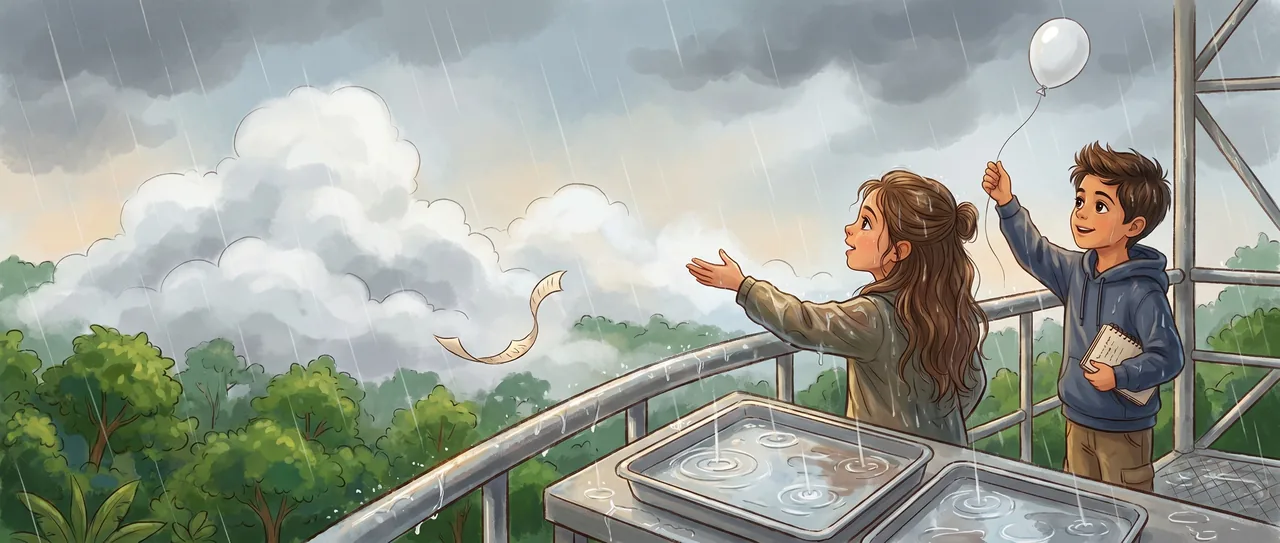
Maya held one palm out.
The first drop missed her and struck the railing. The second hit the back of her hand. It was warm.
Rain arrived all at once, not falling like water poured from a bucket, but beginning everywhere. Leaves rattled above them. The trays rang under their covers. The tower stairs shone black. The forest took the rain in and threw up more scent, stronger than before.
Dr. Iara climbed onto the platform, soaked from hair to boots, laughing too hard to speak. She looked at the covered trays, then at the paper strips, then at the cloud that had not come from the ocean.
“I need your measurements,” she said.
Soren handed her the curled strip. Maya pointed west, where the dark cloud was already stretching away over the treetops, pulled by a wind no one could see from the ground.
“The balloon,” Maya said.
Dr. Iara stared at the storm, then shoved the coil of line into Soren’s hands. “Then don’t wait for me.”
They ran to the launch rail. Rain streamed down their faces. Maya opened the clamp. Soren checked the knot, because knots mattered, especially when the sky was trying to take something.
The small white balloon leapt up, tugging its instrument pack through the rain. The line hissed through Soren’s wet fingers. Maya fed it higher, higher, until the balloon became a pale dot under the moving cloud.
Soren held the line steady while the forest roared around them.
The kite string leaned west through Soren’s fingers, dark with rain.
Read the interactive version, listen to the narration, and earn a gold star →
A science-verified short story for curious kids · Curiosity Land