The Strip of Sun
The paper was not supposed to hum.
Paper rasped. Paper crackled. Paper tore if you pulled too hard. It took pencil marks and lunch stains and, if adults were not watching, the corner of a flame.
It did not sip light from a skylight and make a tiny motor tremble.
An hour earlier, Maya had been sure the black glass rectangle was the important thing.
It stood on a silver frame at the front of the university lab, hard and shiny and serious. Beside it, a paper roll hung from a machine with clear doors. The paper looked too ordinary to be part of anything named Future Solar Materials Day.
Dr. Rios clapped once. She wore yellow glasses on top of her head and had the hurried look of someone whose thoughts kept arriving before her feet did.
“No fingerprints on the future,” she said. “Especially not on the glass. Especially not on anything wet. Especially not on anything I have already aligned.”
The visiting adults laughed. The class laughed because the adults did.
Maya looked at the paper roll.
Behind it, a wall timeline ran from one end of the room to the other. The first card said, First perovskite solar cell, two thousand nine, three point eight percent. The last card said, Perovskite silicon tandem, more than thirty three percent. A red arrow climbed so steeply it looked like it had changed its mind about being a line.
Under the arrow someone had written, Fastest climb in solar history.
Maya stood under the three point eight percent card for longer than the guide wanted. Three point eight percent sounded like a quiz returned upside down on a desk. More than thirty three percent sounded like the same quiz had learned to fly.
“Keep moving, please,” Dr. Rios said. “The printer is about to start.”
The machine woke with a soft shuffling sound. A sheet slid forward. One clear layer. One dark layer. Silver tracks like thin bones. Another clear layer sealing it in.
“Public sample,” Dr. Rios said. “Sealed. Safe to touch when it comes out. The lab samples stay in the glove box, away from moisture and grubby human weather.”
The sheet that came out was not a panel. It was a long, flexible strip, dark purple in some angles and brown-black in others. It drooped when a technician lifted it. It had tiny silver tabs along one side.
A woman near Maya said, “That is solar?”
“That is a small demonstration cell,” Dr. Rios said. “Do not ask it to run a city. Do ask it to prove a point.”
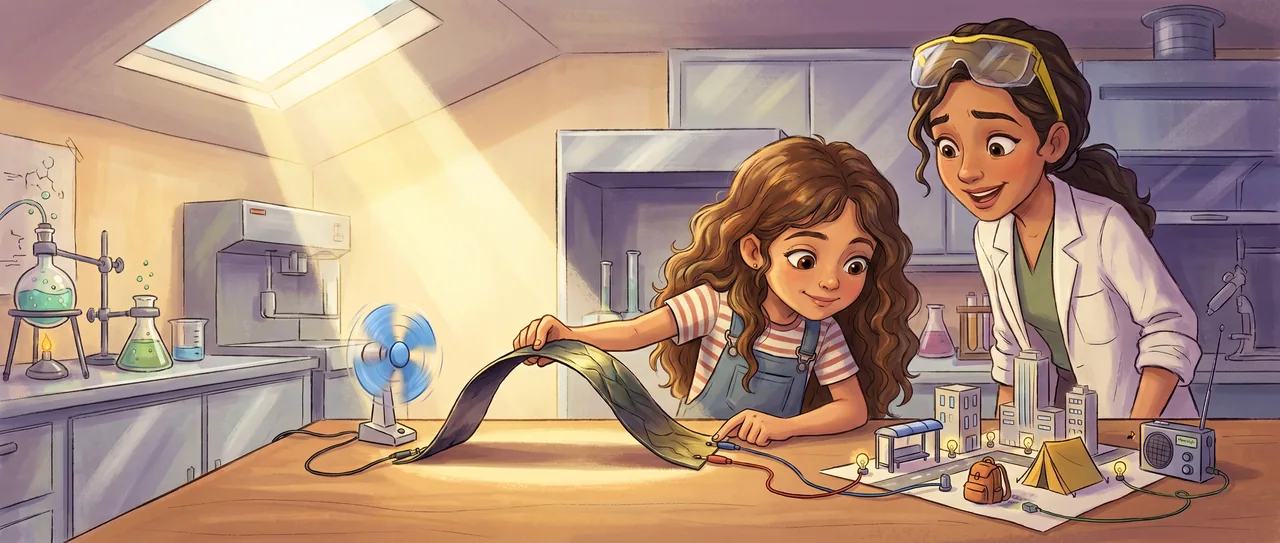
The strip was supposed to power a model on the center table. The model was called Sun on Everything. It had a paper school roof, a curved bus shelter, a backpack, a rolled tent, and a little emergency radio smaller than Maya’s thumb. Tiny bulbs were threaded through the model like stars waiting for permission.
Maya liked the model better than the glass panel. The glass panel looked as if it expected a roof and would not forgive any other job.
The printer made a sound like a hiccup.
Dr. Rios froze.
The sheet crawled out crooked. The dark rectangles leaned. The silver tracks wandered where they should have gone straight. The technician reached for the stop button.
“No, no, no,” Dr. Rios said, but quietly, like she was trying not to frighten the machine.
The strip emerged in a long, wrinkled ribbon. It was still sealed between clear layers, but the printed cells marched at angles, not in clean rows.
Dr. Rios held it up with two fingers. Her mouth went flat.
“Alignment failure,” she said. “Crooked bus lines. Terrible for the display.”
Maya liked it immediately.
The strip did not look broken. It looked as if it had refused the ruler.
Dr. Rios turned toward the glass panel. “We will use silicon for the first demonstration. Reliable. Handsome. Heavy as a moral lesson.”
The technician carried the crooked perovskite strip to a side table marked rejects.
The skylight brightened. Sun slid across the lab floor in a long narrow bar. It touched one leg of the center table, crossed the rejects table, and climbed the wall under the timeline.
The glass panel stood two steps away from the light.
Dr. Rios tilted it. The silver frame squeaked. The power cable pulled tight. The model’s tiny bulbs stayed dark.
“Clouds moved faster than the schedule,” Dr. Rios said. “Of course they did.”
The visiting adults checked their watches. The class shifted from foot to foot. Someone whispered that the glass panel looked like a television that had forgotten to be a television.
Maya was looking at the reject table.
The crooked perovskite strip lay half in the sun. Where the light crossed it, the dark rectangles showed colors like beetle shells. Purple. Gold. Almost green.
“Does crooked mean dead?” Maya asked.
Dr. Rios was on her knees beside the glass frame. “It means inconvenient.”
“Different word.”
Dr. Rios looked up. For a second she seemed annoyed. Then she seemed interested in spite of herself.
“Touch only the clear edges and the silver tabs,” she said. “Bend, do not crease. If you can get anything useful from that before the guests escape, I will pretend this was the plan.”
Then she went back to fighting the frame.
Maya picked up the strip by its clear border. It was lighter than a classroom handout. Warmer where the sun had touched it.
A tray beside the rejects held alligator clips, a tiny motor with a paper fan, a red light, and a meter. The labels were too neat. Maya ignored the labels and followed the tabs.
One clip on this silver end. One clip on that silver end.
The red light gave one weak blink, then nothing.
Maya moved the strip fully into the sunbar. The strip was too long. Only the middle cells lit up. The ends lay in shadow under the table edge.
She remembered the glass panel demonstration from the beginning of the visit. Dr. Rios had covered one square with her palm, and the little fan had slowed. One shaded piece could sulk for the whole row.
Maya lifted the perovskite strip again.
It did not have to lie flat.
She curled it gently, not a crease, just a wave. The first dark rectangle caught the sun. The second tilted away. The third caught it. Wrong.
She changed the wave. Smaller hills. The strip made a shallow staircase above the table, each crooked rectangle turning its own face toward the narrow band of light.
The red light blinked twice.
Maya held her breath and changed the angle of the last hill with one finger.
The tiny motor shivered.
Not enough.
On the rejects table lay two more sealed strips from earlier tests. One was short. One had a blank patch where the coating had skipped. The blank patch would not help. The short one had clean tabs.
Maya clipped the short strip after the crooked one. She did not know if the order mattered, so she tried one way, then the other. One way did nothing. The other made the meter needle jump.
The motor began to hum.
The paper fan turned once. Stopped. Turned again. Then it spun so fast its blue edges disappeared.
“Maya,” Dr. Rios said.
She had stopped fighting the glass panel.
So had everyone else.
Maya kept one finger against the strip, holding the little arch in the sun. If she moved, the fan slowed. If she matched the bent cells to the light, the fan sang.
The crooked sheet was not acting like a worse glass panel. It was acting like something glass could not become.
The fan pushed a soft breath across the paper model. The tiny bulbs along the bus shelter flickered on, not all at once, but one after another, as Dr. Rios quickly moved the clips from the fan to the model lead.
The backpack lit. The tent lit. The little emergency radio lit with one green dot.
The adults stepped closer.
Someone said, “It is paper.”
Dr. Rios lifted both hands, as if surrendering to the room. “It is a sealed perovskite demonstration cell printed on a flexible backing,” she said. “Which is a longer way to say, yes, it bends.”
Maya looked past the model.
The lab changed shape without moving.
The curved handrail by the stairs was no longer only a handrail. The window shade was not only a shade. The paper badges hanging around every visitor’s neck were small blank roofs. The red arrow on the timeline did not look like a line anymore. It looked like something still climbing.
Dr. Rios came beside her, holding the crooked strip with more care now.
“Three point eight percent,” Maya said, looking at the first card.
“Tiny,” Dr. Rios said.
“More than thirty three.”
“Laboratory records. Tandem cells. Many problems still to solve.”
Maya touched the clear edge of the strip. The little bulbs stayed lit under the skylight.
“Fifteen years,” she said.
Dr. Rios looked at the red arrow, then at the printer, then at the roll of white paper still waiting in the machine.
“Choose the next shape,” she said.
Maya did not choose the glass rectangle.
She chose the long paper curve that had been meant only for decoration, the one cut like a river.
Dr. Rios fed its leading edge into the printer slot.
Maya placed both hands on the roll of blank white paper as the first dark line slid onto it.
Read the interactive version, listen to the narration, and earn a gold star →
A science-verified short story for curious kids · Curiosity Land