The Star That Wasn't There Yet
The planetarium show broke at the exact place called The Last Star.
Maya liked that immediately.
The dome above her and Soren had been full of blazing things. Blue giants. Red giants. The swollen future Sun, which made Soren sit very still. Then the stars went out in waves, not all at once, but like lights in faraway apartments after midnight.
At the front console, the planetarium director slapped the side of the projector with the flat of her hand.
"Not now," she said. "Please not now. The donors arrive in forty minutes, and I refuse to end the universe with an error message."
Across the dome, in enormous white letters, floated:
No observed object in catalog.
Soren leaned forward. "What object did you ask for?"
"A black dwarf," the director said. She had three pencils in her hair and a scarf with tiny Saturns on it. One pencil slipped and bounced off the console. "The script says, after a white dwarf cools for trillions of years, it becomes a black dwarf. Cold. Dark. The longest ember. I need one on the dome."
Maya looked up at the message.
"It says observed," she said.
"Yes, and that is the problem," said the director. "The database is being fussy. I can put in an artist's picture. Charcoal ball. Nice label. Very dramatic."
"If we can see it," Soren said, "is it still a black dwarf?"
The director opened her mouth, closed it, then pointed at him with a pencil she had rescued from the floor.
"You are both here to test the seats and tell me if the narration is boring. You are not here to make the universe more difficult."
"It already is," Maya said.
The director sighed the sigh of a person whose show had cost too much and whose best volunteers had turned out to be eleven.
"Fine. Ten minutes. Make it less broken. I have to go convince the lobby screen to stop advertising last month's comet night. Do not dismantle anything with a warning sticker."
She hurried out through the side door.
The dome stayed black except for the error message.
Soren took out his notebook. It was paper, which everyone at school treated as if he had brought a fossil to lunch. He did not write yet. He just held the pencil ready.
"A black dwarf is what a white dwarf becomes," he said. "White dwarf first. Then cooling. Then black dwarf."
"So ask for the before," Maya said.
Soren slid into the console chair. He did not touch anything at first. He read the labels. Maya waited by not waiting. She walked in a small circle under the dome, looking up at the wrongness.
"Search white dwarf," Soren said.
The console listened.
The dome filled with dots. Not many. Small. Steady. One bright blue-white point burned near the fake shoulder of a fake constellation.
"Sirius B," Soren read. "White dwarf. Companion to Sirius. About the size of Earth, but with about the mass of the Sun."
Maya stopped walking.
"Say that again."
"Earth-sized. Sun-mass."
The dot on the dome was not impressive. It was smaller than a pinhole. It did not flare or swirl or do anything a movie star would do.
Maya held up her thumb and covered it.
"That tiny thing used to be a star," she said.
"Yes. A star used up its fuel, puffed off its outer layers, and the core collapsed down. Not a black hole. Not neutron star small. White dwarf small."
"Earth-sized," Maya said.
"Sun-mass," Soren said.
For a moment, the planetarium seats and carpet and exit signs seemed too thin to hold what was above them. Maya kept her thumb over Sirius B. A whole star fit behind her thumbnail because it was far away, and it was also a crushed thing, a leftover thing, a not-finished thing.
"Make it older," she said.
Soren found the timeline controls. The show had a slider, now to far future. He dragged it right.
The little white dwarf dimmed.
He dragged farther.
It dimmed more.
At the end of the slider, it was still faintly there.
"That's all?" Maya asked.
"The slider stops at one hundred billion years," Soren said.
"That's not enough?"
Soren checked the script notes. "The universe is thirteen point eight billion years old. Black dwarfs take trillions of years to form. Maybe far longer, depending on the star."
Maya stared at the tiny stubborn dot.
"The show's far future is too short."
Soren wrote that down, then underlined too short.
The words on the dome had changed when he searched. Now the black dwarf error sat in the corner, small but still present.
No observed object in catalog.
Maya smiled.
"That's not an error. That's the whole thing."
Soren tapped the pencil against his notebook once. "There are none to observe because the universe hasn't had time to make one."
"The catalog is telling the truth," Maya said.
They both looked at the blank corner where the message waited.
At school, Maya had once been told that a blank answer meant she had not done the work. Soren had once been told that a page full of crossed-out attempts meant he should try to be neater. But here was the sky itself refusing to fill a space because filling it would be a lie.
The director burst back in holding a cable in one hand and a cup of coffee in the other.
"Why is Sirius B on my apocalypse show?"
"Because it is not an apocalypse show," Maya said. "It is a waiting show."
"That is not a comforting phrase for donors."
Soren turned the console screen toward her. "If we draw a black dwarf, it is wrong. A black dwarf would send no light to the dome. No heat. No radio. Nothing for a telescope to catch."
"But it would still have mass," Maya said.
Soren looked up.
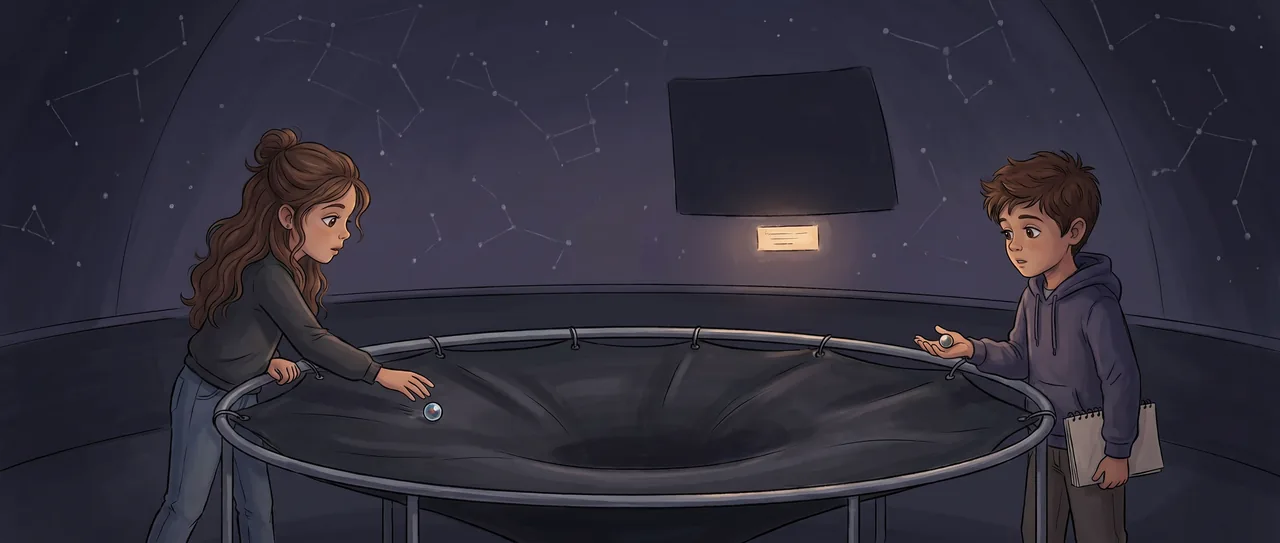
Maya pointed to the front of the planetarium, where a rubber gravity well sat beside the first row for school demonstrations. It was a stretchy black sheet clamped in a round metal frame. Usually the director put a heavy ball in the middle and rolled marbles around it to show orbits.
"You can't see the thing," Maya said. "But other things can move around it."
The director looked at the gravity well. Then at the blank dome. Then at her coffee, as if it might contain a better answer.
"The last part of my beautiful show," she said slowly, "would be nothing on the dome and a marble rolling on a sheet."
"Not nothing," Soren said. "No radiation. Still gravity."
"And no black dwarfs yet," Maya said. "So don't say here it is. Say here is where one would be, after enough time."
The director put her coffee on the floor, which seemed dangerous but sincere.
"Can you make the dome go completely dark except one marked patch?"
Soren had already found the projector mask settings. "Yes. But the patch cannot glow. The label can be outside it."
"The label can glow," Maya said. "The star cannot."
The director stared at them for half a second, then laughed once.
"You two are terrible for deadlines. Keep going."
They worked fast.
The director recorded one new sentence for the narration, but Maya made her do it twice because the first time she said, "At last, we see a black dwarf."
"We don't," Maya said.
The director rubbed her forehead. "At last, we reach the place where a black dwarf could be."
"After trillions of years," Soren said.
"After trillions of years," the director repeated, and recorded it.
Soren set the timeline so Sirius B faded and faded until the software could fade it no more. Then the dome went dark. Not movie dark, with blue shadows and pretty edges. Dark like the projector had shut one eye.
Maya placed the heavy metal ball under the center of the rubber sheet, hidden by the fabric. The sheet sagged around a thing no one could see.
People came in. Adults in coats. A few children dragged there by adults in coats. The director stood by the console with all three pencils back in her hair.
The show began.
This time, when the stars went out in waves, no error message appeared. Sirius B shone small and hot and fierce, then aged without burning, cooling through stretches of time that made human numbers sound like pebbles dropped into a canyon.
The narration said, "The universe is not old enough for even one black dwarf to exist. Not yet."
In the dark, someone whispered, "Not even one?"
The dome held its unlit patch.
Soren stood beside the gravity well with a marble in his palm. Maya stood on the other side, one hand resting on the metal rim. The hidden weight pulled the rubber down into a smooth, invisible hollow.
The director did not step forward.
A small voice from the seats asked, "If it gives off nothing, how would anybody know it was there?"
Maya set the marble at the rim of the black cloth and opened her fingers. The marble rolled toward the place where nothing was showing.
Read the interactive version, listen to the narration, and earn a gold star →
A science-verified short story for curious kids · Curiosity Land