The Shape the Wave Could Not See
The invisible thing was a coffee can.
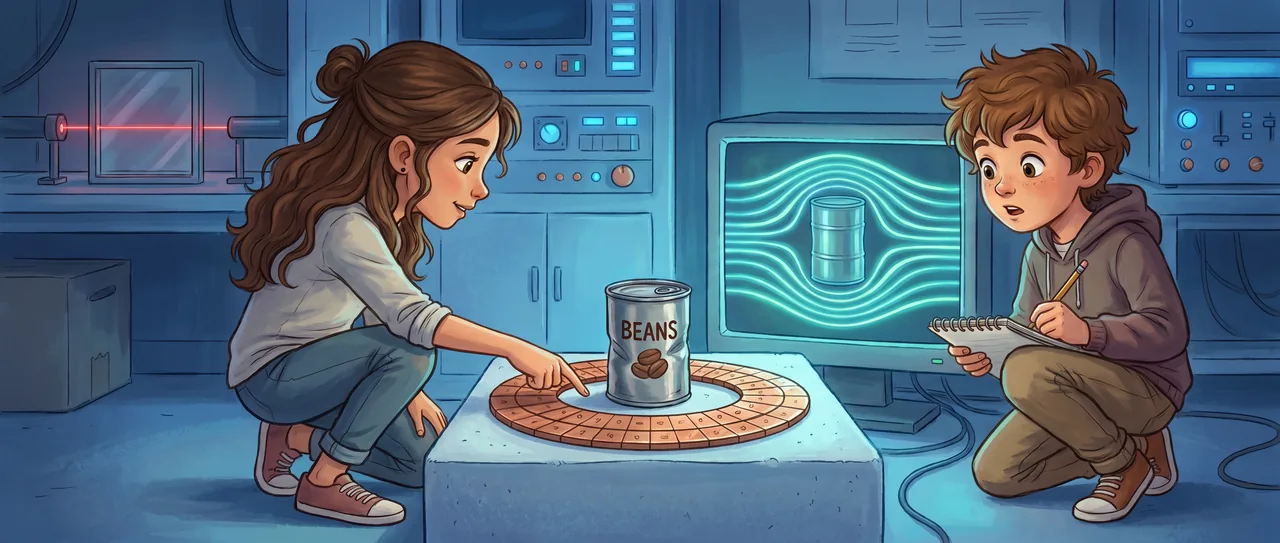
It sat on a foam pedestal in the middle of the lab, shiny and dented, with the word BEANS printed on one side in blue letters.
Soren stared at it.
Maya stared at the screen beside it.
The screen showed a dark smear where the coffee can blocked the microwave beam. The smear looked like a thumbprint made of night.
Behind them, thirty visitors murmured. Someone’s little brother said, loudly, “I can still see it.”
Dr. Vega clapped once, too brightly. She wore purple safety glasses on top of her head and had a silver sticker on her sleeve that said ASK ME ABOUT IMPOSSIBLE MATERIALS.
“Of course you can see it with your eyes,” she said. “Your eyes use visible light. Today we’re hiding it from microwaves.”
“That did not sound like the poster,” Maya said.
Soren opened his notebook. The poster in the hallway had said: WALK AROUND AN INVISIBLE OBJECT.
The coffee can remained extremely walk-around-able.
Dr. Vega placed a ring around the can. The ring was made of curved tiles, each tile printed with tiny copper shapes. They looked like broken squares, hundreds of them, all facing the same way. The whole ring was wider than a dinner plate and not much taller than the can.
“This is the cloak,” Dr. Vega said. “It does not reflect the microwaves. It does not soak them up. It guides them around the hidden object and brings them back together on the other side.”
She pressed a key.
A little motor pulled the receiver along a rail. The transmitter hummed softly from the opposite side. On the screen, blue dots appeared, then green, then a black crescent.
The crescent was smaller than before, but it was still there.
Dr. Vega’s smile froze for half a second.
The visitors leaned closer.
“It’s dramatic because science is alive,” Dr. Vega said. “One moment, please.”
She hurried to the laptop. A man with a camera waved at her from the doorway. “Livestream in four minutes,” he said.
“Tell the dean I have defeated physics and am polishing the victory,” Dr. Vega said.
The camera man did not laugh. He went away.
Maya stepped sideways until the screen and the coffee can lined up in her sight.
“The shadow moved,” she said.
Soren looked at the rail. “The receiver moved.”
“No. The wrong part moved.”
He wrote that down, then looked again.
Dr. Vega tapped the keyboard harder than a keyboard deserved. “It worked yesterday.”
“Yesterday at this frequency?” Soren asked.
Dr. Vega glanced at him as if she had just noticed he was not part of the furniture. “Three gigahertz. That is what the sign says.”
Soren looked at the tiles. Each one had a white sticker with tiny printed letters. He bent close enough that his breath fogged the plastic cover.
“Can I read this?” he asked.
“If you do not lick the copper,” Dr. Vega said.
Maya was already at the side of the ring. “These are all turned the same way.”
“They have to be,” Dr. Vega said. “The shape matters.” She pulled a cable from one port and plugged it into another. “The shape is the whole trick.”
Soren read the sticker aloud. “Design frequency, two point four five gigahertz. Polarization, vertical.”
Dr. Vega stopped moving.
The room made the kind of silence that has elbows in it.
“The sign says three,” Soren said.
“The sign was printed by Communications,” Dr. Vega said.
Maya leaned over the transmitter. Its little antenna lay sideways, like a fallen ladder.
“Is sideways vertical?” she asked.
“No,” Soren said.
Dr. Vega shut her eyes. “I rotated the antenna so the visitors could see the label.”
The little brother said, “So the invisible can is facing the wrong way?”
Maya grinned. “The can is fine.”
Soren did not touch the equipment yet. He waited until Dr. Vega nodded. Then he turned the antenna upright.
Maya pointed to the frequency box on the laptop. “It’s still three.”
Dr. Vega’s hand hovered over the keyboard.
Soren said, “May I?”
“You may, if you are careful, exact, and do not make the university famous for the wrong reason,” Dr. Vega said.
Soren typed two point four five with one finger.
The transmitter clicked. The receiver slid back to the start of the rail. The visitors pressed in until Dr. Vega had to stretch both arms like a gate.
The scan began again.
This time the colors flowed.
The blue bands reached the ring and bent. They curved around the coffee can on both sides, thin and bright, like water dividing around a stone in a stream. Behind the can, where the black thumbprint had been, the colors joined again.
The screen showed no dark crescent.
The coffee can sat in the middle of the lab, shiny and dented and plainly there.
On the screen, it had nowhere to be.
Maya did not blink. “It didn’t vanish from us.”
“No,” Soren said. “From that.”
He pointed at the microwave map.
Dr. Vega let out a laugh that sounded like dropping a toolbox and finding music inside. “Yes. From that.”
The visitors burst into questions.
“Can you make a person disappear?”
“Can you hide a spaceship?”
“Can you do my math test?”
Dr. Vega started answering three people at once. “Only certain wavelengths. Only certain directions. No, and your teacher would still see the pencil.”
Maya had crouched beside the ring.
The copper shapes were not wires exactly. They were not pictures exactly. Each broken square held a gap, and every gap faced the same direction. The pieces did not look powerful. They looked patient.
Soren crouched too. “They’re smaller than the wavelength.”
Maya held her fingers apart, then wider, then wider. The microwave was much bigger than the copper marks.
“So the wave can’t see the pieces,” she said.
“It feels the pattern,” Soren said.
Maya glanced at him.
At school, people said pattern like it meant decoration. The border on a worksheet. The thing you colored after finishing the real work. Here, the pattern had bent something no hand could hold.
Soren touched the edge of his notebook, then looked at the copper again. “Not what it is made of.”
“How it is arranged,” Maya said.
The crowd had moved toward Dr. Vega, who was now drawing air-curves with both hands and almost hitting a parent in the nose. Maya and Soren stayed low beside the pedestal.
Maya slid one finger through the open center of the cloak, stopping just short of the coffee can. “There’s a place inside the wave goes around.”
Soren looked at the screen. “A quiet place.”
“Not empty.”
“No. Just not on the path.”
The scan ran again. Around and around, the invisible microwaves crossed the lab. The can did not cast its dark mark. The waves separated, curved, and found each other again.
Soren’s notebook lay open on the floor. He had drawn the first black crescent, the wrong frequency, the sideways antenna, and the broken copper squares. His pencil stopped above the page.
Maya saw where he was looking.
On the far workbench, under a clear plastic cover, sat a square of glass no bigger than a postage stamp. A red laser pointer rested beside it, clamped in place. Behind them, Dr. Vega said, “That one only bends visible red light a little. It is not a cloak. Please do not promise the internet a cape.”
Maya was already standing.
Dr. Vega pointed without turning around. “Do not put your eyes anywhere near the beam.”
“We won’t,” Maya and Soren said together.
The red laser made a dot on a white card. Soren checked the clamp. Maya slid the tiny glass square into the holder, keeping her fingers on the black edges. The glass looked blank.
Nothing should have been able to hide on something so clear.
Soren lowered his head to the side, away from the beam, and lined up the card marks. “Ready.”
Maya pushed the holder until it clicked.
On the white card, the red dot jumped two finger-widths to the left.
Read the interactive version, listen to the narration, and earn a gold star →
A science-verified short story for curious kids · Curiosity Land