The Rain That Came From Leaves
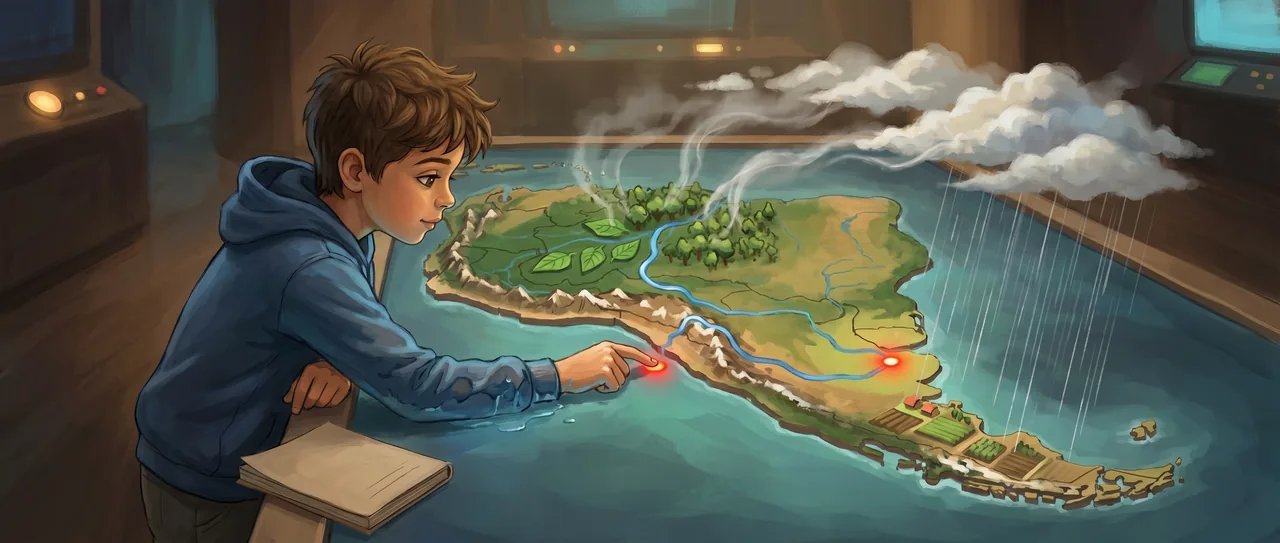
Rain fell indoors over a forest no taller than Soren’s knee.
It tapped on glass leaves, darkened tiny riverbeds, and ran in silver threads down the slopes of a model mountain range. Soren stood with one hand under the warm drizzle. The water smelled faintly of soil and plastic roots.
Thirty-six minutes earlier, he had been completely wrong.
The climate table filled the center of the museum’s Rain Hall. It was shaped like South America, from the green bulge of the Amazon to the long pale edge of the Andes and down to the wide mouth of the Río de la Plata. Above it hung a clear ceiling full of mist nozzles, lights, fans, and sensors. Under the glass, blue lines showed rivers. Red dots showed cities. Yellow patches showed farms waiting for rain.
Soren’s red dot was Buenos Aires.
The curator wore a silver raincoat even though the hall was dry. Her wrist kept chirping with messages. A group from the city council was arriving soon, and one of the fans over the Atlantic had begun making a noise like a trapped bee.
“The challenge is simple,” the curator said, though she sounded as if nothing was simple that morning. “Bring rain to the southern farms without flooding the coast. The ocean is the source, so begin there. I’ll be back after I convince a fan to behave.”
She hurried away, tapping at her wrist.
Soren looked at the table. The Atlantic side glowed blue. That made sense. Oceans were huge. Rain came from water, and the ocean had the most water. Forests were green places that got rained on. They were not the beginning.
He opened his paper notebook.
A child near the doorway said, “They still let you bring those?”
Soren did not answer. He wrote: Trial one, more ocean heat.
He slid the Atlantic warmth control upward. The blue water brightened. Mist lifted from the ocean edge. Clouds formed, rolled west, and burst almost immediately over the coast. The coastal lights flashed flood-warning purple. The southern farms stayed yellow.
Soren wrote: Rain too soon.
He lowered the warmth and pushed the wind control harder. Clouds ran farther inland, thin and fast. They crossed the eastern forest, broke apart, and vanished before reaching the farms.
He wrote: Clouds die over forest?
That did not make sense. Forests were wet. A wet thing should help a cloud, or at least not eat it.
He tried again with more ocean and less wind. Flood. He tried less ocean and more wind. Nothing. He tried a cooler coast. The clouds sulked in gray strips and dropped rain in the wrong place.
The other children drifted toward the robot pollinator exhibit, where mechanical bees zipped through orange flowers. Soren stayed with the failed sky.
On the north side of the table, there were removable forest tiles. Some were deep green and crowded with miniature trees. Some were pale brown, printed with roads and square fields. The instruction card said visitors could compare land choices.
Soren frowned at the Amazon.
If trees drank water, then fewer trees should leave more water for the air to carry south. It was an ugly thought, but the table did not care whether a thought was ugly. It only cared what happened.
He lifted three green tiles and replaced them with pale ones.
The mist over the forest thinned.
The clouds from the Atlantic crossed the first brown patch and fell apart faster than before. The yellow farms at the bottom of the table blinked darker, as if the soil had become thirstier.
Soren stared.
He put the green tiles back.
The mist rose again, not from the ocean, but from the forest.
Not much. Just threads of white, thin as breath on a cold window. They lifted from thousands of tiny leaves. The table lights caught them, and the threads joined the ragged clouds that had come from the Atlantic. The clouds thickened. A few drops speckled the upper forest.
Soren bent close enough that his hair touched the glass rim.
Each green tile had a clear cover over one corner, like a tiny greenhouse. Inside one cover, droplets had gathered on the plastic above the leaves. The soil below was damp, but the drops were on the roof.
He touched the cover. Warm.
The label beside it was small, the kind most people passed because the big moving clouds were louder.
Leaves release water vapor through tiny pores. Forests return water to the air. Forest particles can help cloud droplets begin.
Soren read it twice, then looked back at the map.
He did not move the ocean control.
He moved one forest tile.
Then another.
Not all in one place. That had failed with the ocean, too much at the edge. He made a ragged green path across the Amazon where the wind arrows were already pointing. Atlantic cloud came in low. Forest breath rose to meet it. Rain fell on the first trees. More mist lifted from beyond them. The next cloud formed a little farther west.
It did not travel like a bucket being carried.
It traveled like a message being repeated.
Soren’s pencil moved quickly.
Rain here, then vapor. Rain there, then vapor. Again. Again.
The cloud line reached the Andes and bent south along the mountains. The fans hummed overhead. The farm lights shifted from yellow to pale green.
Then the table flashed red around one brown patch.
Soren stopped.
A gap. Not huge. Just a broken place in the forest path. The cloud line frayed there every time, like thread pulled across a nail.
He tried to force it with wind. The cloud scattered.
He tried to force it with ocean heat. The coast flooded again.
He took back the controls and placed one green tile into the gap.
Mist lifted.
The cloud held together.
The first drop struck the southern farms with a sound so small he almost missed it. Then another. Then the clear ceiling opened above the table, and rain began to fall over the miniature fields two thousand miles from the forest that had helped make it.
Soren put his hand under the indoor rain.
The curator came back holding a fan part in one hand. Her silver raincoat was crooked.
“Oh good,” she said. “You found the setting.”
Soren shook his head.
She looked at the table. The ocean control sat nearly where it had started. The forest tiles made a green, uneven chain. The rainfall display pulsed over the southern farms.
The curator’s mouth opened, then closed. She set the fan part down very carefully.
“That gap,” Soren said. “When it was brown, the rain stopped traveling.”
The curator leaned closer. For the first time that morning, her wrist chirped and she ignored it.
“That is the live-data mode,” she said.
Soren looked at her.
“I thought I had switched it to the lesson version.” She tapped the table once. The map changed. Numbers appeared beside the wind arrows. Dates. Satellite passes. Soil moisture. A warning line blinked over a section of forest far to the north.
The robot bees buzzed in the next room. Children laughed. The Rain Hall fans hummed above Soren’s wet sleeve.
The curator whispered, “That patch is real.”
Soren looked from the blinking forest to the red dot where his city waited at the bottom of the map.
On the glass map, a blue line uncurled from the Amazon, bent along the mountains, and reached the red dot marked Buenos Aires. Soren put his wet fingertip on the dot.
Read the interactive version, listen to the narration, and earn a gold star →
A science-verified short story for curious kids · Curiosity Land