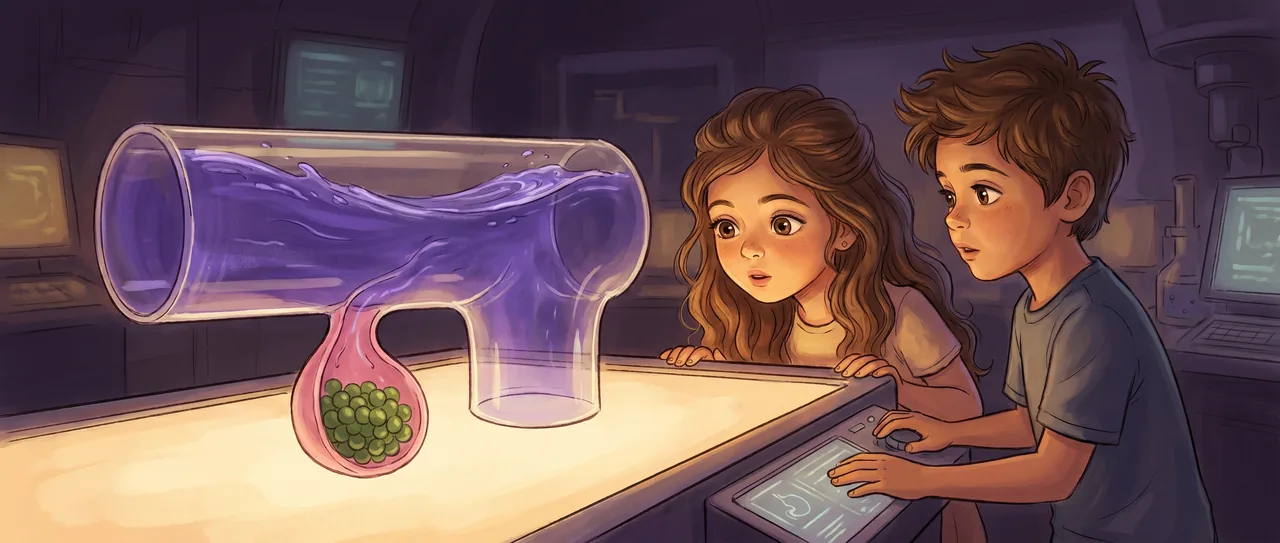
The Quiet Pocket
The first thing they did was throw away the appendix.
It was small, pink, and dangled from the clear plastic cecum like a worm that had forgotten to leave. In the design bay of the orbital medical museum, every part of the model gut had a cost in grams. Soren read the numbers from the glowing table while Maya snapped tubes into place.
"Appendix," Soren said. "Three grams in the model. No main flow. Old tag says optional."
"Optional is suspicious," Maya said.
The exhibit tech was across the room with a coil of tangled sensor cord around one elbow and a badge between her teeth. She took the badge out and said, "For the quick challenge, skip it. You are building a recovery gut, not a history lesson."
Maya held the tiny pouch up to the light. It had one narrow opening and one blind end. Nothing went through it to get anywhere else.
"Dead-end room," she said.
"Dead-end rooms cost air on ships," Soren said.
He put the appendix in the reject tray.
The table accepted their gut with a cheerful tone. Transparent stomach. Looped small intestine. Wide colon. Everything neat, everything flowing in one direction. Soren liked that part. The body made more sense when it behaved like plumbing.
Green gel beads swirled into the model. The sign called them friendly microbes. Not real ones, the sign said, just stand-ins. In a real gut, living bacteria clung to mucus and folds and helped with digestion, immune signals, and keeping troublemakers from taking over.
The green beads settled along the walls of the colon in a soft mossy line.
"Good garden," Maya said.
The table chimed. A violet wave rushed through the tubes.
"Gut infection event," said the exhibit voice. "Severe diarrhea. Microbiome disrupted. Begin recovery."
The violet wash tore through the clear colon. Green beads lifted, spun, and vanished into the waste port. The gut went shining clean.
Too clean.
Maya leaned closer until her breath fogged the shield.
Soren started the recovery timer. The screen drew a flat line. A few green beads crept in from the food input, but they were scattered and lonely. The timer flashed red.
Recovery incomplete.
"Maybe we need more food," Soren said.
Maya was already shaking her head. "Food is not a person."
"The beads are not people."
"They are acting like people. They need other beads."
Soren looked at the empty colon. He looked at the reject tray.
The appendix lay there, uselessly curled.
The tech came over, still wrestling the sensor cord. "If it stalls, use the probiotic refill. Blue button."
Soren did not press it.
"That is outside help," he said.
"It is a museum model," the tech said. "It likes outside help."
Maya picked up the appendix again. "What if it needs inside help?"
The tech glanced at the pouch. "That thing? People live fine without them. Mostly. Also they get infected sometimes and then surgeons are very glad to remove them."
"Mostly is a loud word," Maya said.
The tech opened her mouth, but a wall panel beeped behind her. She hurried away, muttering, "Do not flood the colon. The janitor hates that."
Soren took the pouch from Maya. Its little opening was no wider than his fingernail. At school, the main hallway after lunch sounded like a river. Soren always used the side stair near the storage closet, the one that went nowhere useful unless you knew where it let you breathe.
He fitted the appendix back onto the model.
"Wrong answer first," he said. "Now test the wrongness."
Maya grinned. "Load it."
They restarted. Green beads flowed through the gut. Most swept into the colon, clinging to the wide wall. Some drifted through the narrow neck into the appendix. There, the current slowed. The beads bumped gently against the blind end and stayed.
Soren tapped the flow control down, then up. The colon beads rippled. The appendix beads barely moved.
"Quiet water," Maya said.
"Protected pocket," Soren said.
He ran the violet infection event again.
The wash roared through the main tube. The colon went bare. The waste port flashed green as beads were swept away. But inside the appendix, in the little room off the main rush, a cluster of green remained pressed together like seeds in a pod.
Maya did not speak.
Soren did not either.
The violet faded. Clear nutrient fluid began to move again. One green bead slipped from the appendix opening into the colon. Then another. Then six. They caught on the wall where the old mossy line had been. More followed.
The red recovery timer turned yellow.
Then green.
The table made a sound like a small bell underwater.
The tech looked over. "You used the refill?"
"No," Soren said.
Maya pointed. "It had a hiding place."
The tech came closer. Her sensor cord trailed behind her like a tail. She watched the appendix emptying slowly into the main gut.
"Oh," she said.
It was a better sound than a lecture.
Soren pulled up the model history, not because the answer was there, but because the answer had started making the screen feel too small. A real scan appeared. Human abdomen. Cecum. Appendix. Beside it, a chart of recovery after serious gut infections.
The words were plain. For a long time, many people had called the appendix vestigial, a leftover. Newer studies suggested it could help shelter beneficial bacteria in biofilms, so they could repopulate the intestine after illness. People and populations without appendixes could take longer to recover from certain gut infections.
"They called it leftover," Maya said.
Soren touched the tiny pouch on the model. The green beads inside were almost gone now, not because they had been lost, but because they had returned.
Under his palm, his own belly was warm. Under the warmth were folds and fluids and dark passages he never saw. Not empty passages. Not just him. A crowd so small it could live in mucus. A crowd that helped make him himself, kept partly safe by a room most diagrams had once shrugged at.
The universe did not get bigger by moving away. Sometimes it got bigger by turning inward.
Maya was staring at the wall beyond the gut model. A long ship diagram floated there, meant for older visitors. Closed-loop farms. Water recovery. Waste composting. Microbial processors. All the living systems a ship would carry because humans were not separate from their invisible helpers.
"That ship has guts," Maya said.
"Not human guts," Soren said.
"Still living systems with useful microbes."
Soren looked at the farm loop. It was drawn as one smooth pipe.
Too smooth.
He opened the ship-editing menu. The table warned him that this display was not part of the quick challenge.
Maya said, "Good."
They added a small side chamber to the farm loop, then another to the compost loop. Not big. Not in the main flow. A place where a rush, a cleaning cycle, or a mistake would not take everything at once.
The tech stood behind them. "Those are not in the standard diagram."
"The standard diagram threw away the appendix," Maya said.
Soren adjusted the opening of the smallest chamber until the green bead flow slowed inside it.
On the display, the habitat grew a tiny new chamber beside its long green farm pipe. Soren pinched the valve open, and the first flecks of green moved from the quiet pocket into the rushing line.
Read the interactive version, listen to the narration, and earn a gold star →
A science-verified short story for curious kids · Curiosity Land