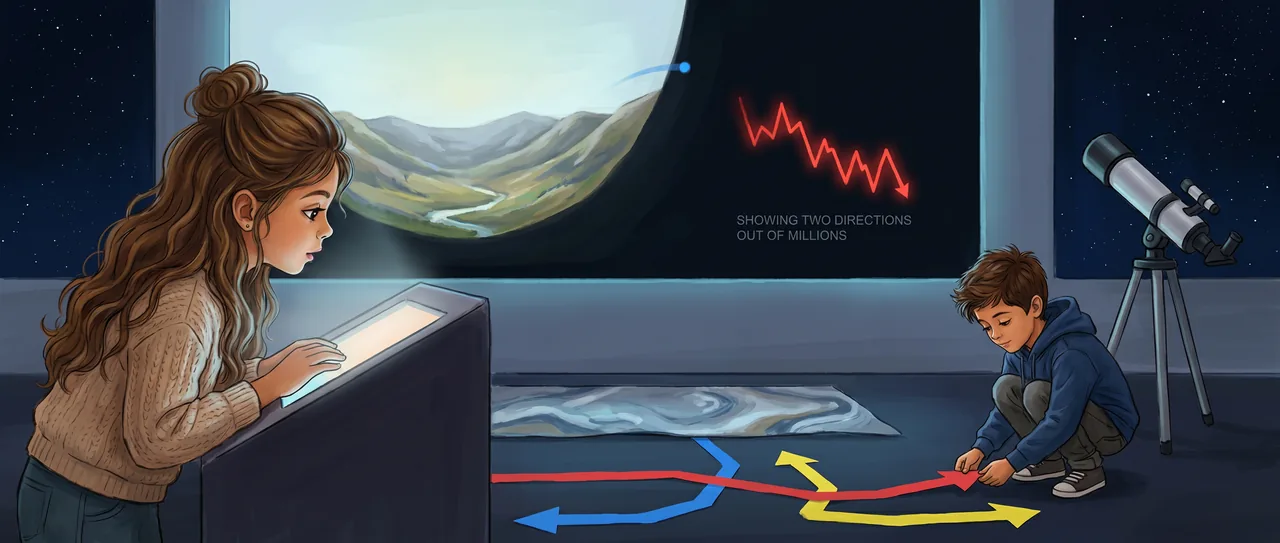
The Part of the Hill Nobody Drew
The telescope on the table was fake, but the trouble was real.
It was made of silver plastic and had a little blinking eye at the end. Behind it, on the wall of the Future Hall, galaxies spilled across a screen like flour thrown into black water. Some were spirals. Some were smooth glowing smudges. Some looked like someone had sneezed stars.
The program was supposed to learn which was which.
Instead, it called every galaxy a spiral.
“Spiral,” said the speaker.
A round yellow galaxy appeared.
“Spiral,” said the speaker.
A long fuzzy streak appeared.
“Spiral,” said the speaker.
Maya leaned closer. “It is being stubborn.”
Soren had already opened his notebook, not because anyone had asked him to, but because the word spiral was beginning to sound less like a word and more like a symptom. “Or it is being pushed.”
Dr. Keene, who ran the hall, stood under a half-attached banner that said TOMORROW LEARNS TODAY. A strip of tape hung from her sleeve. “It worked this morning,” she said. “Mostly. I can restart it before the tour comes in.”
“Restarting is not fixing,” Maya said.
Dr. Keene blew hair out of her eyes. “Restarting is sometimes fixing when thirty people with juice boxes are arriving in six minutes.”
On the control screen, a red number blinked.
LOSS: high
Below it was a jagged line, not going down, not going up, but leaping like a flea.
Soren pointed. “It got better there. Then worse. Then better. Then worse by more.”
Maya watched the next galaxy appear. The program shouted spiral before the image had even finished loading.
“Too fast,” she said.
Dr. Keene frowned. “Fast is the point. We are showing learning in real time.”
“No,” Maya said. “Too fast like missing a step.”
Soren looked at the controls. There were labels for training images, batch size, weights, loss, and one slider near the bottom.
STEP SIZE
It was dragged almost all the way to the right.
Soren tapped the screen beside it, not touching yet. “If it is walking downhill, this is how long its legs are.”
Maya grinned at him. “Long stupid legs.”
“Possibly,” Soren said. “We should make them less stupid.”
Dr. Keene glanced toward the hall doors. Children’s voices were already gathering on the other side. “Carefully. Please carefully. This model has three million, two hundred thousand, and some weights, and I do not have time to rebuild it if you turn it into soup.”
Maya went still.
“Say that again,” she said.
“The soup part?”
“The weights part.”
Dr. Keene sighed. “Three million and change. Tiny numbers inside the network. They shift during training.” She waved one hand at a painted floor mat beside the table. It showed a cheerful blue marble rolling into a simple valley. “The exhibit version is easier. Here is a hill, there is the bottom, the marble rolls down.”
Maya looked at the mat. One neat valley. One neat bottom. One blue marble wearing a smile.
Then she looked at the screen full of galaxies.
“That floor is lying,” she said.
“It is simplifying,” said Dr. Keene.
“It is lying politely.”
Soren’s pencil had stopped moving. He stared at the words on the control screen.
Three million, two hundred thousand, and some weights.
He had drawn hills before. He had drawn valleys. He had drawn maps with contour lines and tiny arrows. But a map needed up and down, left and right, maybe forward and back if he was feeling brave. Three million directions did not fit in his notebook. They did not fit in the hall. They did not fit behind his eyes.
The red loss number blinked again.
Higher.
Maya said, “Move it smaller.”
Soren did not move. “Wait.”
The next image appeared. Smooth galaxy. Spiral, said the program.
Soren watched the loss jump.
“It is not choosing spiral because it likes spirals,” he said. “It is changing all those numbers after each batch. It tries to go downhill, but the step is so big it jumps across the low part.”
“So move it smaller,” Maya said.
“One test,” Soren said.
He took the blue marble from the painted mat and placed it at the edge of the valley. He flicked it gently. It rolled down and stopped near the middle.
Then he put it back and shoved it hard. The marble shot across the valley, climbed the other side, hit the metal rim, and bounced out onto the floor.
Maya picked it up before it rolled under the telescope.
“Long stupid legs,” she said.
Soren moved the step-size slider left. Not all the way. Halfway, then a little more, because being careful was not the same as being timid.
Dr. Keene winced as if the screen might cough smoke.
The next training batch ran.
The loss number dropped.
No one spoke.
Another batch.
It dropped again.
The speaker said, “Smooth.”
The galaxy was smooth.
Maya slapped both hands over her mouth, then lowered them. “Again.”
The next one was a spiral. The program said spiral. The one after that was smooth. Smooth.
From the hall doors came the sound of a teacher saying, “Stay together, please. No, the drinking fountain is not an exhibit.”
Dr. Keene stared at the graph. “Oh,” she said. “That is annoyingly beautiful.”
The loss line kept sinking, but not like the painted valley. It wobbled. It flattened. It took sudden slanting turns. The blue point on the display did not roll neatly toward the center of anything. Sometimes, on the picture, it seemed to go sideways. Once it even moved up.
Soren stiffened. “It went uphill.”
Maya looked at the red number. “No, it did not.”
“The point did.”
“The number did not.”
Soren leaned in until his nose was almost touching the glass. In the corner of the display, small gray words read:
SHOWING TWO DIRECTIONS OUT OF MILLIONS
He said nothing for a moment.
Maya read the words too.
On the screen, the blue point slid upward across the drawn valley while the loss number fell again.
“Oh,” Soren said softly. “The picture is the flat thing.”
Maya turned to the painted mat. “That one is even flatter.”
Dr. Keene pulled the tape from her sleeve and accidentally stuck it to her other sleeve. “We usually do not mention the millions of dimensions during the children’s tour.”
“Why not?” Maya asked.
“Because then someone asks what a million-dimensional hill looks like.”
Soren looked at the moving blue point. “Good.”
The tour came in as a wave of sneakers and damp raincoats. Dr. Keene stepped forward with her bright hall voice, but Maya had already dragged the painted mat halfway behind the table.
Dr. Keene paused. “We need the valley.”
“No,” Maya said. “We need the lie less.”
Soren took three rolls of colored tape from the repair cart. He made a crooked arrow on the floor, then another arrow that turned, then another that nearly doubled back. Maya placed galaxy cards along the table, some labeled, some waiting. The screen showed the loss line descending in uneven red teeth.
A small boy in a green coat pointed at the blue point. “Why does it go that way if the bottom is over there?”
Maya said, “Because over there is only what the wall can draw.”
Soren said, “The program has more directions than the wall has.”
The boy frowned, but not like he was bored. Like his forehead needed more room.
Dr. Keene opened her mouth, closed it, and then said, “Mathematicians are still figuring out why this works so well when the hills have so many directions.”
That made the room quieter than the fake telescope had.
On the screen, the program met a galaxy with a bright bar across its middle and curling arms at both ends. It hesitated long enough that the speaker made a small click.
“Spiral,” it said at last.
The answer flashed green.
The children crowded nearer.
Maya did not watch their faces. She watched the loss number, which had not reached zero. Not even close. It had found somewhere lower, not the end of everything.
Soren touched the step-size slider. “Smaller?”
Maya looked at the crooked tape arrows on the floor, the hidden mat, the galaxies waiting their turn.
“Smaller,” she said. “But not stopped.”
Soren nudged the slider left by the width of a fingernail.
On the wall, the little blue point slid off the drawn bowl and kept moving through the dark margin where no grid had been painted.
Read the interactive version, listen to the narration, and earn a gold star →
A science-verified short story for curious kids · Curiosity Land