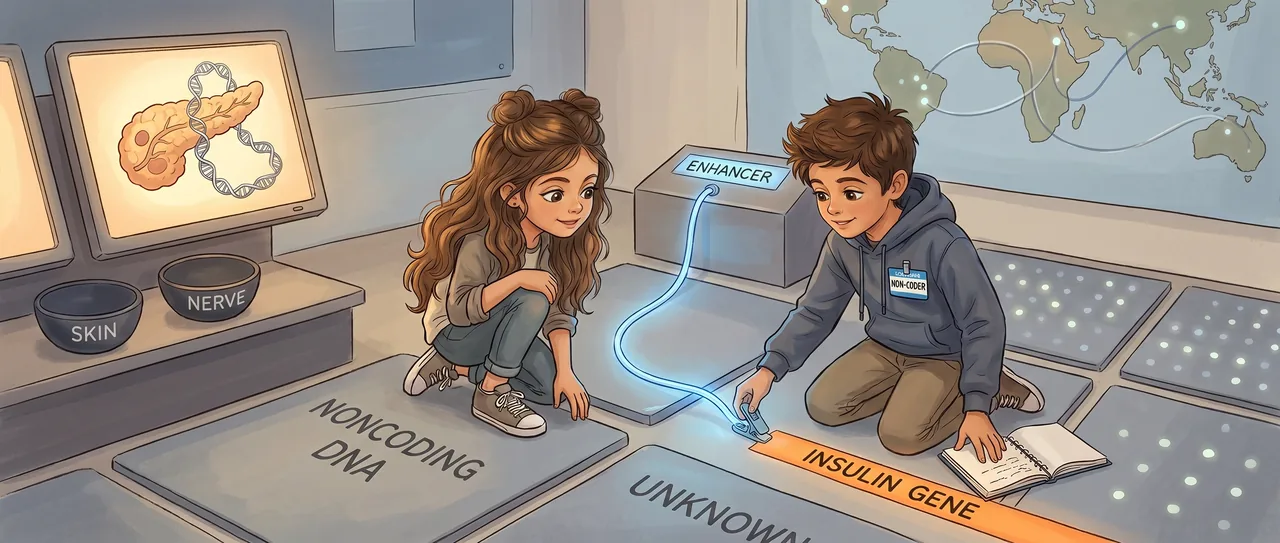
The Gray Part
The sign over the gray floor said NONCODING: PLEASE STEP AROUND.
Maya stepped on it immediately.
Nothing beeped. Nothing broke. The gray tiles only gave a soft plastic click under her sneaker, one after another, as if the floor had been waiting all morning for someone rude enough to use it.
Soren stood at the edge with his blue volunteer badge hanging crooked from his shirt. The badge said NON-CODER in block letters. His notebook was already open, because the hall was full of things that made the inside of his head feel crowded.
The exhibit manager hurried past carrying a coil of fiber-optic cable over one shoulder. She had silver dust on one sleeve and the expression of a person who had slept near a toolbox.
“Please don’t step on the gray,” she said. “The orange islands are the protein-coding parts. That’s where the action is.”
Maya looked down. Orange tiles made bright little chains across the floor. The gray went on and on between them, across the room, under glass bridges, around display cases, all the way to the far wall.
“There is more gray,” Maya said.
“Much more,” said the manager. “The human genome has about three billion base pairs. Only about two percent codes for proteins. We open in twelve minutes, and the pancreas station is still misbehaving.”
Soren wrote: two percent orange.
Maya bent and touched a gray tile with one finger.
The manager made a tiny sound, not quite a groan. “Careful. Some of the labels are old. We were supposed to replace the junk DNA ones before the school groups arrived.”
“Junk?” Soren asked.
“Old nickname,” said the manager. “Bad nickname. Please do not make that face at me. I know it’s bad.”
At the far end of the hall, the pancreas station chimed sadly.
On its screen, a cartoon cell drooped like a wet balloon. Above it, red words flashed: TOO MANY GENES ACTIVE.
The manager dropped the cable, slapped both hands over her face, and said through her fingers, “It has one job. One friendly, colorful, grant-funded job.”
Maya was already walking toward it.
The station had three glass bowls labeled SKIN, NERVE, and PANCREAS. In each bowl floated the same curled silver thread, a model of DNA. Beside them was a tray of orange magnetic strips with gene names printed on them. INSULIN was the largest strip, shiny and new from being handled too much.
“The players choose the insulin gene,” the manager said. “Pancreas cell makes insulin. Simple. Beautiful. Except now every cell keeps trying to make everything.”
Soren picked up the insulin strip. “Do skin cells have this gene too?”
“Yes,” said the manager, impatiently. “Nearly all your cells have the same genome. Different cells use different genes. But for the exhibit, I simplified.”
Maya looked at the three bowls. Same silver threads. Different labels.
“Too simple,” she said.
The manager checked the clock above the entrance. “I have to fix the welcome projector. Do not rewire anything. Do not pry anything up. If the station screams, press the red button.”
She left at a fast walk.
Maya pressed no buttons. Soren did not pry. They both leaned so close to the pancreas screen that their foreheads almost touched the glass.
The instructions said: BUILD A PANCREAS CELL. CHOOSE THE PROTEIN-CODING GENE.
Maya placed INSULIN beside the pancreas bowl.
The cartoon cell brightened. Then the skin bowl flashed. Then the nerve bowl flashed. The sad chime played again.
TOO MANY GENES ACTIVE.
Soren moved the strip away and tried again, slower. Same chime. He tried the skin bowl. Same chime. He tried no bowl at all. The screen flashed: NO EXPRESSION.
“Expression,” he said. “Not having. Using.”
Maya had gone quiet. She was staring past the bowls at the gray floor. Some tiles had faint scratches around their edges, as if many hands had lifted them before the PLEASE STEP AROUND sign was added.
She crouched and pressed one.
A small panel rose with a whisper.
Under it lay a blue magnetic strip. It did not have a protein name. It said PROMOTER.
Soren’s pencil stopped.
Maya pressed another gray tile. ENHANCER.
Another. SILENCER.
Another, farther away, almost under the bridge. TRANSCRIPTION FACTOR BINDING SITE.
“They hid the controls in the part people step around,” Maya said.
Soren picked up the promoter strip. On the back, tiny text said: Helps start transcription near a gene.
He picked up the enhancer. Its back said: Can increase expression. May be far from the gene in the DNA sequence when DNA folds.
“Far from the gene,” he said.
Maya was already carrying the enhancer strip across the gray floor.
“No,” Soren said. “Wait. If it’s far in the sequence, it still has to touch somehow.”
He looked up.
Above the exhibit, flexible blue cables hung from the ceiling like sleeping vines. The manager’s abandoned coil lay nearby.
Soren clipped one end of a cable to the enhancer strip and the other to the insulin gene. The cable glowed faint blue.
On the screen, the silver DNA thread bent into a loop.
The cartoon pancreas cell lifted, round and bright.
The skin bowl stayed dark. The nerve bowl stayed dark.
No sad chime came.
Maya grinned at Soren, quick and fierce.
“Again,” Soren said.
They tested the skin bowl with the insulin gene and no pancreas controls. No expression. They added the promoter only. A flicker. They added the enhancer without the right bowl selected. Nothing useful. They clipped the silencer near another orange strip, and a red glow faded from the wrong place.
The station was not asking for the thing. It was asking for the where and the when and the how much.
The floor under them changed.
All across the hall, the gray tiles woke with small pale dots. Not all of them. Not even most. But enough that the gray stopped looking empty. Lines rose on the wall map, looping from distant gray regions to orange islands, skipping over long stretches, crossing like paths in a city seen from above at night.
Soren looked down at his badge. NON-CODER.
The same word was printed on the tiles under his shoes.
Maya did not look at her badge. She was following one blue line with her whole body, stepping over orange islands, ducking under a glass bridge, stopping where a gray tile blinked beside the word UNKNOWN.
The exhibit manager came back at a run. “Why is the genome map in advanced mode?”
“Because beginner mode was wrong,” Maya said.
Soren pointed to the pancreas station. “The coding gene was fine. The cell needed the switches.”
The manager stared at the bright pancreas cell, the quiet skin cell, the quiet nerve cell. Then she stared at the raised gray panels scattered around the floor.
“I told you not to pry,” she said.
“They opened when pressed,” said Soren.
Maya lifted the old plastic sign from its stand. NONCODING: PLEASE STEP AROUND.
Under it was another sign, still wrapped in clear film. NONCODING: LOOK FOR THE CONTROLS.
The manager took one look at it and laughed so hard she had to sit on the edge of the skin station.
The front doors opened. Voices filled the lobby. Shoes squeaked. Someone outside asked where the genome thing was.
The manager stood, wiped silver dust on her pants, and said, “Can you two run the first demonstration?”
Maya slid the new sign into place.
Soren gathered the promoter, enhancer, and silencer strips in both hands. He left the insulin gene on the tray until last.
The first visitors came in and stopped at the edge of the floor, where orange islands shone in a sea of gray.
Maya stepped onto the noncoding tiles.
Soren clipped a blue cable to a gray square far from every orange island.
Three small lights blinked in the gray, far from every orange island.
Maya reached down, and Soren’s finger landed beside hers on the first blinking square.
Read the interactive version, listen to the narration, and earn a gold star →
A science-verified short story for curious kids · Curiosity Land