The Empty Colors
By noon, Maya had ruined the rainbow three times.
The first rainbow had sixteen stripes, because the mantis shrimp in the next room had sixteen kinds of light-catching cells in its eyes and humans had three. Maya had used every marker in the aquarium classroom, even the squeaky peach one and the gray that smelled like old pennies.
It looked like a barcode that had fallen into fruit punch.
The second rainbow had arrows for polarized light. The arrows made it look like a weather map.
The third rainbow had a hidden ultraviolet section drawn in special paint. It stayed hidden until Maya shone the little violet flashlight on it. Then it glowed blue-white, which was beautiful for four seconds and wrong immediately after.
“That is very bright,” said the exhibit manager, rushing past with a bucket of fake coral and a walkie-talkie clipped backward to her belt. “Bright is good. Families like bright.”
“It is not what he sees,” Maya said.
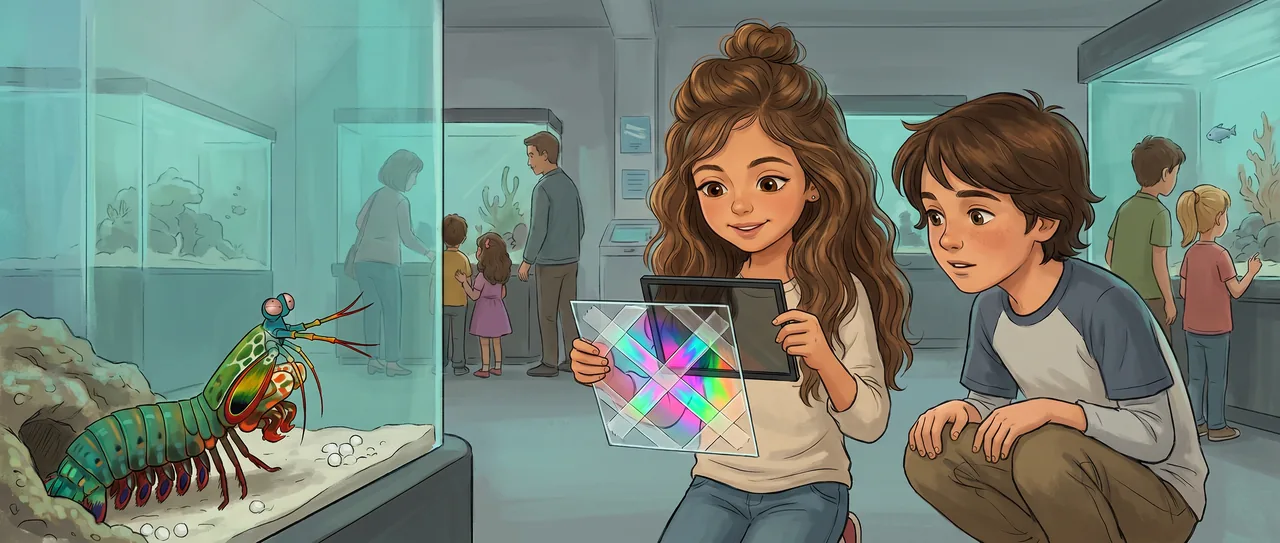
The exhibit manager glanced toward the next room, where the peacock mantis shrimp waited in a low glass tank. He was green and orange and blue, with eyes on stalks and front limbs folded like he was keeping a secret under each elbow.
“Nobody knows what he sees,” the exhibit manager said. “Just make them feel it.”
Then she hurried away, leaving a wet crescent from the bucket handle on the floor.
Maya looked at the ruined rainbows.
Make them feel it.
That was worse than being told to explain it.
On the table lay the supplies from the education cart: colored gels, a cracked magnifying glass, ultraviolet beads, two polarizing filters, a roll of clear packing tape, a dead phone screen someone had saved because science teachers saved broken things, and a stack of laminated cards that said Please do not tap the glass.
Maya picked up one polarizing filter and held it to the classroom window. Nothing much happened. The harbor outside became slightly darker. A gull on a post stayed a gull.
She put the second filter over the first and turned it.
The harbor vanished.
Not all at once. It dimmed, dimmed, dimmed, until the white sky went gray and the water went black and the gull became a cutout.
Maya turned the filter back. The world returned.
She did it again.
Gone. Back. Gone. Back.
“Not color,” she said.
The shrimp was not seeing a bigger box of crayons. Or not only that. There was another handle on light, and human eyes had no fingers for it.
Maya laid one filter flat on the table and stretched strips of clear tape across it. Tape over tape. Crossways. Slantways. A messy window made of nothing.
It looked empty.
She put the second filter on top and turned it.
Colors burst out of the clear tape.
Pink, blue, green, orange, all trapped inside the places where the tape overlapped. Maya stopped breathing for exactly as long as it took a bubble in the classroom sink to swell and pop.
The tape had been full the whole time.
The exhibit manager came back carrying a sign that said MEET THE OCEAN’S TINY BOXER.
“Please tell me you have a rainbow,” she said.
“I have something better than a rainbow,” Maya said.
“That sounds expensive.”
“It is tape.”
“That sounds possible.”
Maya held up the filters. The exhibit manager leaned in, tired and doubtful. Maya turned the top filter slowly. The empty tape flashed into colors.
The exhibit manager’s mouth opened.
“Is that safe?” she asked.
“It is tape.”
“Wonderful. Use the tape.”
She hurried off again, calling into the backward walkie-talkie, “No, not the octopus cupcakes near the touch tank. We discussed this.”
Maya did not make a poster.
A poster was one answer, flat and finished, and the mantis shrimp was a problem with too many doors.
She made stations.
At the first station, she placed three colored circles, red, green, and blue, overlapping in the middle. A small card said, Human eyes use three kinds of cones for color.
At the second station, she taped ultraviolet beads under a flap. In ordinary room light, they were dull white. Under the small ultraviolet flashlight, they blushed purple and blue. A card said, Some light is outside the colors humans can see.
At the third station, she built a spinner from the two polarizing filters and the dead phone screen. When the filters crossed, the bright screen turned black. When they lined up, it glowed again. A card said, Polarized light has a direction. Some animals can see it.
Then she made the fourth station and took the longest with it.
She used a clear sheet and layered tape on it in patterns that looked like accidents. She added a few colored gels and a row of ultraviolet beads. She slid the whole thing into a stand in front of the mantis shrimp tank, low enough for children to reach and high enough that nobody would poke the water.
Without tools, it looked almost blank.
With the ultraviolet flashlight, hidden beads lit up.
With the polarizing filter, clear tape became a storm of color.
With the red and blue gels, some colors disappeared and others sharpened.
No single view showed the whole thing.
Maya tried to imagine having all of those doors open at once. Not one after another, like a game. Not flashlight, then filter, then gel. All together. A world with extra handles. A world where blank places might be busy, where a plain flash off a shell might carry direction, where darkness to one animal might be a sign to another.
The mantis shrimp shifted in his burrow. His eyes moved separately, one toward Maya and one toward the room where people were beginning to gather. Each eye had bands across it, tiny and strange, as if someone had wrapped a telescope in striped ribbon.
The first visitors were a family with a little kid in shark shoes and an older kid who stood behind everyone else. The older kid did not touch the flashlight. He watched the other children turn the filter and say, “Whoa,” and “Do it again,” and “How is that there?”
Maya recognized the way he watched. Not bored. Not shy. Measuring the distance between wanting to know and wanting nobody to notice.
She held out the filter, not to his face, just into the space between them.
“You have to turn it slowly,” Maya said.
He took it.
At first he turned it too fast, and the tape flickered without becoming anything. Then he slowed. The clear sheet filled with colors that had not been colors a second before.
He looked up at the mantis shrimp.
“Does it see that all the time?” he asked.
Maya looked at the shrimp’s folded claws, the floating eyes, the body bright as a spilled paint box and stranger than any paint box.
“It has sixteen kinds of photoreceptors,” she said. “Some for colors we see. Some for ultraviolet. Some for polarized light. So not like this exactly.”
The kid kept turning the filter by tiny amounts.
“So this is a bad picture,” he said.
“Yes,” Maya said.
He smiled.
The exhibit manager appeared beside the tank with a tray of stickers and a worried forehead.
“Is ‘bad picture’ the official wording?” she asked.
“No,” Maya said. “The official wording is, ‘Your eyes are not wrong. They are just not the only way light can be sorted.’”
The exhibit manager looked at the line of children waiting for the filter, at the blank sheet becoming crowded in their hands, at the mantis shrimp watching from his burrow with one eye tilted up and one eye tilted down.
“That is too many words for a sign,” she said.
“Good,” Maya said.
The older kid handed the filter back, then did not leave. He crouched beside the tank instead. The mantis shrimp lifted one clubbed limb and set it down on the sand, neat and silent.
Maya lowered the polarizing filter in front of her own eye and turned it slowly.
On the clear sheet by the glass, a dark stripe flashed bright, vanished, then flashed again.
Read the interactive version, listen to the narration, and earn a gold star →
A science-verified short story for curious kids · Curiosity Land