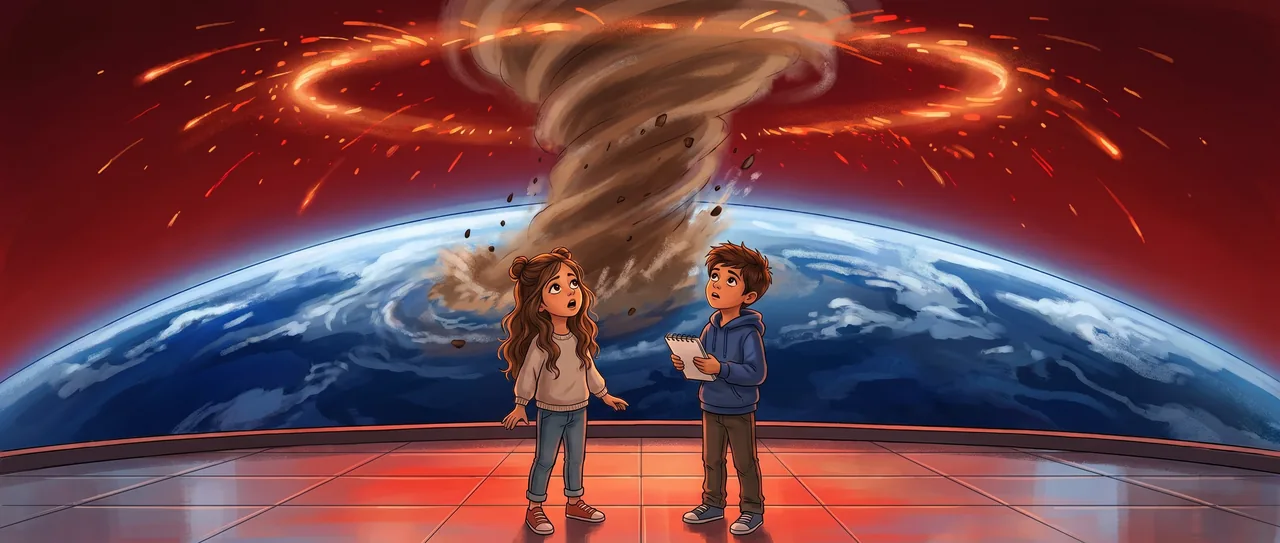
The Door Behind the Explosion
The rain was made of glass.
It came down out of a red sky in bright little streaks, too many to count, each one glowing for a blink before it vanished into the black floor of the simulator.
Maya stood very still. Soren did not. He crouched and put his palm near the floor without touching it.
“It skipped the asteroid,” Maya said.
“It skipped the crater too,” Soren said. “That seems like a strange choice for an impact exhibit.”
Above them, the museum dome flickered. A voice that was trying to sound grand said, “Sixty-six million years ago, a rock from space, about ten kilometers wide, struck what is now the Yucatán Peninsula with energy equal to ten billion atomic bombs.”
Then the voice stopped. The red sky froze. One glass bead hung in the air like a tiny orange star.
Dr. Ibáñez banged the side of the control pillar with the heel of her hand.
“Not again,” she said. She was the museum’s opening-day director, which meant her jacket had too many pockets and every pocket had a different problem in it. “The donors arrive in seventeen minutes. Children, if the room asks you anything, just choose crater. People understand craters.”
The frozen bead made a soft ticking sound, as if cooling.
Maya looked at the five silver tiles on the floor. Each tile had a word burned into it.
IMPACT.
ORBIT.
GLASS.
FIRE.
WINTER.
Soren took out his paper notebook. The security scanner had tried to recycle it twice when they came in.
“Why does a museum exhibit have a wrong answer?” he asked.
“Because someone from education insisted it should be interactive,” Dr. Ibáñez said. “And because someone from communications said the explosion should come first, which is obviously me. It is a very good explosion. Please press crater when it appears.”
“There isn’t a crater tile,” Maya said.
Dr. Ibáñez blinked at the floor as if the tiles had betrayed her personally.
From the wall, the grand voice returned, smaller this time. “Sequence incomplete. Choose the shape of the disaster.”
“That’s not asking where it hit,” Soren said.
Maya was already stepping onto IMPACT.
The dome woke.
For one breath, there was a white flash. Not like lightning. Lightning belonged to weather. This light belonged to stone becoming vapor. The floor leaped under their shoes. A circle of fire spread across a ghost map of the ancient Gulf of Mexico, wider and wider until the coastline disappeared inside it.
Then the dome froze again.
“Good,” Dr. Ibáñez said. “Excellent. Now it should show the crater.”
But the only tile glowing was ORBIT.
Maya stepped back. “It wants the next thing.”
Soren wrote one word and underlined it. “Why orbit?”
“Rock went up,” Maya said.
“Lots of rock goes up in impacts. But orbit means around Earth.”
“Not forever,” Maya said. “Long enough.”
She stepped onto ORBIT.
The ceiling vanished.
Above them, the planet curved away, blue and white and terribly round. A brown plume rose from one spot on its surface, punched through the atmosphere, and spread outward into space. It was not smoke. It was Earth, lifted. It was seafloor, limestone, granite, living coast, and blasted bedrock, thrown high enough that the whole planet looked small underneath it.
Soren forgot to write.
Maya’s mouth opened, but nothing came out.
The plume became a ring. The ring became countless sparks moving around Earth in thin paths, not neat, not peaceful, all of them coming back.
The room dropped them under the red sky again.
The glass rain continued.
This time Soren did not crouch. He looked up.
“They fell everywhere,” he said.
“Like the sky was grinding its teeth,” Maya said.
On the wall, a display opened. Inside it sat a tray of tiny brown beads, each smaller than a seed. A label waited below them, blank.
Dr. Ibáñez had stopped hitting the control pillar.
“They are called spherules,” Soren said. “Melted droplets. They cooled into glass.”
“How do you know that?” Dr. Ibáñez asked.
“They were in the preparation reading.”
“There was preparation reading?”
Maya stepped onto GLASS.
The red deepened until the room looked as if it were inside an oven. The beads rained down through the air, not touching leaves, not touching ferns, not touching the backs of small running animals, and still everything brightened. Heat arrived from above. Forests appeared in strips across continents, and each strip began to burn.
No monster chased anything. No giant foot crushed anything. The sky did the terrible work without having hands.
The dome froze with FIRE glowing under Maya’s left shoe.
Soren swallowed. “That part is not the crater.”
“No,” Maya said. “That part is the whole sky.”
Dr. Ibáñez’s wrist screen chimed three times. She looked at it, then at the burning forests, then at the door.
“I have to stop a caterer from putting comet-shaped ice in the coffee,” she said. “Do not break the Cretaceous.”
She ran out.
For a few seconds, the only sound was the tiny hiss of simulated flames.
Soren looked at the last tile.
WINTER.
“But fire is hot,” he said.
“After,” Maya said.
“After what?”
She did not answer. She was looking at the display cases beyond the dome. The big one held a cast of a dinosaur skull with teeth as long as bananas. The small one beside it held a slice of rock behind glass. A narrow dark line ran through the rock, thinner than the edge of Soren’s notebook.
Maya walked out of the dome. The simulation complained softly, then let her go. Soren followed.
The label on the rock slice said: Boundary clay, found far from the crater. Contains impact spherules, soot, and unusual amounts of iridium.
Soren put his finger in the air, lining it up with the dark stripe without touching the case.
“That is the same disaster,” he said.
Maya moved to the next case. Another rock. Another dark line.
Italy.
New Zealand.
Colorado.
Tunisia.
The lines were not exactly the same thickness. Some were wavy. Some were broken. Some had pale stone above and dark stone below, or dark above and pale below. But the line kept returning, in pieces of Earth that had never been neighbors.
Soren opened his notebook, then closed it again because the page looked too small.
Maya tapped the glass beside the tiniest line. “The dinosaurs got the huge part. Teeth. Bones. Museum middle.”
“Except birds,” Soren said.
“Except birds,” Maya said. “But this got the answer.”
The dome called again. “Sequence incomplete.”
They went back in.
Soren stood on FIRE. Maya stood beside WINTER, but did not step yet.
“If soot went up from the fires, and dust from the impact, and sulfur from the rocks,” Soren said, “sunlight would have trouble getting through.”
“For years,” Maya said.
“Plants first.”
“Then everything that needed plants.”
Soren looked at the frozen flames. “Not one day.”
Maya stepped onto WINTER.
The fire vanished.
Darkness arrived without night sounds. No crickets. No frogs. No leaf-shiver. A sun hung overhead as a pale coin behind a dirty window. Snow did not fall, but the world looked cold anyway. Ferns curled flat against the ground. The ocean surface dimmed from blue to iron.
The grand voice spoke very quietly now.
“After the impact, debris and gases in the atmosphere blocked sunlight. The cold, dark years that followed are sometimes called an impact winter.”
Soren looked up at the pale coin of the sun.
Maya whispered, “The explosion was only the knock.”
The dome did not freeze this time. The five tiles sank into the floor, and a new doorway opened in the black wall where no doorway had been before.
Dr. Ibáñez burst in holding a comet-shaped ice cube in a napkin.
“You fixed it,” she said.
Maya pointed through the new doorway. “It was behind the explosion.”
The doorway led not to another theater, but to a narrow room with no seats. In the center stood a microscope taller than Soren. Beneath its lens, one glass spherule sat in a clear dish.
Behind it, a window looked into the asteroid tracking center. People moved between bright screens. No one ran. No alarms flashed. On one wall, pale dots crossed a black map of the inner solar system, each dot with numbers beside it, each number being watched by someone.
Dr. Ibáñez looked through the doorway and lowered the melting comet ice.
“Oh,” she said. “That room was supposed to open after the speech.”
Soren bent to the microscope. The bead under the lens was not smooth. It had bubbles trapped inside it, tiny sealed circles from a day when stone had flown higher than weather.
Maya looked past him, through the window, at the moving dots.
The live sky map refreshed.
A new white dot blinked into the corner, smaller than the period at the end of a sentence, and Maya set one fingertip on the dot that had no name yet.
Read the interactive version, listen to the narration, and earn a gold star →
A science-verified short story for curious kids · Curiosity Land