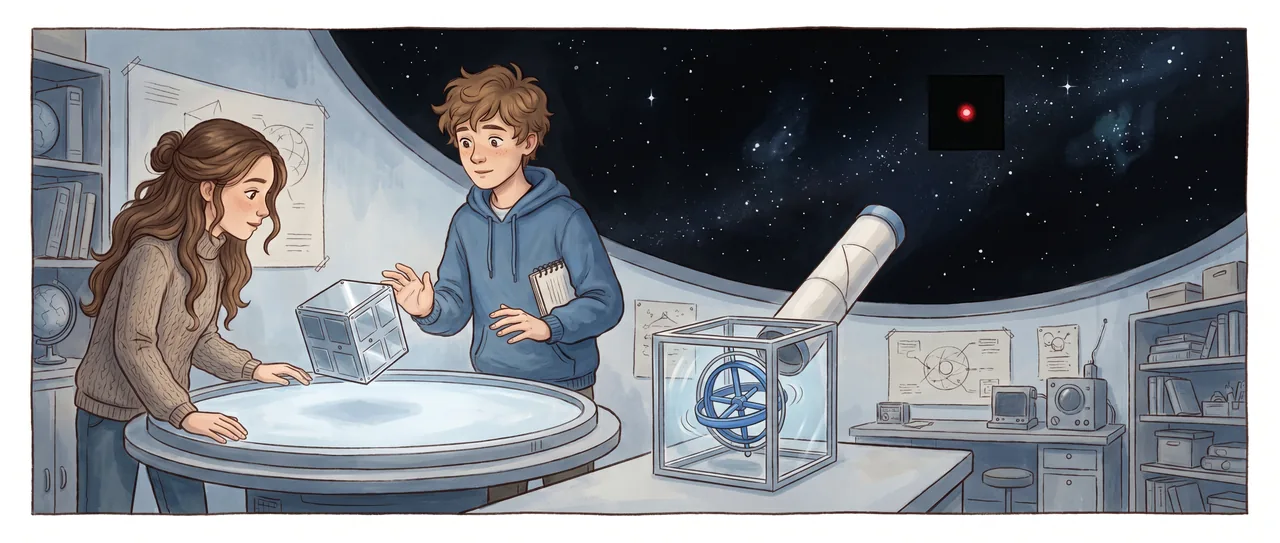
The Direction That Would Not Move
The black square on the planetarium dome was supposed to stay black for one whole minute.
It lasted seven seconds.
Then the square smeared sideways, the pretend star field slid after it, and the little telescope on the air table began to turn with the sad, slow wobble of a shopping cart wheel.
Soren counted under his breath until the smear reached the edge. He did not write anything down yet. If he wrote down every failed thing immediately, his notebook would become too heavy to lift.
Maya leaned over the round table, close enough that her hair stirred in the cushion of air hissing from the holes. The satellite trainer floated on it, silver and boxy, with a paper tube for a telescope and a laser pointer taped inside.
"Again," she said.
"That was the fourth again," Soren said.
"Fourth is not a kind of done."
Across the room, Dr. Venn was elbow-deep in a cabinet beneath the projector. She had silver glasses on top of her head and another pair on her face, which made her look as if she had prepared for two different emergencies and chosen both.
"If it drifts, it is calibration," she called without looking up. "Do not touch the red drive motors. I need this ready before the families come in."
"What about the blue thing?" Maya asked.
"If it is blue, it is probably educational," Dr. Venn said. "Be gentle with education."
The blue thing was a heavy wheel inside a clear plastic cage, mounted on an axle that could point different ways. A label on the cage said, A spinning gyroscope resists changes to its axis of rotation. Gyroscopes help spacecraft know and hold direction. Hubble can point with a precision like aiming at a human hair at arm's length.
Maya read the label once, too fast, then looked at the wheel.
"It is not spinning," she said.
"The software was supposed to hold the target," Soren said.
Maya flicked the cage lightly. The whole satellite trainer turned, lazy and free.
"Software can only tell it what it did wrong after it already did it," she said.
Soren considered this. He liked sentences that could be tested. He pressed one finger against the paper telescope and gave it the smallest push he could manage. The trainer obeyed him completely. The black square on the dome slid away.
"It has no stubbornness," he said.
Maya grinned. "Make it stubborn."
There was a pull cord looped beside the blue wheel. Soren wound it into the groove, careful not to cross the string over itself. Maya held the cage steady. He pulled.
The wheel hummed.
It was not a loud sound. It was a tight sound, like a bee trapped inside a button.
Maya reached to twist the cage upright.
The wheel answered.
It did not move the way her hands asked. It pushed back sideways, smoothly and impossibly, as if the room had turned slippery in one direction only.
Maya let go.
"No," she said, delighted.
Soren put both hands near it but did not touch. "Do that again. Slower."
She tried. The axle that should have tilted down swung around instead. Not falling. Not staying. Going somewhere else.
"I pushed it this way," Maya said, showing the motion with her wrist.
"It moved that way," Soren said, pointing at a right angle.
"Rude."
"Consistent rude."
They both watched the humming wheel. The satellite trainer drifted quietly under it, ignored.
On the wall above the tool cart, a poster showed the Hubble Space Telescope against black space, its silver body and gold panels sharp as folded paper. Under it were photographs, not drawings, of things that looked too large to be photographs. A pillar of gas shaped like a creature lifting its head. A galaxy with arms. A black patch full of tiny colored grains.
Soren had seen those pictures before. Everyone had. They were on screensavers and classroom walls and lunch boxes. But the label beside the black patch said that telescope had stared at a spot that looked empty.
Empty, and then not empty.
He looked back at the wheel humming inside the little model. The wheel did not know about the poster. It did not know about Hubble, or the black square, or the crowd coming in, or whether anyone thought paper notebooks were strange when every table had a screen. It only had the direction it had been given, and it kept it.
Soren touched the corner of his notebook through his pocket.
Maya was already reaching for the mount.
"We aimed the wheel wrong," she said.
"We did not aim it," Soren said. "We just spun it."
"Exactly."
She turned the cage so the blue wheel's axle lined up with the paper telescope, straight through the tube toward the black square on the dome. The humming changed when she touched it, not louder, just more serious.
Soren frowned at the mount. "If the spin axis is along the telescope, then a bump that tries to point it somewhere else has to change the wheel's axis too."
"And it hates that."
"It resists that," Soren said.
"Same thing, but with manners."
They reset the trainer. The air table hissed. The laser dot climbed the wall, crossed Orion's fake shoulder, and settled inside the black square.
Maya took her hands away.
The model held.
For three seconds, nothing happened.
For ten seconds, nothing happened.
At fifteen, Soren allowed himself to breathe.
Then the dot crept left.
"No," Maya said.
She did not sound disappointed. She sounded as if the creep had made a shape in her head.
Soren leaned close without touching the table. The blue wheel was still humming, but the trainer was yawing around the telescope tube, rolling the square off center. The gyroscope's axis still pointed down the tube, but the whole model could twist around that line without changing where the axis pointed.
"It is holding the aim," Soren said. "Not the roll."
Maya snapped her fingers once. "The black square does not care if the telescope is upside down. The laser does because it is taped crooked."
The pointer had been strapped to the side of the tube, not through the center. As the trainer rolled, the laser drew a tiny circle around the true aim.
Dr. Venn banged her knee inside the cabinet and said a word that was probably not educational.
"Families in five minutes," she called.
Maya pulled the tape from the laser.
"We are not touching red motors," Soren said quickly.
"This is tape. Tape is not a motor."
Together they slid the laser deeper into the paper tube. Soren found two foam rings in a tray and wedged them around it until the pointer sat along the center line. Maya spun the blue wheel again. Soren counted the turns of cord this time, because repeated mysteries deserved repeated beginnings.
They set the trainer loose.
The laser dot landed in the black square and stayed there.
Twenty seconds.
Thirty.
The air table hissed like a tiny ocean.
Maya tapped the side of the trainer with one fingernail.
The model shivered, started to leave, then pressed back toward where it had been. Not perfectly. Not magically. Stubbornly.
Soren wrote one line in his notebook without looking away: axis is the promise, not the target.
Dr. Venn appeared beside them holding a projector cable in one hand and a sandwich in the other. She looked at the dome, then at the table, then at the blue wheel.
"You aligned the rotor with the optical axis," she said.
Maya squinted at her.
"We made the wheel stubborn in the useful direction," Soren said.
Dr. Venn's mouth opened. Then she took a bite of sandwich and nodded as if that was better than anything she had been about to say.
The doors at the back opened. Families rustled in, coats whispering, shoes squeaking, voices dropping because planetariums made people whisper even before the stars came on.
Dr. Venn hurried to the control desk. "We are beginning with the empty sky demonstration," she announced. "Please do not breathe on the satellite."
A small child near the front immediately held his breath.
Maya stood on one side of the air table. Soren stood on the other. Neither of them touched it.
On the dome, the black square gathered one white point, then another, then a powdering of white so fine it looked as if someone had breathed stars onto wet paint.
Read the interactive version, listen to the narration, and earn a gold star →
A science-verified short story for curious kids · Curiosity Land