The Armor That Dripped
On the morning of Future Safety Day, the armor was dripping through Soren's fingers.
It was supposed to be a flexible impact patch. It was supposed to lie between two squares of black cloth, soft enough to bend around an elbow, strange enough to make people stop at the booth and say, wait, what?
Instead, it sagged out of the seam in pale gray ropes and plopped onto the makerspace table.
Maya leaned close.
"Too wet," she said.
Soren did not answer right away. He held his hand still over the mixing bowl. The stuff hanging from his fingers stretched like melted ice cream. Then a drop fell, and the rest followed.
He wrote too wet on the corner of his test sheet, then crossed out too.
"Wet is not the whole problem," he said.
Across the room, Dr. Imani was unpacking the visiting engineer booth with the speed of a person who had already lost three cables, one timer, and most of her patience. She had silver hair clipped in a triangle barrette and bright orange safety glasses on top of her head instead of over her eyes.
"If it leaks, it cannot go on the public table," she called. "Last year someone made a volcano that erupted into the power strip. We are a no-mystery-fluid event now."
"It is not mystery fluid," Maya said.
"It is cornstarch and water," Soren said.
"That is exactly what a mystery fluid would say," Dr. Imani said, and went back to untangling a roll of golden fabric.
The golden fabric was the reason Maya and Soren were there before everyone else. Dr. Imani designed safety materials. Not the stiff kind that made people move like robots. The future kind. Flexible pads for skaters. Better protection for rescue workers. Body armor that could bend when a person bent and resist a sudden strike.
On the case beside the fabric, a printed label said: Shear-thickening fluids can flow under gentle motion and stiffen under rapid force. Researchers are studying them in protective fabrics.
Maya had read the label three times the day before, not because she did not understand it, but because the words kept rearranging the room.
Soft until hit.
Liquid until shoved.
Not one thing. Not the other thing. Not waiting to be sorted.
Soren stirred the bowl slowly with a craft stick. The mixture folded around the stick. He jabbed downward. The stick stopped as if it had struck a table hiding under the surface.
"Still works," he said.
"The pouch doesn't," Maya said.
They had sealed the oobleck in a plastic food bag, slipped it inside the cloth, and tried to stitch the edges. It had worked for eleven seconds. Then the corners bulged, the seam opened, and the armor dripped.
At the next table, two sixth graders were setting up a robot hand that could pick up a foam apple. Their poster had straight lines. Their wires were color coded. Their tablecloth had no wet gray fingerprints.
Dr. Imani came over holding a clipboard.
"I need your booth description for the schedule," she said. "Is it liquid or solid?"
"Yes," Maya said.
Dr. Imani waited.
Soren looked at the form. There were two boxes.
Liquid.
Solid.
He picked up the pencil and wrote, depends on how fast you ask.
Dr. Imani looked at it. "That will not fit on the printed sign."
"Then the sign is wrong," Maya said.
Dr. Imani sighed, but not angrily. More like a bicycle tire losing air. "I like this stuff. I do. But I have a room full of families coming in one hour, and I cannot have them punching bowls of paste. Use the foam pad. It demonstrates protection. Cleanly."
She tapped a blue foam square on the table. It sat there, behaving.
Maya poked it. The dent stayed for a moment, then rose.
"Foam is fine," she said.
Soren heard what she did not say. Fine was not the same as impossible to walk away from.
He picked up a marble and held it over the bowl.
"Don't splash," Dr. Imani said.
Soren lowered the marble gently. It sank with a slow gulp.
Then he fished it out, wiped it on a towel, and dropped it from the height of his chin.
The marble struck the surface and bounced sideways onto the table.
Dr. Imani stopped tapping her clipboard.
Maya smiled. "The test was wrong."
"The pouch test?" Soren asked.
"The armor was just sitting there. Gentle force. Of course it flowed into every stupid corner."
Soren looked at the leaking bag, the bowl, the blue foam, the golden fabric in its clear case.
"We don't make it hold still," he said. "We make the hit happen where people can see."
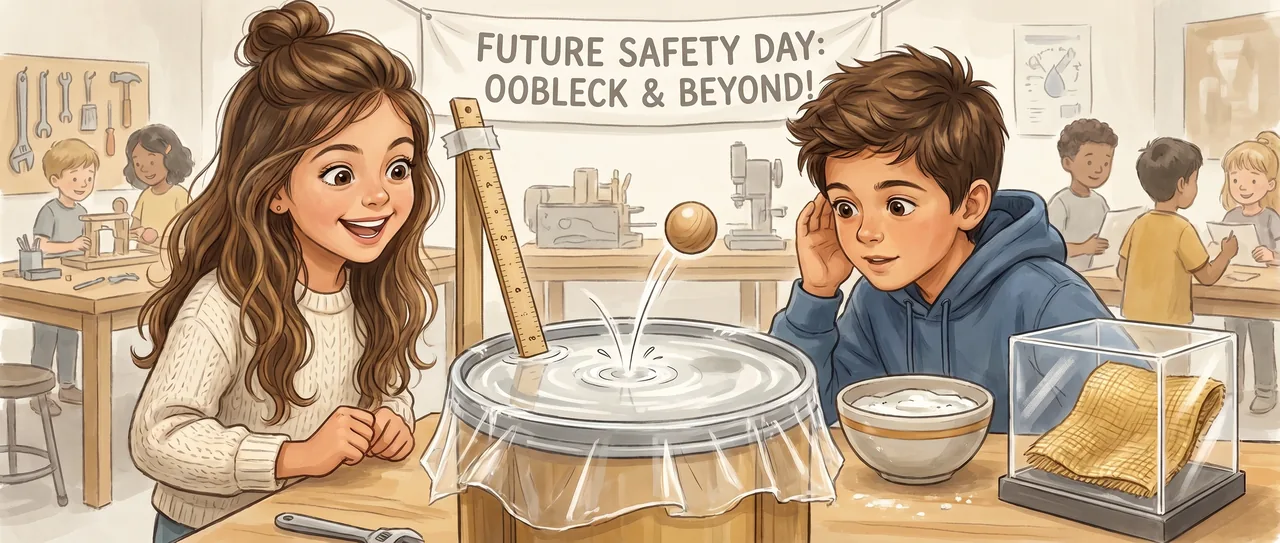
They emptied the failed pouch back into the bowl. Soren cut the bottom off a clear plastic jar so it became a short cylinder. Maya stretched a square of tough balloon rubber across one end and fixed it with three thick bands. They turned it upside down, poured oobleck into the open top, and covered that with plastic wrap, not tight, just enough to keep fingers out.
The result looked like a drum with soup inside.
"That is not armor," Dr. Imani said, returning with a roll of tape in her teeth.
"It is a question you can hit," Maya said.
They put the oobleck drum beside the foam pad and a bowl of plain water covered the same way. Soren built a drop guide from two rulers taped upright, with a wooden ball that could slide down between them and strike each surface from the same height. Maya made three cards.
Press.
Drop.
Try to decide.
Dr. Imani read the cards. "No one will know what to do."
The first visitors came in before Maya could answer.
A little boy with a glitter star painted on his cheek pressed the water drum. It wobbled. He pressed the oobleck drum. It sagged, slow and soft.
"Liquid," he said.
His older sister dropped the wooden ball down the guide. It struck the water drum with a wet slap and rolled off. Then she dropped it onto the oobleck drum.
Thock.
The sound was sharp enough to turn heads. The drum skin barely dipped. The ball hopped.
"Do it again," the sister said.
Soon there was a line.
Children pressed slowly and watched their fingers sink. They hit quickly and felt the surface harden. Parents tried to guess first and got it wrong in satisfying ways. One man in a bicycle helmet said, "So it is like armor custard," and his daughter said, "No, listen to the sound."
Soren listened too.
Slap on water.
Thock on oobleck.
The difference was not hidden in a formula. It was in the table, in the wrist, in the tiny jump of the wooden ball.
Maya stood near the sign, which now had Soren's crossed-out boxes taped to it. Liquid and solid both had question marks beside them.
A girl in a stiff new school blazer watched for a long time without touching anything. She had her sleeves pulled over her hands though the room was warm.
"It is cheating," she said finally. "It changes when you hit it."
"It doesn't change," Soren said. "Not exactly. The grains get crowded when the push is sudden. They jam up."
Maya held out the wooden ball. "Slow asks one question. Fast asks another."
The girl took the ball. She pressed it gently into the covered oobleck. The surface dimpled and swallowed half the curve. Then she set the ball at the top of the rulers and let go.
Thock.
She looked at the oobleck, then at the golden fabric in Dr. Imani's clear case.
"People are putting this in cloth?"
"Other fluids," Dr. Imani said from behind them. Her voice had changed. It was less clipboard now. "Special ones. But yes. That is the idea. Flexible when you move. More resistant during sudden impact. The research is still growing."
The girl touched the sleeve over her wrist. "So the weird part is the useful part."
No one answered right away, because the wooden ball was still rocking in the bottom of the guide.
After that, Dr. Imani stopped telling people it was messy. She started sending them over.
"You need to feel this one," she said to a group of firefighters in training.
"Try slow first," she told a skater with purple wheels clipped to her backpack.
"Do not decide too early," she told the principal, who had already decided wrong twice.
By afternoon, the oobleck had thickened from sitting out, so Soren added a spoonful of water and folded it in slowly. Maya tested it with two fingers, then with her knuckles. Too runny. More cornstarch. Too crumbly. More water.
There was no perfect batch. There was only the batch that answered correctly when asked correctly.
Near the end of the day, Dr. Imani unlocked the clear case.
"This sample is not for the public mallet," she said. "And not for soup fingers."
She lifted out the golden square with both hands. It bent like ordinary cloth. Light ran along the woven threads.
Soren did not reach for it. Maya did, then stopped with her fingers in the air.
"May we test one thing?" Soren asked.
Dr. Imani narrowed her eyes. "Define one thing."
Maya pointed to the little clamp at the edge of their drop guide. "Not a hit. A twist. Fast and slow."
Dr. Imani looked at the golden cloth, then at the gray fingerprints all over the table, then at the line of children still waiting with the wooden ball.
She set the fabric down.
Maya slid the corner of the golden cloth into the clamp, and Soren set his fingers on the crank.
Read the interactive version, listen to the narration, and earn a gold star →
A science-verified short story for curious kids · Curiosity Land