The Air That Would Not Be Eaten
The bean plants were supposed to be the easy part.
That was what Mr. Vale said, and Mr. Vale liked easy parts. He ran the school greenhouse on Moonbase Pelican with lists clipped to his sleeves, one for water, one for light, one for carbon dioxide, one for things children were not allowed to touch.
The beans had light from the mirrored roof. They had water from the graywater loop. They had carbon dioxide from the breathing pipes. They had warm black growing beads that looked like soil if you did not think about soil too hard.
Still, the newest leaves came in pale yellow.
Maya stood with her nose almost touching the glass.
“They look hungry,” she said.
“They cannot be hungry,” said Mr. Vale, checking his sleeve list. “They are plants. Plants eat light.”
Soren, kneeling by the lower tray, looked up. “Not only light.”
Mr. Vale sighed the way airlocks sighed when they were tired of people. “The nitrate cartridge for this bay is delayed. The supply rover is crossing Mare Imbrium tomorrow. Until then, the beans will be decorative.”
“They are for Founders’ Supper,” Maya said.
“They were for Founders’ Supper,” said Mr. Vale. “We have printed chickpea cutlets. Very respectable. Protein is protein.”
He moved away before Maya could answer, already speaking into his wrist about a stuck valve in the algae wall.
Soren stayed kneeling. He touched one yellow leaf with the back of his finger, not bending it.
“Plants need nitrogen,” he said. “For proteins. DNA. Chlorophyll.”
“There is nitrogen everywhere,” Maya said.
She pointed at the greenhouse air gauge. It had a blue slice so large it made all the other slices look like crumbs.
Nitrogen, seventy-eight percent.
Soren frowned at it. “That is the annoying kind.”
Maya liked that immediately. It belonged on her inside list of things that did not make sense yet.
She said, “Annoying air.”
“N two,” Soren said. “Two nitrogen atoms stuck together really hard. Most living things cannot pull them apart.”
Maya looked from the blue slice to the yellow leaves. The room was full of what the plants needed, and the plants were starving in it.
That made the greenhouse feel suddenly enormous. Not larger in meters. Larger in unfairness. Larger in hidden doors.
Soren opened his paper notebook, which everyone on Pelican thought was strange because paper had mass and mass had cost. Soren said that was why he used every corner.
“Beans are legumes,” he said. “Legumes can get nitrogen from bacteria. Root nodules.”
Maya was already at the side cabinet, pulling out the inspection gloves.
“Do not uproot the supper,” Soren said.
“It is not supper yet.”
They slid one bean seedling from the edge of the tray. Its roots dangled pale and clean through the black beads. Maya turned it slowly.
“No bumps,” she said.
Soren leaned close. “No nodules.”
“They forgot the bumps.”
“Bacteria make the bumps.”
Maya looked at the sterilized beads, the sterilized tray, the sterilized water, the sterilized seed packet with its silver seal. Moonbase Pelican was very proud of clean things. Clean things did not smell. Clean things did not rot. Clean things did not surprise you.
Clean things, apparently, could starve.
They found the greenhouse manifest on the wall screen. Mr. Vale’s lists were locked, but the educational layer was open because adults often forgot children could read the parts meant for children.
Bean seed, dwarf variety.
Growth medium, sterile.
Nutrient plan, cartridge nitrate.
Microbial partner, none.
Maya tapped the last word with one gloved finger. “That is rude.”
Soren typed rhizobium into the search box. A long list appeared, not one thing but many, with names like secret passwords. Some liked peas. Some liked clover. Some liked soybeans. Some did not help beans at all.
Soren read quickly, lips moving. “They have to match. Not any bacteria. The right bacteria.”
“Where do we keep right bacteria?” Maya asked.
The wall screen answered with a map.
Soil Ancestry Archive, Cabinet Six.
The archive was not a room people visited for fun. It was behind the compost drums, past the mushroom shelves, where the air was damp and busy. Cabinet Six was small, cold, and covered with warning labels that said not dangerous, just alive.
Maya liked that warning best.
Inside were tiny vials in foam slots. Each label held a plant name and a place on Earth. Clover from Kenya. Pea from Canada. Soybean from Brazil. Common bean from Mexico. Common bean from Rwanda. Common bean from Colorado.
Soren did not grab the first one. He checked the seed packet again.
“Common bean,” he said. “Phaseolus vulgaris. We need one for that.”
Maya held up three vials. “Mexico, Rwanda, Colorado.”
“Maybe all three?”
“Is that guessing?”
“It is making a mixed invitation.”
They were not allowed to use the big inoculation sprayer. It was on Mr. Vale’s sleeve list of things children were not allowed to touch. They used droppers, a measuring cup, and the patience Soren kept in places Maya did not have.
They made a cloudy wash and trickled it around the roots of every bean. Nothing flashed. Nothing beeped. No machine congratulated them.
The next morning, the beans were still yellow.
Mr. Vale noticed the open archive cabinet at lunch.
He stood in the greenhouse doorway with his lists hanging from both sleeves. “Did either of you introduce unapproved organisms into my clean bay?”
“They were approved,” Soren said. “They were in Cabinet Six.”
“For demonstrations.”
“This is a demonstration,” Maya said.
Mr. Vale rubbed the bridge of his nose. He was not angry yet. He was deciding whether anger fit on the schedule.
“The rover will bring nitrate by evening,” he said. “We will feed the plants properly.”
“If you add too much nitrate, they may not make nodules,” Soren said.
Mr. Vale blinked.
Maya said, “They will take the easy food and ignore the bacteria.”
“That sounds like children,” Mr. Vale said.
“That sounds like plants,” said Maya.
The corner of Mr. Vale’s mouth moved, but he did not smile all the way. “One tray,” he said. “You get one tray without cartridge nitrate. If it dies, it goes to compost, and nobody cries into the compost because salt balance is difficult enough already.”
They chose the tray by the glass where everyone could see it failing.
For six days, it failed in public.
The other bean trays, fed by the rover’s nitrate, turned a rich green. Mr. Vale gave them a satisfied look every time he passed. The no-cartridge tray stayed smaller. Its leaves remained the color of old moon dust.
Other kids stopped to read Soren’s temporary sign.
This tray is trying to eat air.
“That is not how eating works,” said Juno from hydroponics club.
“Exactly,” Soren said.
Maya did not explain. She watched the stems. On the seventh day, the newest leaves were not yellow. They were not dark either, but they had chosen green and were considering it seriously.
On the tenth day, Soren asked Mr. Vale for permission to sacrifice one plant.
“You make it sound ceremonial,” Mr. Vale said.
“It is data,” Soren said.
“That is also ceremonial around here.”
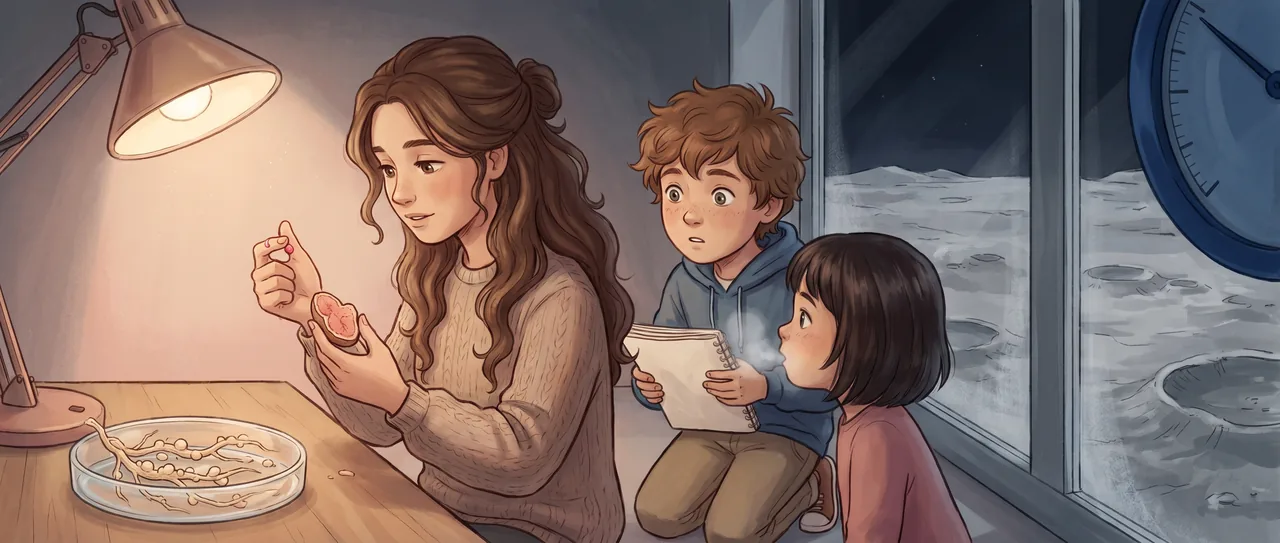
They washed the roots in a clear dish. This time, the roots were not smooth. Tiny round swellings clung to them, beige and pinkish, like the plant had grown a necklace underground.
Maya forgot to breathe for almost long enough to notice.
Soren cut one nodule open with the smallest greenhouse blade. The inside was pink.
“Leghemoglobin,” he said softly.
“Like blood?” Juno asked from behind them.
“Not blood,” Soren said. “But it holds oxygen carefully. The bacteria need oxygen to live, but the enzyme that fixes nitrogen gets damaged by too much oxygen.”
Maya looked at the pink dot on the blade, then at the blue nitrogen slice on the air gauge, then at all the children fogging the greenhouse glass with their breath.
A room could be full of a thing and still need someone strange enough to change it.
Founders’ Supper was moved by eight days, which made Mr. Vale twitch whenever anyone mentioned calendars. The printed chickpea cutlets came first. Beside them, in a small bowl, were eleven green beans from the no-cartridge tray, steamed with lunar basil.
There were not enough for everyone to have a bean. Mr. Vale cut them into pieces so small they looked like punctuation.
Before eating, Pelican always read the origin tags. Water, recycled. Carbon, breathed and grown. Phosphorus, recovered from waste. Nitrogen, cartridge for most trays.
For the small bowl, Soren had written a different tag.
Nitrogen, pulled from the air by root bacteria.
Mr. Vale added another tag underneath, because he could not resist completing a list.
On Earth, during the twentieth century, factories learned to pull nitrogen from air too, making ammonia for fertilizer. Scientists estimate that nearly half the nitrogen in human bodies today came through that industrial path.
Maya read it twice.
The words did not make the room smaller by explaining it. They made every hand at the table unfamiliar. Every fingernail. Every eyelash. Every bite of printed chickpea. Some of the people in the room had been made partly by bacteria in roots, partly by old factories hot enough to persuade air to become food, partly by farms and storms and compost and breath, all of it passing through bodies that did not keep it forever.
Juno held up her tiny bean piece. “So this was air?”
“Not was,” Soren said. “Got changed from.”
Maya picked up her piece last. It was barely longer than her thumbnail.
Mr. Vale watched the bowl as if it were a valve he did not yet trust. “Next season,” he said, “we may reserve a whole bay for microbial partners.”
“Not reserve,” Maya said.
Mr. Vale looked at her.
“Invite.”
After supper, the younger kids followed them back to the greenhouse to see the roots. Soren lifted the clear dish. Maya cut one nodule open under the lamp.
One of the younger kids leaned so close her breath fogged the glass, and Maya held the cut nodule up to the light. A bead of pink juice shone on her thumb.
Read the interactive version, listen to the narration, and earn a gold star →
A science-verified short story for curious kids · Curiosity Land