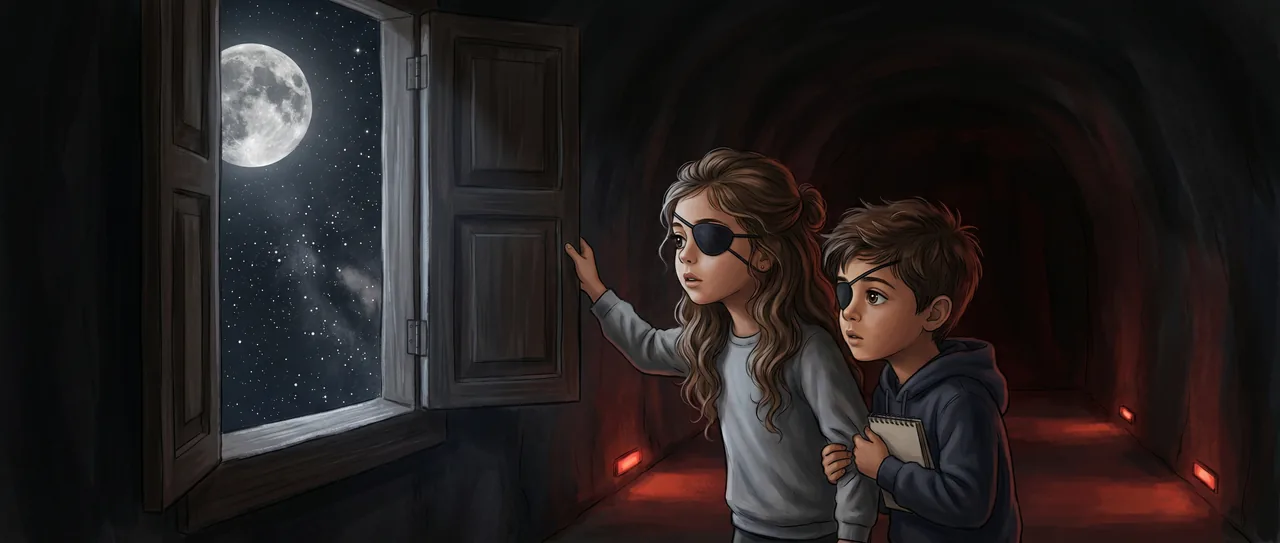
One Eye for Noon
The Star Walk opened at two in the afternoon and failed before the first group had finished blinking.
Maya knew it had failed because nobody whispered. In a real dark room, even noisy people lowered their voices, as if the dark had a hand. Here, the first visitors shuffled out of the black door talking in regular hallway voices.
"There weren't any stars," a small boy said.
The curator made the smile adults made when a thing was expensive and misbehaving in public.
"Projection lag," she said. "The lamp array probably needs a reset. Everyone can visit the rock garden while we make a tiny adjustment. Tiny. Very tiny. Perfectly normal."
The visitors drifted away under the museum dome. Beyond the glass, the Moon was white and hard and shadowed, with Earth hanging blue over the rim of a crater.
Maya did not drift. Soren did not either.
The sign over the entrance said: Your eyes can cross a range of one hundred billion. From noon to starlight. Walk slowly.
Maya stepped back into the first room.
It was called Noon.
White walls bounced bright sunlamps from every direction. The floor was pale gray, dusted with crushed glass to look like lunar soil. Maya's pupils squeezed until the room had sharp edges. Soren held his notebook against his chest and squinted at the black doorway ahead.
"It's not projection lag," Maya said.
"What made you think that?" Soren asked.
"The boy didn't sound disappointed enough. He sounded certain. Like blank was the correct answer."
Soren considered this. He liked answers that came with handles.
They went through the black doorway.
The star chamber swallowed them.
For the first few breaths, there was no room at all. No ceiling. No floor. No Maya, except for her sleeve brushing Soren's elbow.
"I can see nothing," Soren said. "Not even my page."
"Don't move," Maya said.
They stood.
A green exit strip floated up first, low and soft along the wall. Then a corner appeared. Then the round outline of the projector housing. Maya tilted her face upward.
"There," she said.
"Where?"
"One speck. No, two. Left side. High."
Soren looked. Nothing. He waited anyway.
The curator came in through the Noon door and slapped the worklight switch.
White light filled the chamber.
Maya made a sound like a hinge breaking.
"Sorry," the curator said, not sounding sorry enough. She hurried to the projector and opened its panel. "We have another group in six minutes. If I boost the stars, it should carry through."
The chamber walls were suddenly full of tiny silver dots. Under the worklight they looked painted on, flat and silly.
"Don't make them brighter," Maya said.
The curator's hand paused over the controls. "That is usually how one fixes things people cannot see."
"The room isn't the broken part," Maya said.
Soren had one palm pressed over his left eye. He had done it when the worklight came on, because the light felt like a shove.
"Turn it off again," he said.
The curator looked at him. "I am not running a darkness game."
"Please," Soren said. "For ten seconds."
The curator was the kind of adult who disliked being delayed but disliked mystery slightly more. She snapped the worklight off.
Blackness dropped.
Soren opened his right eye. Nothing.
He opened his left eye, the one his palm had covered.
The green strip was there at once. So was Maya's shoulder. So were seven faint stars on the wall.
He shut the left eye. They vanished.
He opened it. They returned.
"Oh," he said.
Maya turned toward him in the dark. "What?"
"My eyes disagree."
"Good," Maya said. "Eyes are allowed."
Soren did not trust a thing just because it was wonderful once. He took the black rubber cap from an unused telescope eyepiece and held it over his right eye. He stepped into Noon with his left eye open and the right eye covered. Maya counted under her breath, too fast at first, then slower because Soren made a small clicking sound with his tongue every time she rushed.
They waited two minutes. The curator paced for both of them.
Then Soren walked back into the star chamber.
Left eye, black.
Right eye, stars.
"Again," he said.
"We do not have again," the curator said.
Maya was already at the wall tablet. It controlled the exhibit in simple blocks, lamp level, wait, door, sound, projector. She had watched the technician use it that morning while everyone else watched the ribbon cutting.
"Noon stays," she said. "That's the point. But one eye gets night early."
Soren came to the tablet. "Patch station before Noon. Visitors cover one eye while the other eye gets the bright room. Then in the star chamber, they compare."
"That is not the whole range," the curator said. "Full dark adjustment takes much longer than a tour."
"Then don't pretend it is instant," Soren said. He tapped the wait block and stretched it. "First the pupil. Then the picture changes. Then the dimmer cells take over. The slow part should have room to be slow."
Maya moved the projector brightness down.
The curator made a noise. "Down?"
"If the stars shout, the eyes don't have to listen," Maya said.
Soren added dim red floor lights for the first stretch, then a darker pause, then the star wall. Maya changed the door chime to a heartbeat. Not a loud one. Just enough to make people stop talking without being told.
The next group arrived with the restless energy of people promised a broken thing.
Maya stood beside a basket of soft black eye patches.
"Choose an eye," she said.
"Why?" asked the same boy who had said there were no stars.
"So one eye can go to noon," Soren said, "and one can start walking toward night."
The boy looked at the curator.
The curator looked at the tablet, at the waiting visitors, at Maya's hand already holding out a patch.
"Choose an eye," the curator said.
They went through Noon half laughing, with one eye covered. The uncovered eyes watered in the clean white glare. The patched eyes sat behind cloth, doing invisible work.
At the black door, the heartbeat sound began.
No one rushed.
Inside the star chamber, Soren stood near the wall where the first group had seen nothing.
"Use the eye that was open in Noon," he said.
A few people groaned. Someone bumped a shoe against the floor strip. The boy said, "Blank again."
"Now switch," Maya said.
Cloth rustled.
The room inhaled.
Not loudly. Not all at once. A gasp here. A hand reaching for another hand there. The boy took one step forward and stopped with his mouth open.
"There are more," he whispered.
The curator lifted one finger toward the brightness control.
Maya caught her wrist without looking away from the ceiling.
The curator lowered her hand.
More stars came. Not because the wall changed. The projector stayed almost embarrassingly faint. The visitors changed instead. Their dark eyes gathered what their noon eyes had thrown away.
Soren kept his patched eye closed for one extra minute after everyone else had switched back and forth. When he opened it, a faint river crossed the ceiling, a milky spill so soft his other eye still denied it.
At school, people wanted seeing to happen at the speed of pointing.
In the Star Walk, the quiet eye found the river first.
Maya turned her head. She had seen his face, even in the dark.
"You got something," she said.
"A smear," Soren said. "Like spilled breath."
"Good smear?"
"Very good smear."
After the visitors left, they did not talk in hallway voices.
The curator closed the public door and stood with her back against it.
"There is an exterior viewing slit behind the last panel," she said. "We keep it shut. People come from the bright galleries and say the Moon has no stars."
Maya looked at the final wall.
Soren picked up two patches from the basket.
They went back through Noon. They covered one eye each. They waited through the red-lit corridor, then the darker pause, then the star chamber, then longer, while the heartbeat sound counted without numbers.
At the last panel, the curator did not touch the handle.
Maya did.
The inner shutter began to crawl sideways. No projector hummed. No floor lights glowed. Beyond the glass, the Moon lay in silver cuts and black wells, and above it the stars came in numbers no wall could hold. Maya's hand found Soren's sleeve and held on.
Read the interactive version, listen to the narration, and earn a gold star →
A science-verified short story for curious kids · Curiosity Land