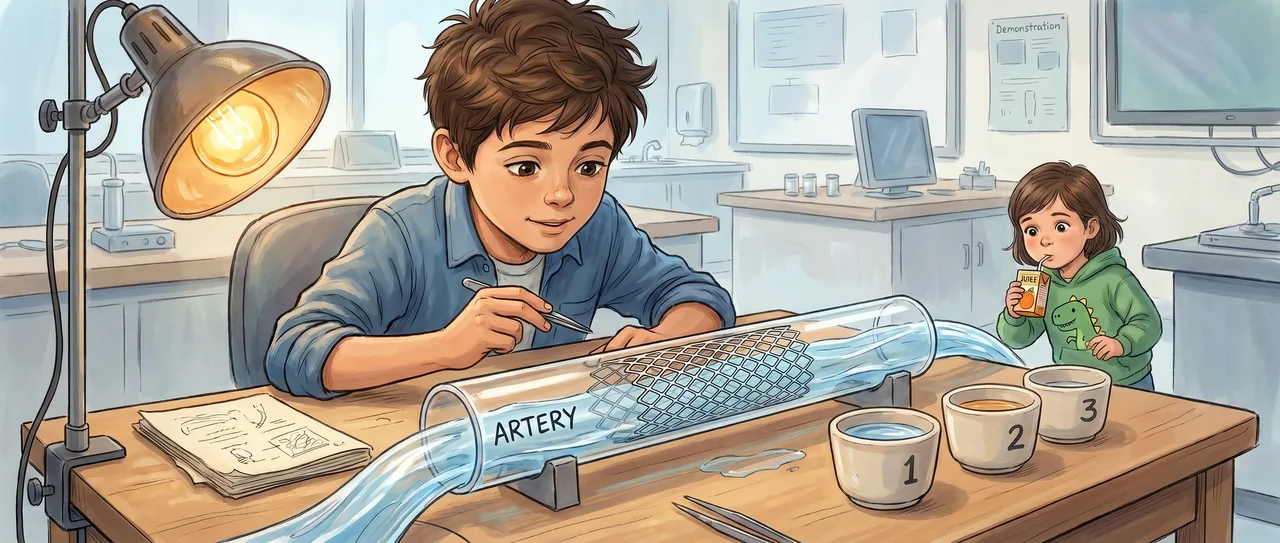
The Wire That Waited
The first time the metal pushed back, Soren nearly dropped it.
He was sitting on the floor under the edge of the demonstration table because the table was the only quiet place left in the hospital materials lab. Above him, adults moved boxes, tested screens, and said things like public-facing and clinically accurate. In his closed fist was a crushed silver cylinder smaller than a grape.
It had looked like trash.
Now it was pressing his fingers apart.
Thirty minutes earlier, the demonstration had failed in front of everyone.
The lab director had stood beside a clear plastic tube labeled artery and smiled her bright, hurried smile. She wore safety glasses on top of her head instead of over her eyes, which made Soren nervous.
“This is the best part,” she had said. “A tiny stent, squeezed small, goes into a blood vessel. Body heat helps it open. No motor. No battery. Just material science.”
She pinched a crumpled mesh tube with tweezers and dropped it into a cup of warm water. A thermometer floating inside read thirty-seven degrees Celsius.
The mesh tube sank.
It did not open.
The director tapped the cup. The tube rolled over lazily, like it was pretending not to hear.
Someone laughed. Not meanly. Worse. Politely.
The director’s smile became even brighter. “We have a video if the live demo is being dramatic.”
Soren moved closer. The water was clear. The tube was not tangled around anything. It had not opened a little and stopped. It had done almost nothing.
“Maybe it is the wrong temperature,” Soren said.
“It is body temperature,” the director said, already reaching for her tablet. “That is the point.”
“Maybe the metal is not body-temperature metal.”
The director looked at the tray. There were labels everywhere, but most of them had been moved by people in a hurry. “It came from the shape-memory drawer. Same family.”
Same family did not mean same person. Soren did not say this because adults became tired when he corrected their shortcuts.
The director swept three failed mesh tubes into a shallow dish. “We will use the animation. It is cleaner.”
Soren watched the dish slide toward the waste bin.
“Are those garbage?” he asked.
“They are not opening,” she said. “So for today, yes.”
Then she was gone, called away by a printer that was eating name tags.
Soren was not supposed to use the hot plate. The hot plate had a sign that said TRAINED STAFF ONLY in red letters. But the warming baths on the student table had green stickers and lids and a maximum setting of fifty-five degrees. The safety sheet said visitors could use them with supervision. There was no supervision, but there was also no hot plate.
Soren took one straight piece of silver wire from the demonstration tray. A tag beside the tray said Nitinol, programmed straight. Bend cold. Heat to return.
He bent the wire into a sharp zigzag. It felt wrong to bend metal that easily, like folding a paper clip that had secretly become licorice.
He laid out three cups from the warming bath rack. Thirty-seven degrees. Forty-two degrees. Fifty degrees. He checked each one with the floating thermometer, then wrote the numbers in his paper notebook because the numbers looked more obedient when they were trapped on a page.
He dropped the zigzag into thirty-seven.
Nothing.
He nudged it with tweezers. Still a zigzag.
He moved it to forty-two.
One corner softened. Not melted. Not even softened exactly. It shifted, as if a tiny muscle had pulled inside the wire.
Soren held his breath and moved it to fifty.
The zigzag snapped straight so fast it flicked water onto his sleeve.
Soren stared at the straight wire lying at the bottom of the cup.
He bent it again. Zigzag. Fifty-degree cup. Straight.
He did it again.
By the fourth time, the motion still made his stomach lift. The metal did not look alive. It did not look clever. It looked like metal. That was the unsettling part.
He tried one of the failed mesh tubes from the director’s dish. Thirty-seven degrees did nothing. Forty-two degrees made one edge twitch. At fifty degrees, the crushed tube opened into a little round tunnel.
So the failed stents were not failed.
They were waiting for the wrong kind of warm.
Soren climbed onto the stool and looked through the shape-memory drawer. The drawer was organized in the way adults meant to organize things and then forgot to finish. There were packets marked demo wire, actuator spring, eyeglass frame sample, stent model, body-temp alloy, and maybe body-temp alloy? The question mark had been written in thick marker.
Behind a foam block, Soren found a small paper cup with three mangled silver pieces in it. The cup had no label. The pieces were thinner than the others, woven tighter, and crushed flatter. They did not look like the neat model stents on the tray. They looked like a tiny animal had chewed them.
He almost put them back.
Then one of them moved.
Not much. It was near the lamp clamped to the shelf, where the air was warm. One bent rim lifted and settled.
Soren carried the cup to the student table.
His hand was warm around the paper. By the time he reached the bath rack, one piece had opened enough that he could see through it.
He put it under the table because the room was getting louder and his head felt full. He closed his fist around the smallest crushed cylinder.
The metal pressed back.
Not hard. Not like a creature trying to escape. More like a word being spoken very clearly into his palm.
Soren opened his hand.
The crushed bit of mesh was wider than before. Still crooked. Still not finished. He placed it in the thirty-seven-degree cup.
It opened.
No snap this time. No splash. The silver lattice widened slowly and evenly, making a round tunnel in the water. It touched the glass wall of the cup and held itself there.
The lab around him kept rushing. Tape ripped. Wheels squeaked. The printer beeped angrily. On the table in front of Soren, a thing that had looked ruined had become a passage.
He lifted it with tweezers and slid it into the clear plastic artery. It fit.
The director returned with a stack of crooked name tags. “Please tell me you did not use the hot plate.”
“I did not use the hot plate,” Soren said.
She saw the open mesh inside the plastic tube. Her mouth stayed open for a moment before any words came out.
“That one worked?”
“At thirty-seven degrees.”
“Where was it?”
“In the unlabeled cup behind the foam block.”
The director shut her eyes. “Of course it was.”
“The tray ones open at fifty,” Soren said. “They are good for a hot-water demo, not a body-temperature demo.”
The director looked at the table. Three cups. One notebook page. Bent wires. Straight wires. A mesh cylinder standing open inside the plastic artery.
“I thought the ugly ones were damaged,” she said.
Soren picked up one of the still-crushed body-temperature pieces with tweezers. “They are easier to insert when they are small.”
“Yes,” the director said, quieter now. “That is why stents matter.”
The first visitors arrived five minutes later. A girl in a dinosaur sweatshirt came in holding a paper cup of apple juice. She looked at the screens, then at the water cups, then at Soren.
“Is this the part with the metal that remembers?” she asked.
Soren did not like the word remembers, but he liked the way she said it, as if she was not sure whether to believe herself.
“You can bend this one,” he said, handing her a piece of programmed straight wire. “Cold first.”
She bent it into a loop. Her grown-up started to say, “Careful,” but the director shook her head.
Soren pointed to the fifty-degree cup. “Now warm.”
The girl dropped the loop in.
The wire sprang straight.
She stepped backward so fast her juice sloshed onto her hand.
“It had that shape inside it?” she asked.
Soren looked at the wire, straight and ordinary at the bottom of the cup.
“It was made to go back to that shape,” he said.
The girl stared at the straight wire. “But it let me bend it.”
“Yes.”
“And then it did not stay how I bent it.”
“Not when it got warm enough.”
She looked at the clear plastic artery. “Can the tiny tunnel do it?”
Soren placed a crushed mesh cylinder into the end of the plastic tube. It looked too small to matter. He poured thirty-seven-degree water through the tube.
The mesh opened against the clear wall.
The girl leaned so close her forehead almost touched the plastic. Behind her, two more children stopped at the table. Then four. The director forgot about the animation screen.
“What else can metal be made to go back to?” the girl asked.
Soren picked up the smallest crushed cylinder and lowered it toward the cup marked thirty-seven degrees.
Read the interactive version, listen to the narration, and earn a gold star →
A science-verified short story for curious kids · Curiosity Land