The Tile With No Word
The basil scanner announced, in its calmest voice, "Mildew. Mildew. Mildew. Mildew."
It said this about every tray.
The leaves were glossy and green. They smelled sharp when Maya brushed them with her wrist. There was no white fuzz, no gray patches, no curled edges. Still, the scanner's little screen boxed each leaf in red and printed the same word over and over.
The engineer stood with a coil of cable around one arm and a tablet tucked under her chin. The greenhouse doors were propped open for visitors who would arrive in less than an hour.
"It was fine yesterday," she said. "The model knows basil mildew. I trained it on hundreds of labeled pictures. Maybe the new camera update changed something. Please do not touch the main cable."
Maya had already stopped looking at the cable.
Soren had his notebook open, but he was not writing yet. He watched the screen reject another perfect leaf.
"If it knows mildew," he said, "why does it keep saying it when there isn't any?"
"Because computers are annoyingly confident when they're wrong," the engineer said. She crouched behind the table and vanished among plugs. "I need five quiet minutes."
Maya leaned close to the screen. The red boxes trembled as the greenhouse fans moved the plants. Across the leaf images lay a pale net of tiny diamonds, bright, dark, bright, dark.
"New roof cloth," Maya said.
Soren looked up. Above them, stretched under the glass, was a silver shade cloth the volunteers had clipped in that morning to keep the seedlings cool. Sunlight came through it in a mesh pattern.
"The leaves have spots," Soren said. "But not leaf spots. Light spots."
Maya put one hand over a basil plant. Her fingers cast thick shadows. The scanner's red box jumped, then settled.
"Not that," she said. "Too big."
Soren tore a blank corner from a paper seed packet. "Four pictures. Same leaf with roof pattern. Same leaf without roof pattern. Blank paper with roof pattern. Blank paper without roof pattern."
"Yes," Maya said. "Make it say mildew to paper."
The engineer made a sound from under the table. "Please don't teach my scanner botany crimes."
Maya slid a tray under the camera. Soren held a flat piece of cardboard above it to block the patterned sun. The screen blinked.
"Healthy," it said.
They moved the cardboard away.
"Mildew," it said.
Soren placed the blank paper where the basil had been. Sun diamonds crossed it.
The scanner paused, as if embarrassed.
"Mildew," it said.
Maya's grin came fast. Soren did not grin yet. He covered the paper with the cardboard shadow.
"No plant detected," the scanner said.
Now Soren wrote one line in his notebook.
The engineer emerged with a cable tie in her teeth. "Blank paper cannot have mildew."
"It can have your mildew," Maya said.
The engineer took the cable tie from her mouth. "My mildew is a fungus, not a lighting problem."
Soren pointed to the diagnostic tab on the tablet, where small gray squares waited in rows. "What are those?"
"Feature maps," the engineer said. "The network's layers. Edges, textures, parts of things. Mostly useful to people who enjoy staring at electronic soup."
Maya tapped the tab.
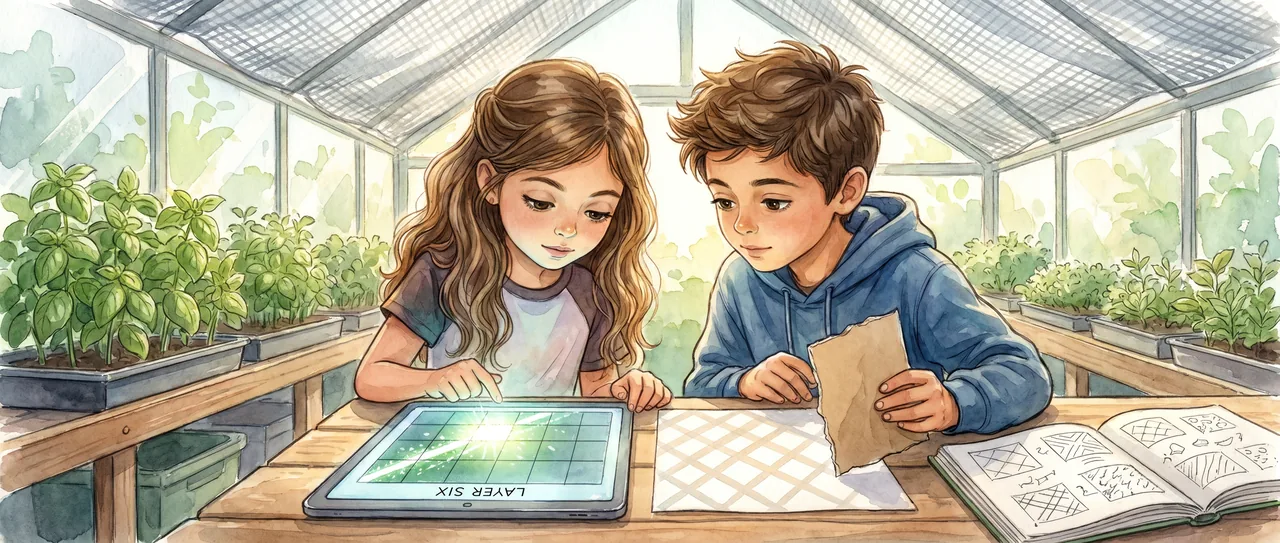
The tablet filled with little windows. Some showed the leaf in ghostly outlines. Some were black. Some flashed white along the veins. One square, in the middle of a row labeled layer six, burned bright whenever the sun diamonds crossed the paper.
Soren moved the cardboard in and out. Bright. Dark. Bright. Dark.
"That one," Maya said.
The engineer's visitor badge swung as she bent over them. "Huh. That filter is very excited."
"By the paper?" Soren asked.
He slid the paper sideways. The square dimmed. He turned the paper so the diamonds ran the other direction. The square went almost black. He put it back. The square flared white.
"Not paper," Maya said. "Not mildew. Angle. Tiny bright dark tiny bright dark."
The engineer opened another view. "This shows which camera patch is making that filter fire hardest."
A square popped up, enlarged until it no longer looked like a leaf or a disease or anything with a name. It was just a jittery braid of pale green and white, cut by a diagonal line of shadow. To the scanner, it mattered more than the basil.
The greenhouse noise thinned around Maya. Fans, water ticks, street sounds beyond the open doors, all of it moved backward.
On the tablet, rows of filters waited. Some liked simple edges. Some liked yellow beside purple. Some liked speckles so fine they looked like dust. One tile showed a curled shape that was almost an insect wing, but not quite. Another showed blue and orange bars crossing in a way that made Maya's eyes refuse to settle.
Nobody had labeled those things.
No grown-up had sat at a computer and typed, find the green-white diagonal sparkle that happens when shade cloth trembles over basil.
The network had been given pictures with names. Mildew. Healthy. Rust. Bite mark. From those names, it had built a private drawer full of smaller things, useful things, things without words printed underneath them.
Soren was very still. Then he opened his notebook to a page Maya had seen before, though he usually flipped past it quickly. It was full of little patterns from floors, vents, window screens, the backs of bus seats, all drawn in careful boxes. None of them were labeled.
Maya touched the screen where the bright filter pulsed.
"Your page," she said.
Soren looked at the tablet, then at his notebook, then back at the tablet. He closed the notebook, but he left one finger inside to keep the place.
The engineer rubbed her forehead. "Wonderful. My model has become a poet of bad shadows. The visitors are coming in forty minutes."
"Put the plants where the roof can't draw on them," Maya said.
"The whole greenhouse roof is drawing on them."
Soren picked up an empty white seedling tray from under the table. He turned it upside down. The inside was smooth and dull, not shiny.
"A tunnel," he said. "Camera at one end. Plants go inside. Same light every time. No net."
Maya grabbed another tray. "White walls. Boring shadows."
"Boring is good," Soren said.
They did touch the main cable then, but only to lift it over the trays so it would not snag. The engineer saw and opened her mouth. Maya held up one finger without looking at her. The engineer shut her mouth and handed them a roll of tape.
They made a white tunnel just tall enough for the basil. The camera looked through a hole cut in one end. The first tray of leaves slid in.
The scanner considered the dim, plain world they had made for it.
"Healthy," it said.
Maya pushed in the next tray.
"Healthy."
The engineer laughed once, too loudly, the laugh of someone who had been holding a table up with her shoulders and had just found out the floor existed.
"You two," she said, "are officially in charge of shadows."
Visitors began to wander through the doors. The scanner behaved beautifully. It found a real dusty patch on one old leaf and called it uncertain. It called the rest healthy. The engineer told people the system was learning to help growers catch problems early, and that good tools needed good conditions. She did not say the word soup.
Maya and Soren stayed beside the diagnostic tablet after the crowd moved on to the strawberry towers.
The bright mildew-shadow filter rested quietly now. Without the shade cloth pattern, it had almost nothing to say.
Soren tapped the next row. "Can we see what makes the others wake up?"
The engineer glanced at the visitors, then at the tablet, then at the tunnel made of taped trays. "Do not change the model," she said. "Do not unplug anything. Do not make it accuse furniture of plant disease unless you can undo it."
"So yes," Maya said.
"So carefully," the engineer said, already turning away.
Read the interactive version, listen to the narration, and earn a gold star →
A science-verified short story for curious kids · Curiosity Land