The Spoon at the Edge
The first spoon failed before it reached the tea.
Maya held it up for the front row, silver and shiny and almost normal. Then the handle bent over her thumb like a tired flower.
A small kid in a rocket shirt said, "Your spoon is sleepy."
Soren looked at the clear cup of dark tea waiting on the table. The tea had not touched the spoon. The spoon had given up early.
Behind them, the museum manager clicked his little visitor counter three times and winced at the growing crowd. He had a headset over one ear and a planetarium schedule in his hand. He loved timetables more than surprises.
"Can you keep them here for six minutes?" he asked. "The foam comet cannon is leaking again. Also, please remember, no one drinks the demonstration tea."
Then he hurried away, already talking to someone who was not there.
Maya lowered the bent spoon onto the tray. It slumped flatter.
"The room ate it," she said.
Soren pulled the little thermometer from beside the silicone molds. It had been meant to check the tea. He held it in the air above the table.
The red line trembled just past thirty.
"Thirty point one degrees," he said.
Maya looked at the label they had printed in block letters that morning. Gallium. Element thirty-one. Melts at twenty-nine point eight degrees Celsius.
"The room is hotter than the spoon," she said.
"Hotter than the melting point," Soren said.
"Same disaster."
They had planned the demonstration perfectly, which was why it had gone wrong. Melt the gallium pellets in warm water. Pour the liquid metal into a spoon mold. Cool it until solid. Lift the shiny spoon. Stir hot tea. Watch the spoon seem to dissolve.
Except the museum was full of breathing people and hot lights and one broken foam comet cannon. The air itself had crossed the invisible line.
Soren touched the ruined handle with one fingertip. It was not wet like water. It was not hard like a nail. It pushed back softly, then shone around his finger.
Maya was already moving.
"Ice," she said.
"We have ice. But if we only hide the spoon on ice, it still melts on the way to the cup."
"Then the way to the cup has to be cold too."
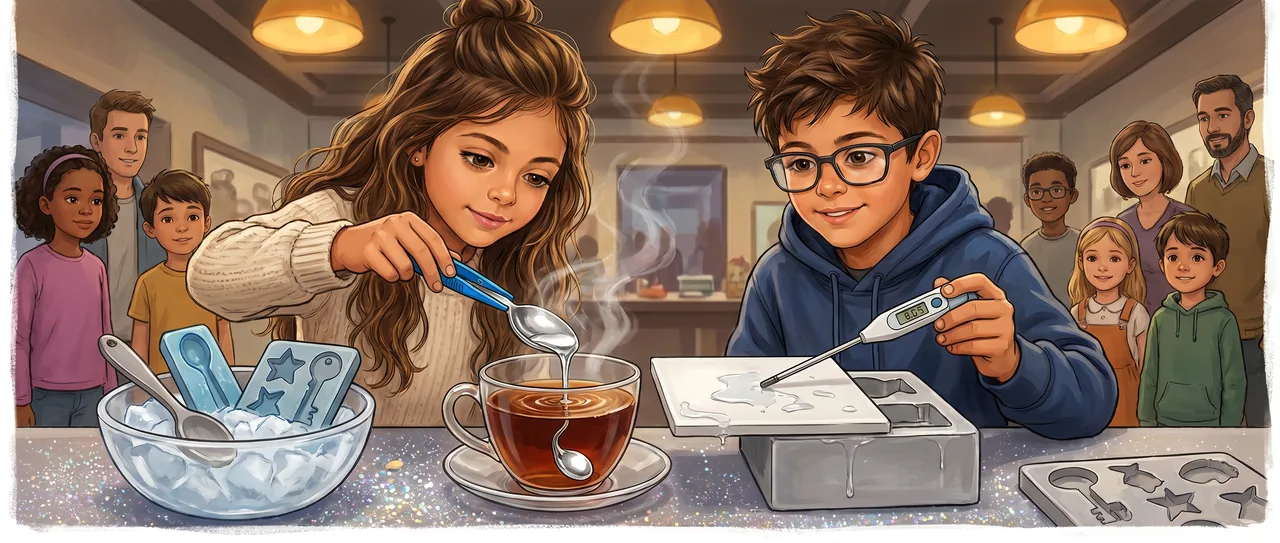
Soren looked at the table. Silicone molds in a row, spoon, star, key, fish. Plastic pipettes. Glass cups. A bowl of ice for cooling the molds. A ceramic tile meant to protect the tabletop from warm beakers. Two paper towels. A sign that said, Do not drink. Science tea.
He set the ceramic tile into the ice bowl.
Maya grinned. "Cold road."
"Cold road," Soren said.
The crowd pressed closer, but not in the way crowds came closer for things that worked. This was the other kind of closeness, the kind that happened when something had gone wrong and people wanted to see whether it would go more wrong.
A tall kid near the back said, "It is probably wax."
Maya did not answer. She picked up one gallium pellet with a plastic spoon and dropped it into a warm glass cup. The pellet sat there, a dull gray lump.
"Needs more heat," Soren said.
He poured a little hot water from the demonstration thermos into the cup. Steam touched his glasses. The gallium pellet shivered. Its corners rounded. The lump became a silver puddle at the bottom of the glass.
The tall kid stopped leaning on the table.
Maya drew the liquid gallium into a plastic pipette. It made the pipette feel heavier than it looked. She squeezed it into the spoon mold, where it filled the bowl first, then the narrow handle, shining like a trapped piece of mirror.
Soren lifted the ceramic tile from the ice and set the mold on top of it. The tile left a wet square on the table. He packed ice around the mold but not over it.
"Now we wait," he said.
Maya stared at the silver spoon shape. "No. Now we measure."
Soren put the thermometer against the tile. The red line dropped below twenty. He checked the air again. Still above thirty. He checked the tea. Forty-six.
Three temperatures. Three different worlds, all on one table.
The spoon in the mold changed without drama. No flash. No puff. The shine dulled slightly, as if the metal had taken a breath and held it.
Soren pressed the end gently with a plastic stick.
"Solid," he said.
Maya reached for it.
"Wait," Soren said.
She froze, fingers above the mold.
He held up his hand. "We are thirty-seven degrees."
Maya looked at her palm as if it had become suspicious.
Soren did not mean to do the next part for the crowd. He did it because his head refused to accept the size of the fact until his skin had checked it.
He placed one leftover pellet in the center of his palm.
At first it was only a cool metal bead. Then the underside softened. The bead flattened, not like ice, not like chocolate, but like metal deciding the rules were different here. A bright drop spread into the lines of his hand.
Maya leaned close. "Your hand is a furnace."
Soren swallowed. Furnaces were supposed to roar. His palm was quiet. The metal did not care. Somewhere between the museum air and the blood under his skin was a border an element could feel.
He tipped the liquid gallium back into the glass cup and wiped his hand carefully with a paper towel.
"Cold tools," he said.
Maya lifted the chilled plastic tweezers from the ice bowl. Soren slid the mold to the edge of the tile. Together they eased the new spoon free.
It looked impossible in the tweezers. Too shiny. Too heavy for something so temporary. A real spoon and not a real spoon.
The museum manager reappeared with a smear of foam on his sleeve. "Wonderful, wonderful," he said, without yet seeing anything. "Are we vanishing? The comet is still emotional."
"Not vanishing," Maya said.
Soren placed the cold tile like a bridge between the mold and the cup of tea. Maya carried the spoon along it with the chilled tweezers, inch by inch. The crowd had gone quiet enough that Soren could hear drops of meltwater falling from the ice bowl into the tray.
At the edge of the cup, Maya stopped.
"It is metal," she said to the crowd.
Soren checked the tea one last time. "It is hot enough."
Maya lowered the spoon into the tea.
For one second, it stirred.
Then the bowl of the spoon loosened. The handle curled. Silver slid away from its own shape and gathered at the bottom of the cup in a bright bead. The tea rocked once and went still.
The small kid in the rocket shirt whispered, "It drowned."
"It melted," Soren said.
The tall kid said nothing at all.
The museum manager forgot to click his counter.
Maya held the empty tweezers over the cup. A drop of tea fell from them. "Again," she said.
This time no one laughed.
They made another spoon. Then a star. The star melted faster because its points were thin. The fish lost its tail first. Each shape lasted only as long as the cold road and the hot tea allowed.
Children began calling out temperatures instead of shapes.
"What if the room was colder?"
"What if you used soup?"
"What if you held it in a mitten?"
Soren answered the ones he could by moving the thermometer. Maya answered others by making the gallium cross the border again. Liquid to solid. Solid to liquid. A metal that belonged to the periodic table and also to palms, teacups, ice, breath, weather.
When the crowd thinned, the table was wet and glittered with harmless smears they would clean before anyone touched them. The tea had gone brown-black and undrinkable under the sign.
The museum manager stood beside them at last, quiet for almost a whole minute.
"Next weekend," he said, "could you do the spoon every hour?"
Maya looked at the molds. Spoon. Star. Key. Fish.
"Not only the spoon," she said.
Soren slid the chilled key mold across the tray. Maya tipped the cup. The gallium bead rolled to the lip, dropped with a bright tick, and filled the smallest key.
Read the interactive version, listen to the narration, and earn a gold star →
A science-verified short story for curious kids · Curiosity Land