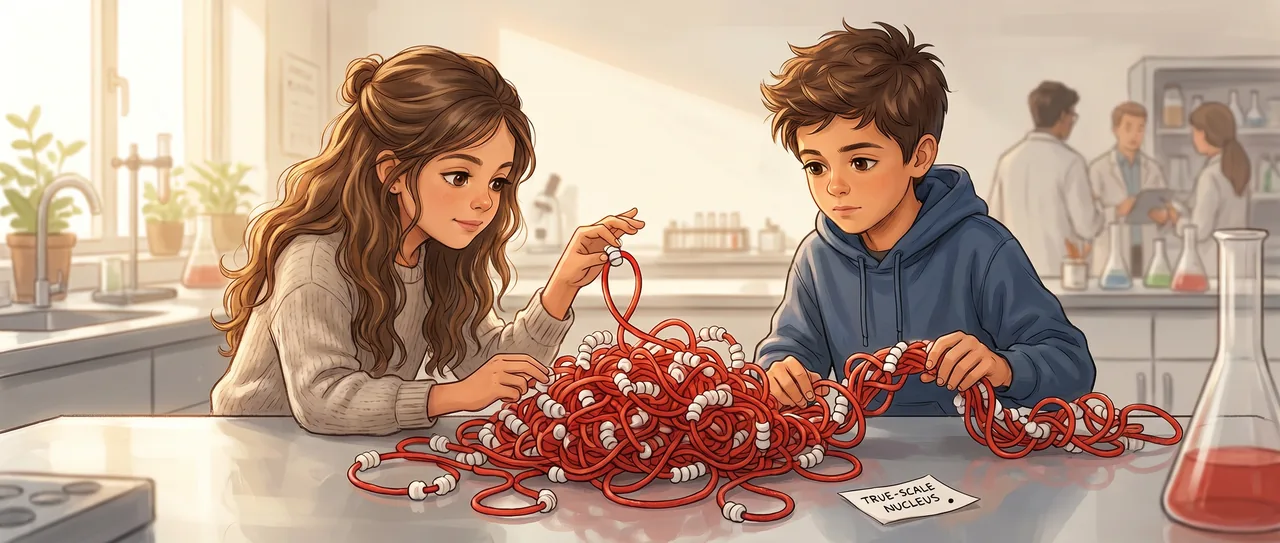
The Space Smaller Than Dust
The lab manager gave Maya and Soren two meters of red cord, a clear plastic globe, a tray of white beads, a box of paper clips, and seventeen minutes.
“Make the DNA packing station look friendly,” she said. She had a strip of tape stuck to one sleeve and a phone wedged between her shoulder and her ear. “Children love stuffing things into other things. Put the cord in the nucleus. Make it neat.”
Then she hurried away to argue with a coffee machine that was making coughing sounds.
The clear globe was the size of an orange.
Maya held it up. “This is wrong.”
Soren had already opened his notebook. “Maybe it is a scale model.”
“No,” Maya said. “If the DNA is two meters, the nucleus is not orange.”
Soren wrote one line, stopped, and wrote another. He pressed his pencil so hard the paper dented.
“If the cord is actual DNA length,” he said, “the nucleus should be six micrometers wide.”
Maya looked at the orange-sized globe.
Soren looked at the red cord lying across the lab bench, down one side, over his shoe, and under a stool.
“Six micrometers,” Maya said.
“About one twelfth the width of a human hair,” Soren said.
Maya pulled one of her hairs free, held it between finger and thumb, and laid it on the bench. It almost vanished against the steel.
“The nucleus is smaller than that?”
“Much smaller.”
The red cord had rolled off the stool and was making a lazy curve on the floor.
Maya crouched until her cheek almost touched the bench. The strand of hair was thin enough to be a line someone had forgotten to finish. The nucleus, at the cord’s true scale, would be a speck she could not pick up with tweezers. Not a tiny box. Not a miniature room. A nearly invisible place that somehow held the long red trail under the stool.
The lab seemed to grow in the wrong direction. Not outward, toward the ceiling and windows, but inward, into the clean metal bench, into the hair, into the skin of Maya’s thumb where cells sat packed with impossible strings.
Soren said, very quietly, “That is rude of biology.”
Maya smiled without looking up. “It’s excellent.”
They tried the lab manager’s way first.
Soren fed the cord into the plastic globe, circle after circle. Maya turned the globe so the cord would settle evenly. At first it looked promising, like red noodles in a bowl. Then the cord sprang out in a loop and knocked over the tray of beads.
“Stuffing is not packing,” Maya said.
“Stuffing is hiding,” Soren said.
They tried winding the cord around a cardboard tube from the recycling bin. It made a tight red spool.
“That fits,” Soren said.
Maya tugged on the middle of the cord. The whole spool jerked off the bench and bounced against Soren’s knee.
“Ow,” he said.
“Cells have to use the DNA,” Maya said. “Not just store it.”
Soren unwound the tube. “So the solution has to pack it and let one part come out.”
“And not tangle.”
“And not snap.”
“And fit where it absolutely cannot fit.”
The coffee machine hissed across the room. The lab manager said, “I am begging you, just make it cute.”
Maya picked up one of the white beads.
It was not round. It was slightly flattened, with a groove around its middle. The tray label said histone model, but the words were half covered by a price sticker.
Soren took another bead and rolled it under his fingertip. “Why would packing need beads? Beads make things bigger.”
Maya did not answer. She was already wrapping the red cord around the bead.
One turn. A second turn. Not quite twice around.
The cord came away from the bead in two loose arms.
Soren leaned closer. “It did not get shorter.”
“No,” Maya said. “It got handled.”
She wrapped another bead, then another, leaving a little red cord between them. The cord no longer slithered off the bench. It lay in a lumpy chain, red loops around white centers.
“Like beads on a string,” Soren said.
“Except the string is around the beads.”
He touched one red stretch between two beads. “Can you open here?”
Maya lifted one bead gently. A loop loosened. The rest stayed put.
Soren’s mouth opened. He closed it again and reached for the paper clips.
They clipped groups of bead-wrapped cord into loose loops. Not tight. Tight made knots. Loose made neighborhoods. Soren tested each loop by pulling one section free and letting it settle back. Maya changed the loops that snagged. She did not count them out loud. Her fingers moved from problem to problem, feeling where the cord wanted to twist.
The display did not look cute. It looked like a red city built on white moons.
“It still will not fit in the globe,” Soren said.
“Good,” Maya said.
“That is not usually what people mean by good.”
“The globe is lying.”
Soren looked at the orange-sized sphere. He looked at the two meters of cord, now folded into loops and beads, still too large for the fake nucleus. Then he tore a small square from the corner of a scrap label and made a dot on it with a fine black marker.
“What are you doing?” Maya asked.
“Making the nucleus for this cord.”
The dot was almost too small to see.
Maya placed the dot beside the heap of red and white loops.
The lab manager came back with a coffee cup in one hand and a stack of visitor badges in the other. She stopped.
“Where is the nucleus?” she asked.
Soren pointed to the dot.
The lab manager stared. “That is not friendly.”
“It’s honest,” Maya said.
The lab manager put down the badges. She was still frowning, but now it was the kind of frown that measured things. “Visitors cannot put the cord into that.”
“No,” Soren said. “That’s the point.”
Maya lifted one loop from the red city. “They can try the bad ways first. Stuffing. Spooling. Knotting. Then this.”
“Histones,” Soren said. “The DNA wraps around them. Then the wrapped parts fold more. Loops. Chromatin. Chromosomes when the cell divides.”
The lab manager’s frown changed again. It became almost a smile, but not the easy kind. “And you are going to explain that to seven-year-olds?”
Maya shook her head. “We’re going to let them try to pull one piece out without wrecking the whole thing.”
Soren clipped the marked dot to the front of the table. Under it he wrote, The real nucleus for this cord would be about this wide.
The lab manager read the sign twice.
Then she took the orange globe off the table and hid it under the bench with her foot.
The first visitors arrived in a rush of sneakers and jacket zippers. The lab manager began her welcome speech too loudly. The younger children pressed toward the tables, hands already reaching.
One small child grabbed the loose red cord Maya had left for the stuffing test and shoved it into a plastic cup. It jammed at once. Another wound cord around a pencil until it trapped the pencil completely.
“Now try this one,” Maya said.
She put the bead-wrapped chain on the table.
Soren held the far end steady. “Pick any red bridge between beads. Not the end. Somewhere in the middle.”
A child pinched a section and pulled. One loop rose. The nearby beads shifted. The rest of the chain stayed where it was.
The table went quiet in a way Maya liked better than cheering.
“So your cells do that?” the child asked.
“Almost every cell with a nucleus,” Soren said. “Cheek cells. Skin cells. Liver cells.”
“My elbow?”
“Yes.”
“My tongue?”
Maya looked at Soren.
Soren looked at the red loops, then at the children, then at the dot that was supposed to be a nucleus and was nearly nothing.
“Same long instructions,” he said. “Different parts opened.”
The child stuck out his tongue and crossed his eyes trying to see it.
Maya lifted the red cord from one white bead, and a small loop opened between her fingers.
Read the interactive version, listen to the narration, and earn a gold star →
A science-verified short story for curious kids · Curiosity Land