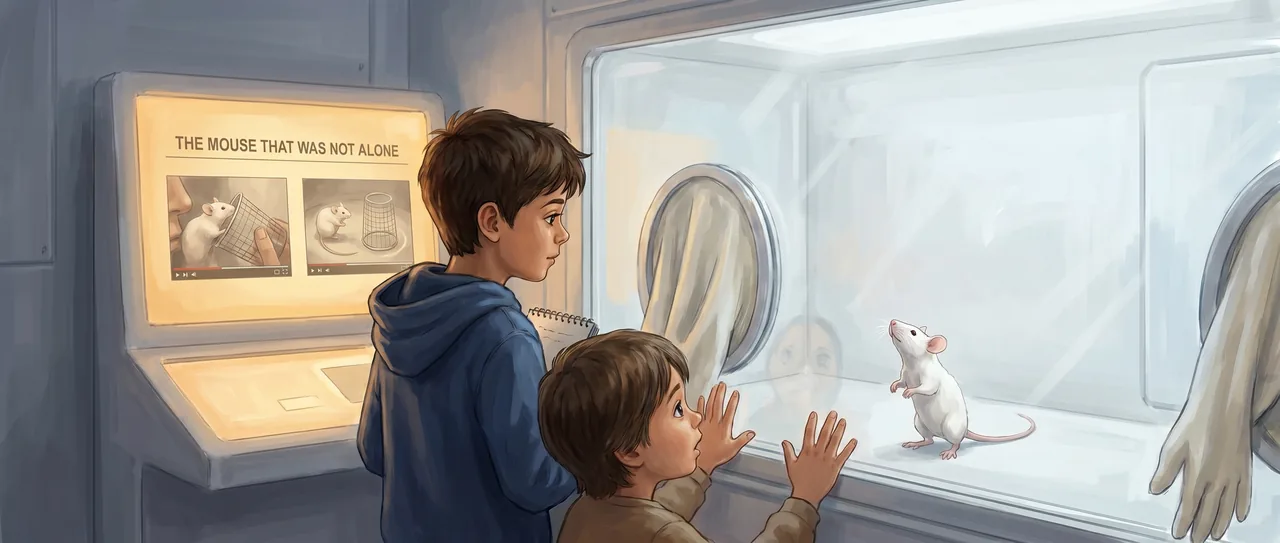
The Mouse That Was Not Alone
The title card already existed when Soren arrived.
THE PURE MOUSE, it said, in letters as white as the gloves sealed into the plastic wall.
Beyond the wall, a mouse stood inside a clear bubble of a room. Its bedding was pale. Its food pellets were pale. Even the little tunnel in the corner looked scrubbed of color. Two fat rubber gloves hung into the bubble from round metal rings, waiting for hands that were not there.
The outreach director tapped the screen with one finger.
"Cleanest animal in the building," she said. "No bacteria. No fungi. No viruses. Not in its gut, not on its fur, nowhere. Children love that part. Parents love it more. Can you click through the exhibit once and tell me if anything is confusing? I have donors in twelve minutes."
Soren looked through the glass at the mouse. It lifted its nose, whiskers moving.
"Pure means normal?" he asked.
"Pure means we can see what the mouse does by itself," the director said. She was already checking a message on her wrist screen. "That is the friendly version. Please do not make it a thesis defense."
Soren sat at the visitor console. His paper notebook lay beside the touchpad. The director glanced at it and made the small face adults made when they saw paper, the face that said extra equipment.
The first video began.
A mouse entered a three-room box. In one side room sat an empty wire cup. In the other side room sat a wire cup with another mouse inside it. The voice-over said, "Without microbes, we see the mouse as it truly is."
The mouse in the video sniffed the empty cup. It circled the empty cup. It put its paws on the empty cup as if the empty air inside had written it a letter.
It barely went near the cup with the other mouse.
Soren stopped the video.
He dragged the progress dot backward and watched again.
Empty cup. Empty cup. Quick sniff at the other mouse. Empty cup.
He opened the next clip. A different mouse entered the same three-room box. This one went almost straight to the stranger mouse and pressed its nose to the wire.
The label on both clips said GERM-FREE BASELINE.
Soren opened his notebook and drew two boxes. He did not write a conclusion. Conclusions were slippery if you put them down too soon.
The next screen showed a graph titled Stress Hormone After Brief Restraint. One line rose high. One line rose lower. The label under the higher line said ordinary mouse.
Soren frowned.
The next screen showed the inside of a mouse gut as a gentle diagram, not a photograph. One pouch, the cecum, was drawn huge on one side and small on the other. The huge one was labeled ordinary.
That made his pencil stop.
The director hurried back with a stack of plastic name badges hanging from her arm.
"How is it?" she asked.
"The mouse by itself is acting less like the ordinary one," Soren said.
"That is too philosophical for the lobby."
"Also the cecum is wrong."
The director looked at the screen. "The what is wrong?"
Soren pointed. "That pouch. Germ-free mice often have big cecums. If the diagram is right, the label is backward."
She blinked at him. "How do you know that?"
"I read the wall sign while I was waiting for you."
The wall sign was behind them. It said GNOTOBIOTIC ANIMALS in blue letters. Under it, a diagram showed sealed air, sterilized food, and a note about enlarged ceca in germ-free mice because gut contents move and ferment differently without microbes.
The director stared at the sign as if it had been rude on purpose.
"The file export lost some labels this morning," she said. "I matched them as best I could. Cleaner, simpler, calmer, that sort of thing."
"Maybe clean is not simpler," Soren said.
The director rubbed her forehead. "I have donors in nine minutes."
Soren opened the folder marked RAW CLIPS. Each file had a code in the corner, tiny gray letters. GF-seven. SPF-seven. GF meant germ-free. SPF meant specific pathogen free, ordinary lab mice without certain diseases, but not without gut bacteria.
The videos had codes. The graphs had codes. The immune charts had codes too, if he zoomed far enough.
"I can match them," Soren said.
"In nine minutes?"
"Maybe eight. If the codes are honest."
The director looked at his notebook, then at the donors gathering behind the lobby doors. "Do not touch the animal controls."
"I am touching the bad labels," Soren said.
She made a sound that was almost a laugh and left him there.
Soren made columns. GF-seven. SPF-seven. Three-room box. Stress graph. Cecum diagram. Immune chart.
The ordinary mouse, SPF-seven, carried pages of bacterial DNA in the sequencing report. Not pages exactly. Columns. Names like tiny countries, Bacteroides, Lactobacillus, Akkermansia, and many more he could not pronounce without taking them apart piece by piece. The germ-free mouse report was mostly blank where bacterial reads should have been.
Blank looked simple. Blank also looked like a missing bridge.
He dragged the social video of the mouse visiting the stranger under SPF-seven. He dragged the empty-cup video under GF-seven.
He dragged the high stress-hormone line under GF-seven. The chart note said corticosterone, higher after brief restraint in germ-free animals in this study. He mouthed the word once, not to memorize it, but to feel how large it was.
Cor-ti-cos-ter-one.
He dragged the large cecum diagram under GF-seven.
Then he opened the immune chart.
There were little bars for IgA, Peyer’s patches, and certain T cells. The germ-free bars were smaller. Not broken. Not sick in the simple way. Developed differently, the chart note said, because gut microbes help train parts of the immune system.
Train was a strange word for bacteria. Soren pictured no whistles, no uniforms, no teacher at the front.
The lobby doors opened.
Voices entered. Shoes squeaked. Someone said, "Where are the mice?"
The director hurried to Soren’s station. "Tell me you have something that will not embarrass the institute."
Soren clicked SAVE.
The title card changed.
THE MOUSE THAT WAS NOT ALONE.
The director stared.
"That sounds lonely," she said.
"It is the ordinary one," Soren said. "The ordinary one is not alone."
A small crowd gathered around the screen. The director began her welcome in her bright voice, but when the first video played, she stopped reading from her wrist.
On the screen, SPF-seven went to the stranger mouse.
"This mouse has a normal community of gut microbes," Soren said, before the director could smooth it smaller. His voice came out quieter than he wanted, so he said the next part more clearly. "This one spends more time with the other mouse."
The next video showed GF-seven circling the empty cup.
No one laughed. No one said gross. No one said germs like the word had teeth.
The stress graph rose. The cecum diagram appeared. The immune bars shifted lower.
The director leaned toward the microphone. "Germ-free mice help researchers ask what changes when those microbes are missing," she said. She looked once at Soren’s notebook. "The answer is, many things."
A child in the crowd pressed both hands to the glass. "So the bacteria are part of the mouse?"
The director opened her mouth.
Soren looked at the sealed bubble, the pale bedding, the rubber gloves waiting for careful hands. GF-seven stood on its back legs and sniffed at the air it could not share.
"They are not mouse cells," Soren said. "But the mouse grows up differently without them."
The child did not move away from the glass.
The director did not add a simpler sentence.
After the visitors drifted toward the sequencing room, Soren stayed by the isolator. The title card looped behind him. THE MOUSE THAT WAS NOT ALONE. Then the videos began again, stranger mouse, empty cup, rising line, quiet bars.
On the table beside the console was a basket of sealed take-home gut microbiome study kits, each small box printed with a barcode and a consent form tucked beneath the flap.
Soren picked one up and turned the unopened box until the barcode faced his palm.
Read the interactive version, listen to the narration, and earn a gold star →
A science-verified short story for curious kids · Curiosity Land