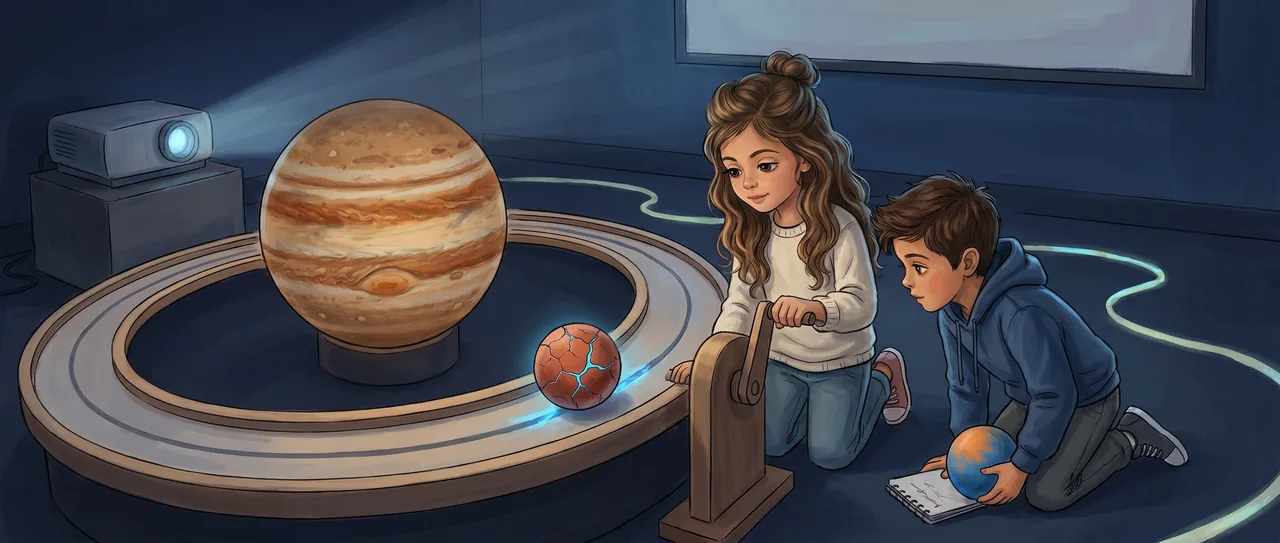
The Moon That Would Not Freeze
The blue ball labeled EUROPA'S OCEAN was bigger than the blue ball labeled EARTH'S OCEANS.
Soren stopped walking.
Maya nearly bumped into him. She had been following the trail of glow tape through the dark exhibit room, past the cardboard Saturn rings and the half-built Mars rover wheel, but Soren had gone still in front of the water display.
"Those are switched," he said.
The exhibit manager, who had a pencil behind one ear and a strip of tape stuck to her sleeve, looked up from a projector menu. "What is switched?"
Soren pointed. "The oceans. Earth is the ocean planet. Europa is an ice moon."
"Then fix it," the manager said. "Doors open in fifteen minutes, and the stars are currently upside down."
She turned back to the projector, where Orion was standing on his head.
Maya leaned close to the two blue balls. They were clear plastic, each filled with water and a slow swirl of glitter. Earth's ocean ball was a little smaller than a tennis ball. Europa's was closer to an orange.
Behind them sat two worlds on black stands. Earth wore blue and brown and white. Europa was smaller, white as old chalk, scratched all over with reddish lines.
"It feels wrong," Soren said.
"It looks wrong," Maya said.
"Same thing?"
"Not always."
Soren pulled his paper notebook from his back pocket. Everyone at school used wrist screens or air tabs. Soren's notebook had bent corners and one page held in by a strip of clear tape. He flipped to a blank page, frowned, then shut it again.
"No," he said. "Not yet. If I write down the wrong thing, it starts pretending to be true."
Maya had already lifted the smaller blue ball. The label on its stand said ALL EARTH'S OCEAN WATER, GATHERED INTO ONE SPHERE. She turned the Earth model with one finger. The painted Pacific slid past. The Atlantic. The Indian Ocean.
"It covers so much," she said.
"Most of the surface," Soren said.
Maya tapped the model lightly. "Surface."
Soren looked at Europa. No seas. No clouds. Just ice and scratches.
"Hidden doesn't make it bigger," he said.
Maya grinned. "It can."
There was a third stand, empty, with a crank and a sign that read TURN JUPITER. A basketball-sized striped planet sat at the center of a metal oval track. On the track was a small mount for Europa. A rubber version of the moon lay on the floor underneath, as if it had fallen off.
Maya picked it up. It was soft under its white shell, not hollow, but squishable. When she squeezed it, the reddish cracks narrowed.
"The moon has a squish moon," she said.
"Probably for tides," Soren said.
"Ocean tides?"
"Gravity tides. Maybe. The Moon pulls Earth's oceans. Jupiter pulls Europa."
He put the rubber Europa back on the mount and turned the crank.
Nothing happened.
The handle stuck. Somewhere inside the oval track, a gear clicked with a tiny, stubborn sound.
"Broken," the exhibit manager called without looking over. "Please tell me it is not broken."
"It is thinking," Maya called back.
Soren knelt by the track. "It is a gear."
"Gears think in teeth."
"That is not true."
"It is a little true."
Soren found a loose pin under the edge of the stand. He slid it back into a hole where two metal arms met. The arms were attached to opposite sides of Europa, one pointing toward Jupiter and one away.
"Try now," he said.
Maya turned the crank slowly.
Europa rolled along the oval track. As it came near Jupiter, the arms tugged at it. The rubber moon stretched, just a little. Farther around the oval, the arms eased. Then tugged again. Stretch, ease. Stretch, ease.
Soren watched without blinking.
"It is not just being pulled," he said.
"It is being changed," Maya said.
The manager walked over at last, still holding the projector remote. "Does the crank work?"
"Yes," Soren said. "But the ocean labels are still suspicious."
"The labels came from the science office," the manager said. "Mostly. I think. Unless the shipping cartons lied."
She looked toward the doors, where a muffled crowd hummed outside. "I need three minutes to convince Orion to lie down. Please do not flood anything."
She hurried away again.
Maya kept turning the crank. Europa flexed in and out as it moved around Jupiter.
"A moon that far from the Sun should be frozen all the way through," Soren said.
"Unless the heat is not from the Sun."
Soren's eyes moved to the oval track. "Its orbit is not a perfect circle. Sometimes closer to Jupiter. Sometimes farther. The pull changes."
Maya squeezed the rubber moon in rhythm with the crank. "Squeeze. Unsqueeze. Squeeze. Unsqueeze."
"That can make heat," Soren said.
Maya looked at him.
"Can it?"
Soren pulled a paper clip from the manager's abandoned stack of programs. He bent it back and forth, fast. After several bends, he held it out.
Maya touched the bend with one fingertip.
"Warm," she said.
"Not fire warm. But warm."
"A whole moon warm?"
Soren looked at Jupiter, huge on its stand. The little rubber Europa went around and around it, never quite escaping the tug.
"For a very long time," he said.
Maya stopped turning the crank.
The room seemed to hold still.
Soren reached for the orange-sized blue ball and held it in both hands. "Twice Earth's oceans?"
Maya read the small card tucked behind the stand. "Estimated. It says estimated."
"Good," Soren said.
"Why good?"
"Because if they said exactly, I would not trust it."
Maya laughed once, softly.
Soren placed the bigger blue ball beside Europa. It looked impossible there, next to the little white moon. Then he picked up the Earth ocean ball and held it against the Earth model. The continents and seas covered a big world, but the gathered water was small enough to hide in his palm.
"Earth wears its oceans outside," Maya said.
Soren put the smaller blue ball down. "Europa might keep more water under the ice than Earth has on its whole surface."
Maya touched one reddish crack on the hard display moon. The lines crossed and doubled back. Some places were jumbled, as if rafts of ice had broken and shifted and frozen again. The strange parts were not decoration. They were the reason anyone had thought to ask.
"If it had looked normal," she said, "we might have missed the ocean."
Soren opened his notebook now. He did not write a sentence. He drew a circle with another circle hidden inside it, then Jupiter beside it, much too large for the page.
Maya looked over his shoulder. "Your Jupiter is eating the margin."
"Jupiter does that," Soren said.
The doors opened before the manager could stop them. A spill of voices entered the exhibit room. Shoes squeaked. Someone gasped at Saturn. Someone else said the rover wheel was smaller than expected.
The manager hurried over. "Is the Europa display fixed?"
Soren looked at Maya.
Maya looked at the two blue balls, the crank, the cracked white moon, and the huge striped planet waiting in the center of the oval.
"It was not broken," Maya said. "It was missing the part where the wrong thing is the clue."
The manager stared at her for half a second, then at the line of visitors coming closer. "Can you run it?"
Soren set the Earth ocean sphere in its place. Maya set the larger one beside Europa.
A little boy near the front pointed. "That moon has more water than Earth?"
"Maybe," Soren said.
The boy frowned. "But it is ice."
Maya put her hand on the crank. "Watch the ice."
Soren pressed the crank into Maya's hand. She turned it once. Europa's white shell squeezed inward, eased back, and a blue ring shone through the cracks.
Read the interactive version, listen to the narration, and earn a gold star →
A science-verified short story for curious kids · Curiosity Land