The Map That Wouldn't Fit
By three in the afternoon, the brain had already failed.
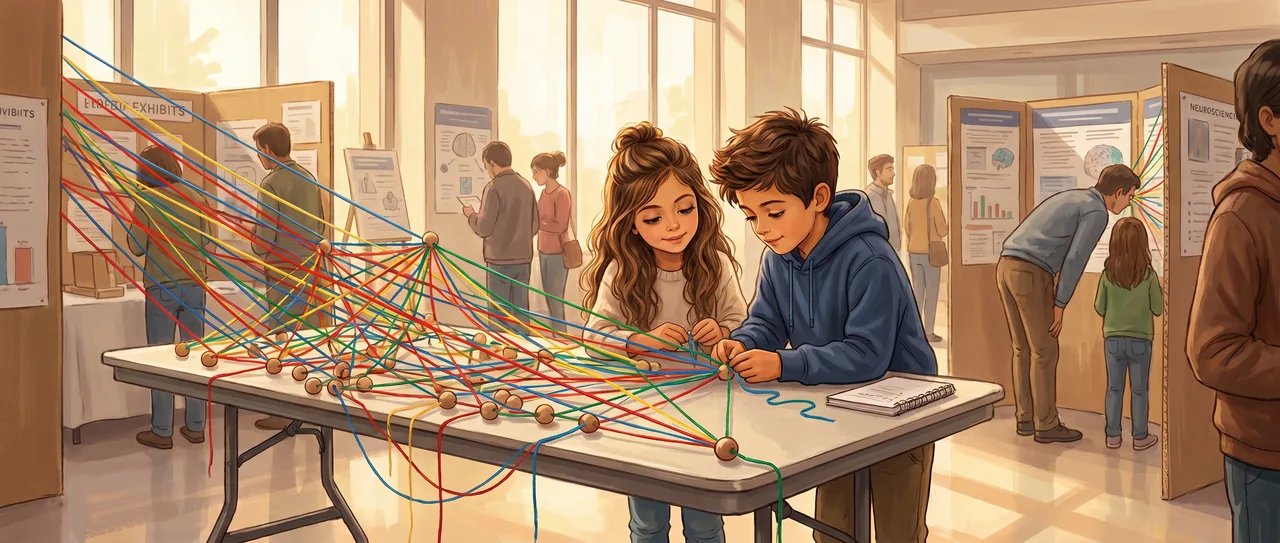
It lay across the folding table in the neuroscience institute lobby, made of wooden beads, silver wire, and three kinds of string. Maya was under the table, holding a knot in her teeth. Soren was above the table, trying to make the beads stop sliding into a heap.
“This is not a brain,” Maya said around the knot.
“It is supposed to be a model,” Soren said.
“It is supposed to be a bad model.”
Soren looked at the instruction card again. Build a simple network. Show how neurons pass signals. Keep it neat for visitors.
The last sentence was underlined twice by the open house coordinator, who had already rushed past them four times carrying a box of name tags, a roll of tape, and half a sandwich. She believed in labels. She believed in clear arrows. She believed children should leave with one idea they could say in the car.
Maya crawled out and pointed at the row of beads Soren had made. “One, two, three, four. Like a train.”
“Signals can travel along chains,” Soren said.
“But my thinking does not feel like a train.”
Soren did not answer right away. He had been trying not to think the same thing.
The institute lobby smelled like coffee, dust, and new plastic. Around them, other exhibits were almost ready. A giant foam brain sat on a cart with colored lobes. A screen showed green branches of neurons grown in a dish. Near the windows, a real neuroscientist was arguing with a projector that refused to speak to her laptop.
On their table sat eighty-six wooden beads, one for each billion neurons in a human brain. Beside them lay a small card that said, A neuron may connect to as many as ten thousand others.
Soren had read that card six times. Then he had written the numbers in his notebook because the inside of his head had felt crowded.
Eighty-six billion.
Ten thousand.
Not all the same. Not all connected to all. Changing with use. Living tissue, not beads.
He had tried to scale it down. If one bead stood for one billion neurons, how many strings should one bead get? The answer became silly almost immediately. Not difficult. Silly. Like trying to pour a swimming pool into a thimble and being surprised when your shoes got wet.
Maya picked up the instruction card and turned it upside down. “The wrong part is ‘neat.’”
The coordinator hurried over. Her glasses were on top of her head, and two pencils were tucked behind one ear. “How are my junior exhibit designers?” she asked.
“The brain is refusing,” Maya said.
The coordinator looked at the collapsed strings. “It only needs to show the idea. One neuron sends a message to the next. Nice and simple.”
Soren said, “But that makes it seem like thoughts are lines.”
“For five-year-olds, lines are friendly,” the coordinator said. The projector across the lobby made a loud unhappy beep. She pointed at them with the sandwich. “Make it work. Visitors in twenty minutes.”
She ran away.
Maya watched her go. “She wants a car idea.”
“What?”
“One idea you can say in the car.”
Soren touched one bead. It rolled, tugged four strings, and made six other beads move.
He turned to a blank sheet of cardboard. “What if we do not show one thought?”
Maya’s eyes moved faster than his words. “Show why one thought will not fit.”
They stripped the table.
The first version took seven minutes and failed in six.
They taped the eighty-six beads flat to the cardboard in a wide, uneven scatter. Soren refused rows. Maya refused symmetry. They tied red thread from one bead to three others, then blue thread from those to five more. It looked better, but still too clean, like a spider had followed instructions.
“No,” Maya said.
Soren pulled out his notebook and started making small marks. “If each bead can choose connections, even just a few, the number of possible maps grows fast.”
“How fast?”
He took the exhibit tablet, opened the calculator, and began entering choices. Ten beads. Then twenty. Then more possible links than he wanted to count by hand. The screen gave him a long number, then another longer number, then a message that meant the calculator had run out of room.
Maya leaned over his shoulder. “It broke?”
“Not the math,” Soren said. “Only the box holding it.”
He wrote atoms in observable universe on the cardboard, then stopped.
Maya looked from the tiny beads to the lobby windows. Outside, afternoon light flashed on the glass towers across the street. Cars moved. People crossed between buildings. Somewhere inside every person passing the windows, a wet forest of cells was firing in patterns no wall could hold.
She took the marker from Soren and crossed out the title on the instruction card.
Simple Brain Network became The Map That Wouldn’t Fit.
Soren said, “We need rules.”
“Brains have rules,” Maya said. “Not straight lines.”
They made the visitors’ table into a challenge.
Each person would choose one bead to start. Then they would tie thread to any three beads that felt connected to it. Not correct. Connected. A smell to a place. A song to a color. A number to a shape. A word to a memory. After that, the next person had to begin from one of the beads someone else had touched and make three new connections.
Soren wrote the facts on three small cards, because facts behaved better when they had space around them.
Your brain has about eighty-six billion neurons.
A neuron can connect to thousands of others, sometimes up to ten thousand.
The possible connection patterns are more numerous than the atoms in the observable universe.
Maya added one more card and did not ask permission.
No two maps have to match.
The coordinator came back with five minutes left. She stopped in front of the table.
“Oh,” she said.
Thread crossed everywhere. Red, blue, yellow, green. The beads were already hard to see under the first layer. Soren had left a basket of cut threads at one end, and Maya had taped an empty bead near the far corner with no label at all.
The coordinator opened her mouth, closed it, then looked at the lobby doors where the first families were entering.
“It is not neat,” she said.
“No,” Maya said.
The coordinator looked at the projector, which had begun beeping again. “Fine,” she said. “But if anyone gets tangled, that is yours.”
The first visitor was a small kid in a dinosaur shirt who chose the bead closest to the edge.
“What does this one mean?” the kid asked.
“Anything you start with,” Soren said.
The kid tied one thread to a bead near the top. “This is soup,” he said. He tied another to a bead on the left. “This is rain.” The third he tied to the empty bead.
Maya crouched to see the pattern from the side. “Why that one?”
The kid shrugged. “No reason yet.”
Soren handed him another thread. “Brains are allowed to have no reason yet.”
More visitors came. A teenager connected the smell of chlorine to summer and the number seven. A grandmother connected a song to a yellow bead and laughed before she said why. A man in a lab coat tied coffee to panic and everyone behind him nodded.
The web thickened.
Soon people had to lift threads carefully to pass new ones underneath. The connections did not spread evenly. Some beads became crowded. Some stayed almost bare. One blue bead collected music, rain, the moon, and the word almost. Maya kept glancing at it.
At school, when a teacher asked for one favorite subject, Maya always had too many answers, and the answers touched. Beetles touched robots. Robots touched ocean vents. Ocean vents touched the smell of pennies. On the table, the crowded blue bead did not look wrong. It looked busy.
Soren watched a girl connect math to orange, then orange to a grandfather, then grandfather to electricity. He did not ask her to explain. His notebook pages were like that too, arrows crossing margins, lists turning into sketches, questions interrupting other questions. The table did not make the crossings tidy. It gave them somewhere to go.
The neuroscientist whose projector had finally surrendered came over during a quiet minute. She bent close, sandwich crumbs on her sleeve.
“You made a connectome nobody can read,” she said.
Soren straightened. “A complete human connectome would be much worse.”
The neuroscientist smiled. “Much, much worse.”
Maya said, “Worse means better here.”
The neuroscientist looked at the empty bead with three threads already tied to it. “Yes,” she said. “Here, I think it does.”
Then someone at the back called for help with the foam brain, and she left.
By the end of the hour, the table was no longer a table. It was a low cloud of thread. People bent down to look through it. The beads flashed and vanished. Every new thread changed the paths that were easy to see.
Soren tried to find the first red connection they had tied. He could not.
Maya took one loose blue thread from the basket. Soren held out the green thread still looped around his finger. They tied the two ends to the empty bead, and when the air conditioner clicked on, the whole web trembled.
Read the interactive version, listen to the narration, and earn a gold star →
A science-verified short story for curious kids · Curiosity Land