The Fire That Made a Bridge
By ten in the morning, everyone at the rail museum had decided the broken part should stay broken.
The broken part was only the width of Maya’s thumbnail. It sat between two short pieces of rail in the new exhibit called The Future Track. A little inspection car was supposed to roll along the rails while its screen showed vibration, temperature, and sound. Instead, every time the car reached the gap, it hopped, squeaked, and reset itself.
Mr. Bell loved the squeak.
“That is the sound of railroading,” he said. He was the museum curator, and he wore a vest with a watch chain even though his watch was digital. “Clackety-clack. Children expect it.”
Maya crouched beside the track. “It’s the wrong sound.”
“It is the famous sound,” Mr. Bell said.
Soren had his ear near the rail, not touching it. He rolled the car backward. The wheels went click, click, squeak, dead.
“The screen dies before it can measure the interesting part,” he said.
“The interesting part is the clack,” said Mr. Bell.
Maya stood. “Not for future trains.”
Mr. Bell looked at the clock on the wall. The museum opened in two hours. Outside, beyond the big doors, workers were setting orange cones around a real piece of track for the afternoon demonstration. A sign read THERMITE WELDING, KEEP BACK.
“We will put a little speaker under the table,” Mr. Bell said. “It can play a smooth train sound after the clack.”
Soren wrote down, speaker is lying.
Maya saw it and grinned. “Yes.”
Mr. Bell missed the grin. He was already carrying a box of fake coal toward the gift shop.
The welding crew had a clay mold shaped around two cut rail ends. Beside it stood a tall pot on legs, dull and ordinary, like something for soup if soup could scare everyone into wearing face shields.
Ms. Ibarra, the welder in charge, checked a clipboard with a pencil tucked behind one ear. Her gloves were silver at the backs and black at the palms. She spoke fast, because every minute seemed to be tugging on her sleeve.
“You two are behind the rope,” she said before they asked anything. “Behind means behind.”
“We are behind,” Maya said.
Soren pointed to the pot. “Is that where the thermite goes?”
Ms. Ibarra gave him a look that was not unfriendly, only busy. “Iron oxide and aluminum powder. It burns hotter than two thousand five hundred degrees Celsius. It melts iron. It is not a campfire. If it starts, nobody throws water on it. Water can flash into steam and throw hot metal. We keep clear and let the reaction finish.”
Maya looked from the pot to the rail gap in the clay mold. “So it doesn’t need water to lose.”
“It does not lose to water,” Ms. Ibarra said.
Soren stopped writing.
Most fires he knew were arguments with air. Blow away the air, or cool the fuel, or drown the match, and the fire stopped arguing. But this one had its oxygen packed inside rust. The crumbly orange stuff under old bikes and fence bolts was not just rot. It was carrying a piece of the reaction inside it.
Maya said, very softly, “It brings the missing part with it.”
Soren looked at the exhibit rails through the open doors.
“What?” Maya asked.
He did not answer yet. He ran back inside.
The car was still dead at the gap. Soren measured the space between the wooden blocks that held the display rails. Maya measured the demonstration rail outside with her eyes first, then stole Soren’s tape measure and checked. The short demonstration piece was longer, but not too long. The end blocks could move. The wires could reach if they came up through the left slot instead of the right.
Mr. Bell returned with a cardboard moon that belonged to the space exhibit and had somehow ended up in the locomotive shed.
“We need the welded rail after the demonstration,” Soren said.
Mr. Bell hugged the moon. “Absolutely not.”
“For the exhibit,” Maya said. “Not as decoration. As the track.”
“It will be hot,” Mr. Bell said.
“After it cools,” Soren said.
“It will be heavy.”
“The crew has a cart,” Maya said.
“It will have no clack,” Mr. Bell said.
“That’s the point,” said Soren.
Mr. Bell opened his mouth. Outside, Ms. Ibarra called for the dry run. The crew lowered the empty crucible into place. It lined up above the mold, exactly where the two rail ends waited with a slice of air between them.
Maya pointed. “Your exhibit says future track. That gap says old track.”
Mr. Bell looked at the little inspection car. He looked at the big sign he had painted himself. THE FUTURE TRACK.
“The public demonstration piece is not mine to give,” he said.
“It does not need to be given,” Soren said. “It can be borrowed by the future.”
Mr. Bell snorted. Then he went outside to ask Ms. Ibarra.
At noon, the museum filled with families. By three, the crowd stood behind the ropes. Maya and Soren stood at the front because Ms. Ibarra had put two pieces of yellow tape on the pavement and said, “Curious people may stand there if their feet understand law.”
Their feet understood.
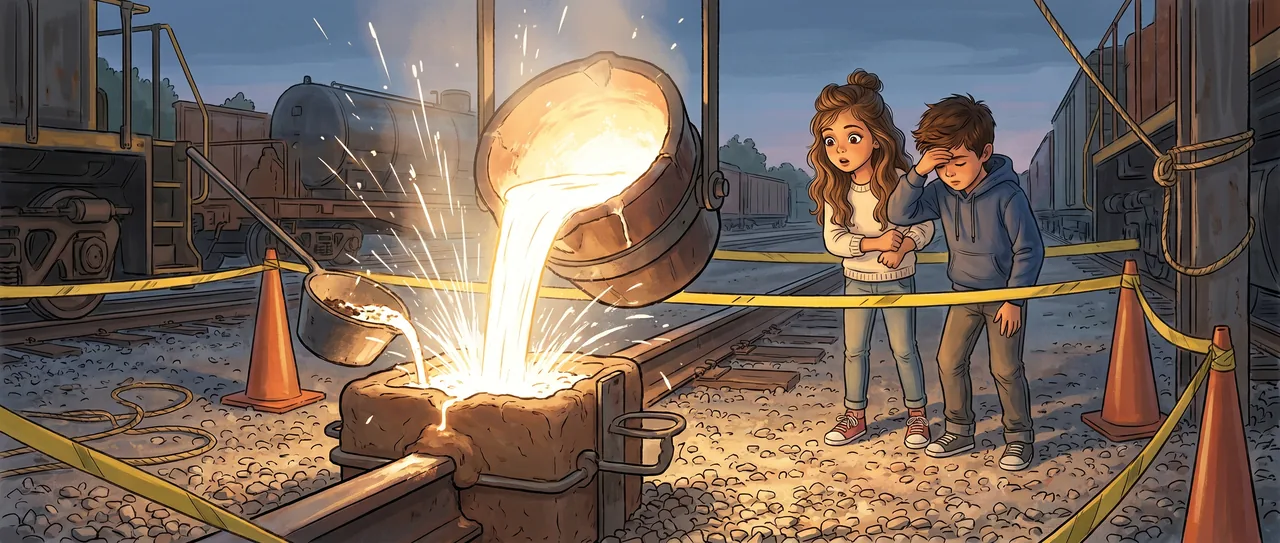
Ms. Ibarra poured the thermite mixture into the crucible. It looked like dark sand. Nothing about it looked strong enough to join railroads.
A worker lit the starter.
For one breath, nothing happened.
Then the pot became a small white sun.
Maya’s teeth clicked shut. Heat touched her face from across the safety space, not like summer heat, not like oven heat, but like a giant invisible hand had opened in front of her. Sparks leaped upward. The crucible roared. People stepped back without being told.
Soren tried to look at the fire and could not. He looked at the ground instead, where the white light shook in little pieces on every bit of gravel.
The reaction did not flicker like wood. It poured brightness. It was doing its work from inside itself.
Ms. Ibarra’s gloved hand lifted. The bottom of the crucible opened.
Molten metal dropped into the mold.
It was not red at first. It was too bright for red. It fell in a stream, thick and shining, and the clay mold swallowed it around the rail ends. Slag spilled into a side cup. Smoke curled upward. The crowd made one sound, not a cheer, not a gasp, but something with both inside it.
Maya’s hand found Soren’s sleeve and squeezed once.
He did not mind. He had forgotten that sleeves were separate from arms.
When the light died down, the rail still glowed through the seams of the mold. The reaction was finished, but no one rushed toward it. No hose appeared. No bucket. The crew waited while the new metal held its heat.
Mr. Bell whispered, “All that from rust?”
“And aluminum,” Soren said.
Maya said, “And the part where it was not really just rust.”
Late in the afternoon, after the mold was broken away, after Ms. Ibarra inspected the weld, after the rail had cooled enough for the crew to move it with hooks and thick gloves, the demonstration piece came inside on a low cart.
The old display rails came out. Maya loosened the end blocks. Soren fed the sensor wire through the left slot. Mr. Bell held screws in his mouth and forgot to look antique.
The welded rail settled into the cradle.
There was a bulge where the mold had been. It had been ground smooth on top, but the sides still showed a faint change in shape, like a scar that had decided to become useful.
Soren set the inspection car at one end. The screen blinked awake. Maya put one finger in the air, the way Ms. Ibarra had before the pour.
“Run,” she said.
The car rolled forward. Its wheels hummed on the steel. The line on the screen trembled, but it did not jump. The car crossed the welded place and kept going.
Mr. Bell waited for the clack.
There was none.
A little boy at the rope frowned. “It missed the sound.”
Soren moved the car back to the start. “Listen again.”
The boy leaned close. So did three other children. So did Mr. Bell.
The car rolled. The screen drew a thin green line across the place where two rails had become one.
Outside, the real track shone in the lowering sun, its new joint cooling beside the cones.
Maya set the little steel wheel on the new rail.
It rolled over the place where the gap had been and kept going.
Read the interactive version, listen to the narration, and earn a gold star →
A science-verified short story for curious kids · Curiosity Land