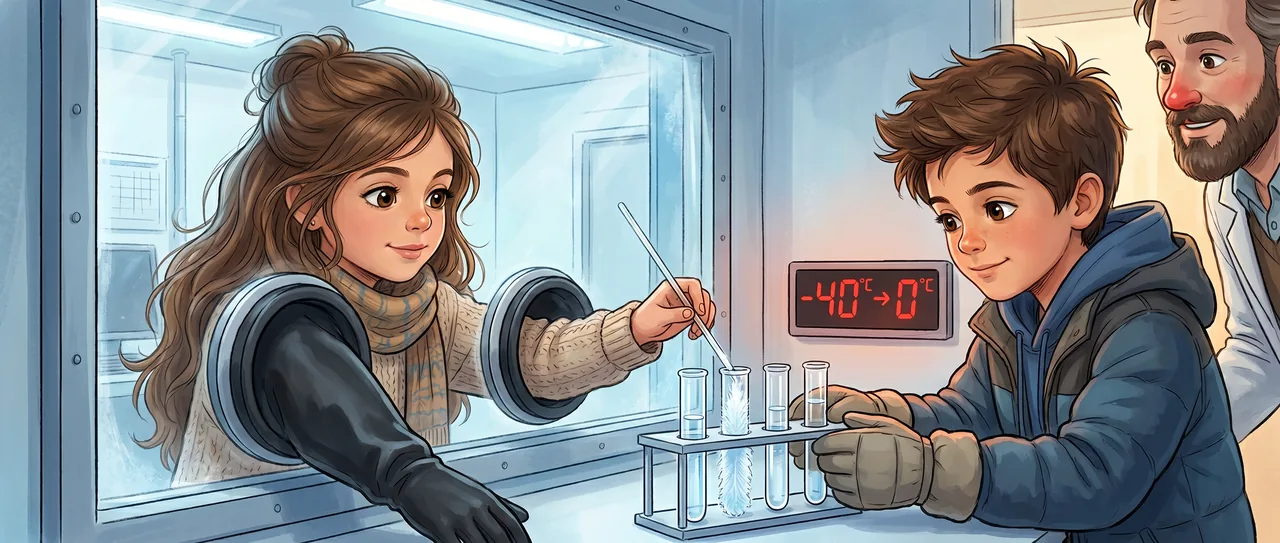
The Clear Ones
The first thing Soren wrote down was not a question.
It was the temperature on the cold room display.
Minus forty degrees Celsius.
He wrote it carefully because minus forty was the place where Celsius and Fahrenheit stopped arguing and became the same number. That seemed like the sort of thing the universe did when it wanted attention.
Maya was already giving the universe attention.
She had her forehead almost against the thick glass window of the cold room. Beyond it, under white lights, trays of sealed glass tubes sat on blue foam. Each tube was no longer than her thumb. Some were cloudy white. Most were clear.
“That’s wrong,” Maya said.
Mr. Vale, the building technician, did not look up from the tablet in his hand. He had a gray beard, a red nose from the cold, and the expression of someone whose evening had been eaten by machines.
“The compressor says it’s working,” he said. “The chamber says minus forty. The pea soup in there is a brick. The orange juice is a brick. The sponge is a brick. But the water is not a brick. So either the chamber is lying or the water delivery people sent us something ridiculous.”
“It says purified water,” Soren said, reading the label on the tray.
“Then it should be purified ice,” Mr. Vale said.
Maya’s eyes moved along the rack.
“Not all of it,” she said.
Mr. Vale sighed. “Exactly. Half failed one way, half failed another. Dr. Cale wanted her big instant cloud demonstration for the families, and what she has is a tray of nonsense.”
He tapped the tablet with one thick finger. Somewhere behind the wall, a motor shuddered. In the cold room, one of the cloudy tubes rattled faintly against the metal side of its rack.
Maya straightened.
“Do that again,” she said.
“I am not doing anything for science right now,” Mr. Vale said. “I am trying to keep science from emailing me.”
He walked away toward the compressor room, muttering about service logs.
Soren looked through the glass. “He thinks the clear ones are the failure.”
Maya said, “Maybe the cloudy ones are.”
“They’re ice.”
“Maybe they stopped being the thing we need.”
Soren liked sentences that had handles on them. That one had none. He opened his notebook, then shut it again because his gloves were too stiff.
The cold room could not be entered during setup, not by children. But it had two black glove ports built into the wall. They hung there like walrus flippers, meant for moving things inside without letting in warm, wet air. Beside the ports was a strip of instructions in large letters.
No bare hands. No open containers. Move slowly. Do not bump the rack.
Maya read the last line twice.
“Why that one?” she asked.
“Because glass breaks,” Soren said.
“No. The tubes on the left are cloudy.”
Soren leaned closer. The left side of the rack touched a metal brace. The right side rested on foam. A little fan spun at the back of the chamber. Every few seconds, its hum deepened, and the metal brace trembled so slightly that Soren could see it only by watching the reflection of a light in the glass.
Left side, metal, vibration, cloudy.
Right side, foam, still, clear.
Soren’s mouth went dry in the way it did when something he knew as a fact suddenly grew teeth.
“I read about this,” he said.
Maya kept watching the tubes. “Good. Say the useful part.”
“Water can get colder than freezing and stay liquid if it is very pure and nothing gives ice a place to start.”
Maya lifted one hand toward the glass, then stopped before touching it.
“It is below freezing,” she said.
“Yes.”
“It is still water.”
“Yes.”
“At minus forty.”
Soren looked at the display again. The red numbers did not blink. Minus forty.
He had known water froze at zero. Everyone knew that. It was one of those facts that stood in the world like a fence. But behind the glass, clear water sat far past the fence, quiet and impossible-looking, as if the fence had never been a wall at all.
Maya said, very softly, “It’s waiting for a start.”
Dr. Cale hurried in carrying a plastic tub of tangled cables.
the window and made a sound like a balloon losing air.
“Oh no. Still liquid. We’ll use the video.”
“Don’t,” Maya said.
Dr. Cale blinked at her. “The families arrive in twelve minutes.”
“The clear ones are the show,” Soren said.
Dr. Cale looked from Soren to Maya to the cold room. “They are the part that did not freeze.”
“That’s why,” Maya said.
Soren pointed to the left side of the rack. “The ones touching the metal froze. The ones on the foam stayed liquid. The fan vibrates the metal.”
Dr. Cale opened her mouth, closed it, and stared harder.
Maya had already slid both arms into the glove ports.
“May I?” she asked, which for Maya meant she was trying very hard to be polite before doing the thing anyway.
Dr. Cale hesitated. Her eyes went to the clock, then to the clear tubes. “Slowly. If one breaks, I will make a noise no scientist should make in public.”
Maya moved the padded gloves inside the chamber. They were clumsy and huge. Soren stood beside her and watched the tube nearest the middle, the clearest one, the one sitting perfectly on the foam.
“Not that one,” he said.
Maya froze.
“The next one. It’s farther from the frozen side. Less chance it already started.”
Maya shifted to the next tube. She did not touch it. She picked up a thin glass rod from the tray beside it, the kind Dr. Cale had set out for demonstrations. The rod clicked faintly in the glove’s grip.
“Tap or shake?” Maya asked.
“Tap,” Soren said. “One small start.”
Dr. Cale whispered, “Oh.”
Maya touched the rod to the side of the clear tube.
Click.
For half a heartbeat, nothing happened.
Then the whole tube flashed white.
It did not freeze from the top. It did not freeze from the bottom. A pale burst shot through it all at once, branching and blooming so fast Maya jerked backward inside the gloves. Clear water became a white feather trapped in glass.
Soren laughed once, too loudly.
Dr. Cale did make a noise no scientist should make in public.
On the tiny probe clipped to the rack, the temperature number jumped upward, racing away from minus forty before slowing near zero. Soren stared at that too.
“It got warmer,” he said.
“It froze and warmed up,” Maya said. “That is rude.”
Dr. Cale laughed, then clapped both hands over her mouth because the first families had appeared outside the hallway doors.
A small child pressed a face to the glass. Behind him came parents, coats, scarves, squeaking boots, the smell of wet wool and winter air. Mr. Vale returned from the compressor room with a wrench in one hand.
“The chamber is not broken,” Soren said.
Mr. Vale looked at the white tube, then at the clear ones still waiting on the foam.
Maya pulled her arms out of the glove ports. Her cheeks were bright. “Do not throw out the wrong ones.”
Dr. Cale set the tub of cables on the floor and turned to the gathering crowd. “Change of plan,” she said. “You are about to see water colder than any snow in this city decide, very suddenly, to become ice.”
Soren glanced at the poster taped beside the window. He had been too busy before to read the bottom line.
In some clouds, tiny droplets of liquid water remain unfrozen below zero until dust, ice, or motion gives crystals a beginning.
He looked past the poster, through the glass, at the clear tubes. They were not empty-looking now. They looked full of almost.
Maya slid her mitten into the glove port. Soren steadied the rack with both padded hands. The clear tube waited under the tip of the glass rod.
Read the interactive version, listen to the narration, and earn a gold star →
A science-verified short story for curious kids · Curiosity Land