The Card That Would Not Stay Sorted
The planetarium dome was still dark when the universe made the wrong sound.
It was supposed to go hush, then swell with music, then let the narrator say, Some flashes come from so far away that their light has crossed half the history of everything.
Instead, the speakers snapped.
Not crackled. Snapped.
A single hard click, so short that Maya saw three teachers in the front row look up after it was already gone.
The planetarium director stuck her head out of the control booth. Her hair had two pencils in it and a third pencil behind her ear, which seemed unfair to the first two.
“That click is correct,” she said to the empty seats. “It is meant to be startling. Please do not report the speakers.”
Maya had been sitting in the back row because back rows were better for seeing patterns in crowds and ceilings. She raised her hand even though rehearsal did not require hands.
“The next sentence is wrong,” she said.
The director looked at the clock above the exit. A bus of sixth graders was due in nine minutes.
“The next sentence is classic,” the director said.
The dome filled with the recorded voice.
Fast Radio Bursts are among astronomy’s strangest mysteries. No one knows what makes them.
“Expired,” Maya said.
The director closed her eyes for half a second. “Mostly not expired.”
“That is different.”
“Everything is different if you have enough time,” the director said. “I do not have enough time.”
Maya stood. She had not meant to. Her feet had made the decision when the word expired came out. “One was traced.”
The director came down the aisle with a tablet in one hand and a strip of Velcro stuck to her sleeve. “To what?”
“A magnetar.”
The director stopped beside the last row. “Are you mixing it up with pulsars?”
“No.”
“With gamma-ray bursts?”
“No.”
“With the exhibit in Hall Three that children keep feeding pretzel sticks into?”
Maya looked at the clock. Eight minutes.
The director looked at Maya. She looked tired, but not unkind. She looked like a person trying to keep the whole sky on schedule.
“If you can make the sentence honest and it still fits the show,” the director said, “you may try. But it cannot say we solved all Fast Radio Bursts, because we have not. It cannot say magnetars are the only source, because we do not know that. It cannot take more than twelve seconds, because then Saturn rises while I am still talking about radio waves.”
Maya was already moving.
The control booth smelled like warm dust and plastic buttons. On one screen, the show script was divided into blocks. On another, a blue line showed sound. The Fast Radio Burst was not even a spike. It was a needle standing up from nothing.
Maya tapped the block.
The click hit the booth speakers.
It was rude. That was the first thing about it. It did not arrive like music or thunder or the slow grand voice adults used for space. It arrived like the universe had snapped its fingers in her ear and refused to repeat itself.
Under the sound file was a note.
Duration, a few milliseconds.
Maya mouthed the word milliseconds. Tiny word. Tiny slice. A blink was too long. A clap was too long. Even a hummingbird wingbeat was too roomy.
Below that was another note from the old show.
Some bursts release more energy than the sun produces in three days.
Maya stared at the tiny needle.
Outside the booth glass, the dome was black. The rows of seats curved below her. The projector waited with all its stars folded up inside it.
Three days of sunlight, pressed into something shorter than the time between hearing a pin drop and knowing you heard it.
The booth felt too small.
“Maya,” the director called from the aisle. “Seven minutes.”
Maya opened the exhibit folder. The first card said FAST RADIO BURST. The second said UNKNOWN SOURCE. The third said DEEP SPACE.
She pulled them out and laid them on the counter.
There was also a newer card, still wrapped in plastic, shoved behind a card about black holes. It said MAGNETAR.
Maya peeled the plastic with her fingernail.
A magnetar was not a normal star. It was the collapsed core left after a massive star died, packed into a sphere about the size of a city. Its magnetic field could be trillions of times stronger than Earth’s. The folder said that much. It said the surface could crack. It said magnetars could blast X-rays and gamma rays.
The folder did not say, This is the sort of thing that makes a one-word answer impossible.
Maya tried typing.
Fast Radio Bursts come from magnetars.
She deleted it.
Fast Radio Bursts are no longer mysterious.
She deleted that harder.
In twenty twenty, astronomers traced one burst to a magnetar in our own galaxy.
Better. Too neat. It made the other bursts sound solved by association, like putting one strange beetle in a jar and announcing the whole forest understood.
She tried again.
Most Fast Radio Bursts still keep their secrets. In twenty twenty, one nearby burst was traced to a magnetar, a dead star with an enormous magnetic field.
Thirteen seconds. Saturn would rise late.
The director appeared in the doorway. “We cannot be late to Saturn.”
“I know.”
“Also, nearby is dangerous. People think nearby means next to the gift shop.”
“In our galaxy?”
“That is honest.”
Maya shortened the line.
Fast Radio Bursts are still mysterious. But in twenty twenty, one in our galaxy was traced to a magnetar, the crushed core of a dead star.
She read it aloud. Ten seconds, if the narrator did not sound like he was wearing a velvet blanket.
The director leaned over the script. “That is not bad.”
“It is not finished.”
“It fits.”
“It does not fit the wall.”
Maya pointed through the booth glass.
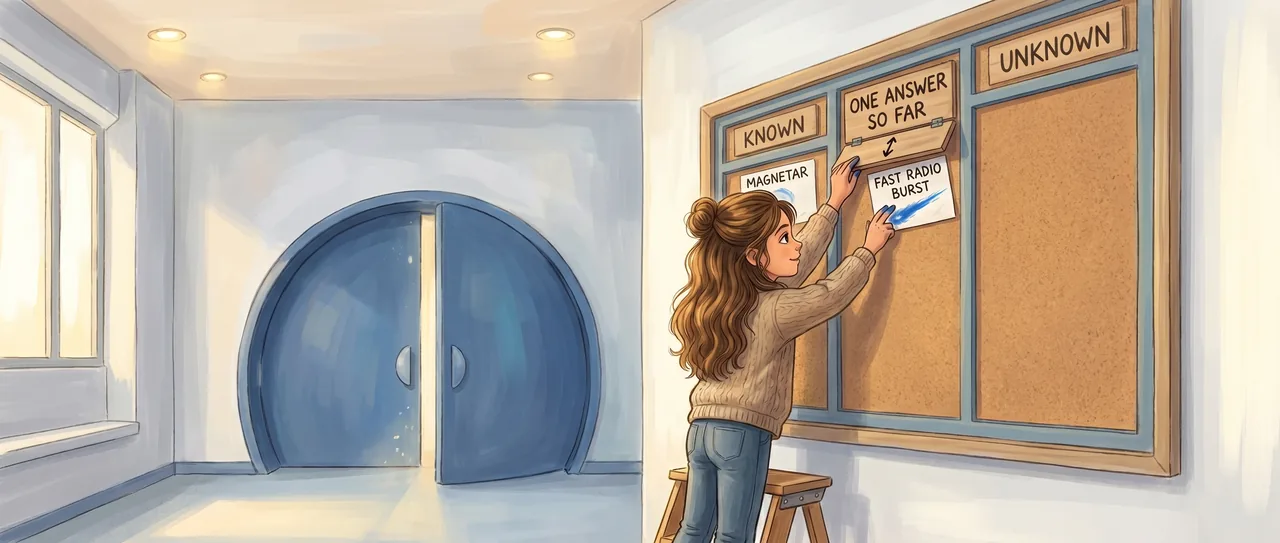
In the lobby, beside the entrance doors, the sorting wall waited for students. It had three columns. KNOWN. UNKNOWN. TOO FAR TO TELL. The Fast Radio Burst card was already stuck under UNKNOWN and TOO FAR TO TELL, because the old exhibit allowed double sorting.
The magnetar card did not belong under KNOWN. Not exactly. It did not belong under UNKNOWN either. It was the card that made the columns look silly.
The director looked at the clock. Five minutes.
“The wall can stay old for one more show,” she said.
Maya was already down the stairs.
The lobby lights were bright after the dome. The sorting wall was taller than she was, covered in magnetic cards with pictures of galaxies, star nurseries, pulsars, comets, and one very annoyed-looking cartoon atom.
Maya dragged the step stool over with a squeak.
The Fast Radio Burst card showed a painted streak of blue lightning crossing black space. She moved it out of UNKNOWN. Then she put it back, but lower, leaving room above it.
She stuck the MAGNETAR card under KNOWN.
Wrong.
She moved it to UNKNOWN.
Worse.
She pressed both cards between her palms, one in each hand. The plastic edges dug into her skin.
The bus hissed outside.
Children were arriving. Their voices came through the doors in clumps and bursts.
Maya looked at the three column headings.
KNOWN. UNKNOWN. TOO FAR TO TELL.
People loved columns. The sky did not seem impressed by them.
She took the TOO FAR TO TELL heading off the wall.
The director made a small sound behind her. “Maya.”
Maya flipped the heading over. The back was blank white plastic. She found a marker tied to the wall with string and wrote across it in square letters.
ONE ANSWER SO FAR.
She stuck it between KNOWN and UNKNOWN.
Under it she placed the MAGNETAR card. Under that she placed the FAST RADIO BURST card, tilted slightly, so it touched both ONE ANSWER SO FAR and UNKNOWN.
A boy at the front of the arriving group stopped with his coat half unzipped. “Can cards do that?”
Maya looked at the card touching two places.
“This one has to,” she said.
The director stood very still. Then she pulled the Velcro off her sleeve and slapped it onto the back of the old UNKNOWN SOURCE sign so it would not fall.
“Doors,” she called to the teachers. “Welcome in. We are starting with something very small and very loud.”
The show began with the click.
In the dome, sixty children jumped at once. Someone laughed. Someone whispered, “That was it?”
The narrator’s new sentence came through cleanly.
Fast Radio Bursts are still mysterious. But in twenty twenty, one in our galaxy was traced to a magnetar, the crushed core of a dead star.
On the ceiling, a star field opened. A pale band of the Milky Way stretched overhead, not a picture in a book, not a foggy stripe, but a place big enough to hide a dead star that could snap its magnetic bones and make radio telescopes across space flinch.
Maya stood at the back, under the exit sign, with the marker ink still damp on her fingers.
Read the interactive version, listen to the narration, and earn a gold star →
A science-verified short story for curious kids · Curiosity Land