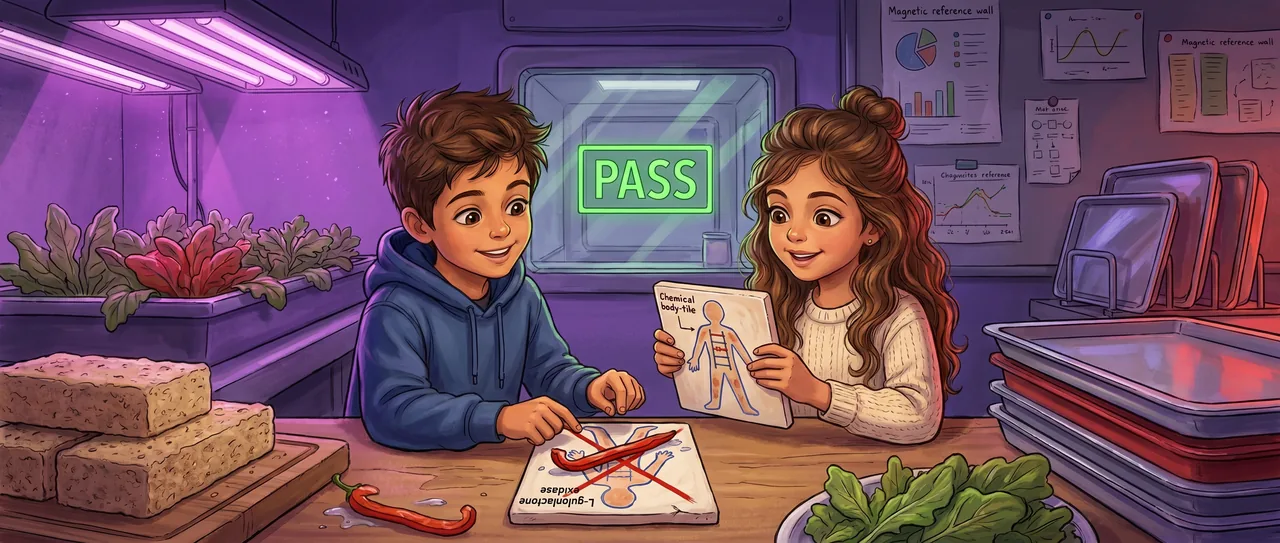
The Broken Recipe
On the first morning, the habitat refused to let Maya and Soren eat.
The food hatch stayed locked. A red line blinked across the screen.
ASCORBIC ACID: FAIL.
Maya stared at it with both hands on her hips. Behind the glass, their breakfast trays waited in perfect silver rows. Oat bricks. Lentil paste. Rice cakes. Sunflower butter in squeeze tubes. Everything tidy. Everything efficient. Nothing with juice.
"It is mad about oranges," Maya said.
"It says ascorbic acid," Soren said. He had his paper notebook open against the wall because the habitat had no tables yet. "That is vitamin C. Oranges are only one way to get it."
"It is still mad about oranges."
The dietitian stood outside the clear habitat door with a tablet under one arm and a cup of coffee she had forgotten to drink. She was talking into a headset about algae protein for a real lunar greenhouse. When she noticed the red screen, she covered the microphone.
"No pretend astronauts with pretend scurvy," she said. "Fix the menu and the hatch opens. You have the pantry drawers, the grow trays, and the reference wall. No internet. Launch window in forty minutes."
Then she turned away and said into the headset, "No, if the basil is flowering, you waited too long."
Maya pulled open the first pantry drawer. Empty vitamin bottles rattled in little holders, each one stamped EMERGENCY ONLY.
"That is cheating," she said, and slammed it shut.
Soren copied the screen message into his notebook. ASCORBIC ACID: FAIL. Then he added, not enough from menu.
"Maybe the machine is being too strict," he said.
Maya opened the hatch control panel and tapped HUMAN CREW.
The screen showed a small outline of a person. Under it, a ladder of chemical names glowed blue until the last rung, where the ladder broke.
GLUCOSE.
GULONOLACTONE.
L-GULONOLACTONE OXIDASE.
The last name was crossed out.
"We have a broken ladder," Maya said.
Soren went to the reference wall. It was covered in magnetic animal tiles, each one with a body diagram and a tiny glowing pathway. He pulled down mouse, dog, goat, guinea pig, fruit bat, macaque, and human. He lined them on the floor.
Mouse glowed all the way to vitamin C.
Dog glowed all the way.
Goat glowed so brightly the tile made a smug little chime.
Guinea pig stopped at the same broken step as human.
Fruit bat stopped too.
Macaque stopped.
Human stopped.
"Not only us," Soren said.
Maya crouched until her nose was almost level with the tiles. "But lots of mammals make it. They just make it. Out of sugar."
"Most mammals," Soren said. "In the liver, mostly. The last enzyme is called GULO. If you have it working, you can make vitamin C."
"So we tell the habitat to give us goat livers."
"I do not think the software rewrites organs."
"Rude software."
Soren lifted the human tile. On the back was a strip of tiny printed text.
In the ancestors of humans, apes, and monkeys, a mutation disabled the GULO gene about sixty million years ago. Fruit-rich diets supplied vitamin C from outside the body.
He read it once silently. Then aloud.
Maya stopped moving.
The habitat fans hummed. The red line on the hatch blinked and blinked. Outside, the dietitian argued softly with someone about whether spirulina could taste like cheese if nobody called it cheese.
Maya reached for the macaque tile and flipped it. The same sentence was there.
She flipped the human tile back over. The little person on it did not look sick. It looked unfinished by itself.
Soren's notebook bumped against his knee when he shifted. He kept paper because screens made his thoughts slide too fast, and because people always asked why he needed it when everyone else managed fine. On the floor, the human tile sat with its crossed-out rung, surrounded by fruit symbols printed along the primate branch.
"The fruit was doing the last step," he said.
Maya snapped her fingers once. "Externally."
"Outside the body."
"Like a liver you climb."
"That is a terrible sentence," Soren said.
"But not wrong."
"Not entirely wrong."
Maya grinned, quick and bright, then ran to the grow trays.
The trays were stacked under violet lights. Some held lettuce. Some held pea shoots. One held small pepper plants with red peppers hanging like glossy lanterns. A label beside them listed numbers in milligrams per hundred grams.
Maya scanned the labels too fast for Soren, then backed up and scanned them again.
"Wait," she said. "Red pepper beats orange."
Soren came over. He checked the label. Red bell pepper had more vitamin C than orange, at least by weight. Kale had plenty too. Mustard greens. Broccoli shoots.
"Our menu was beige," Maya said.
"Very shelf-stable beige," Soren said.
"Ancient primates would not approve."
"Ancient primates did not have vacuum-sealed lentil paste."
"And yet they kept the gene broken for us. We owe them crunch."
Soren drew a quick table. Human daily need. Crew of two. Three habitat days. He did not know the exact weight of one pepper, so he used the scale beside the trays. Maya harvested while he weighed.
One red pepper. Ninety-eight grams.
A handful of kale. Thirty-one grams.
Pea shoots. Not enough by themselves, but useful.
Maya fed the numbers into the menu screen. The red line stayed red.
"Again," Soren said.
"I did it right."
"I know. Again with serving loss. The reference wall says vitamin C can be reduced by heat and storage. We planned cooked meals."
Maya looked at the oat bricks, lentil paste, rice cakes, and squeeze tubes waiting behind glass.
"Raw side tray," she said.
"Fresh, not cooked."
"Every day. Not decoration."
Soren changed the menu. Raw red pepper at breakfast. Kale and pea shoots at lunch. More pepper at dinner. Rotate with broccoli shoots when the second tray was ready. He added the grow lights to the resource plan and reduced one packet of rice cakes to make mass.
The screen blinked.
ASCORBIC ACID: PASS.
The hatch clicked once, but did not open.
The dietitian appeared beside the door. Her headset hung around her neck now, and her coffee was still full.
Maya held up the human tile. The crossed-out rung caught the violet glow.
"Because this part does not work," she said.
Soren held up the pepper, still damp where its stem had snapped.
"And this part does," he said.
The dietitian looked at the tile, then at the pepper, then at their menu. Her mouth twitched like she was trying not to smile.
"Approved," she said.
The hatch slid open.
Cold habitat air spilled over Maya's shoes. Soren carried the tray in both hands because the pepper slices rolled when he walked. Maya put the human tile on the counter beside the breakfast bricks. The crossed-out rung faced up.
Soren set one red pepper strip across the broken step.
Read the interactive version, listen to the narration, and earn a gold star →
A science-verified short story for curious kids · Curiosity Land