The Brain's Night Rivers
Maya arrived at the sleep lab at four in the afternoon, already annoyed at the word sleep.
The banner over the glass doors said, BRAIN NIGHT: WHAT YOUR HEAD DOES IN THE DARK.
That was better.
Inside, the hospital smelled like floor polish and warm plastic. A line of children waited to wear stretchy caps with silver dots sewn into them. A screen showed colored hills rising and falling from someone’s brain waves. The children were making their hills spike on purpose by blinking hard.
Maya did not get in line.
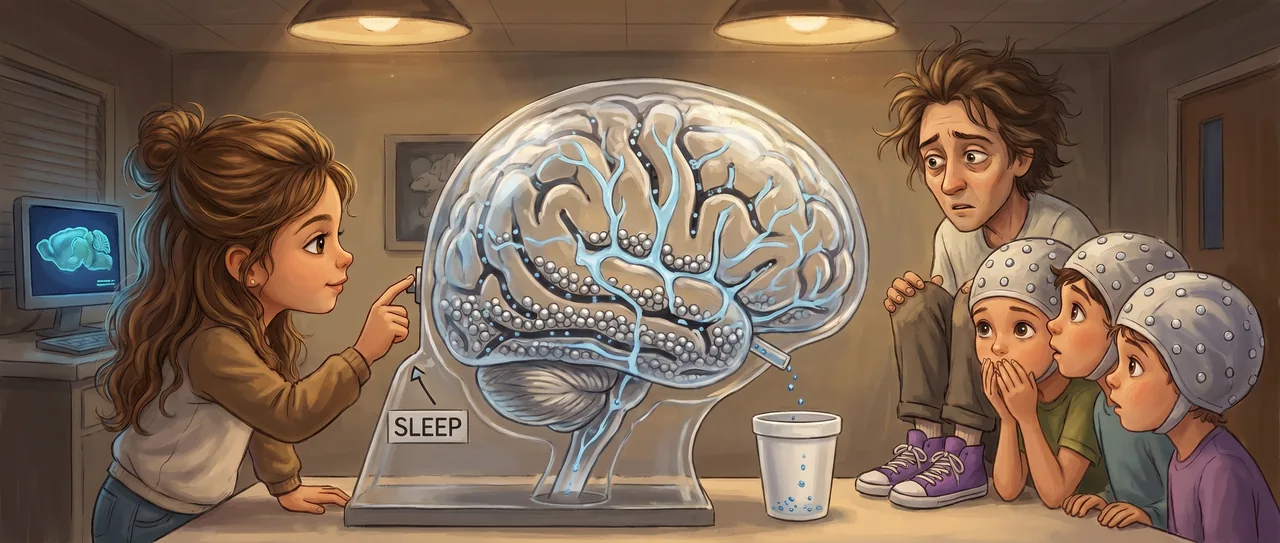
Across the room stood a clear plastic brain as big as a watermelon. It was not shaped exactly right, but it had folds and valleys and a web of tiny transparent tubes running through it. Blue specks floated in a tank above it. Beneath it sat a white cup labeled WASTE.
The blue specks were not moving into the cup.
A researcher in purple sneakers lay on her back under the table with a flashlight in her mouth. Her hair stuck out of its clip. Beside her were three paper cups of coffee, all half full.
The researcher took the flashlight out. "The pump is sulking," she said to no one in particular.
Maya crouched beside the table.
The plastic brain gave a tiny gurgle. The blue specks shivered, then stayed where they were, trapped in the folds.
"It is not sulking," Maya said.
The researcher bumped her head under the table. "Please tell the pump that. The first group comes through in six minutes. They are expecting the brain washer."
Maya looked at the label on the front.
GLYMPHATIC SYSTEM MODEL.
Not lymphatic. Glymphatic. The extra g made the word look like it had swallowed something.
A smaller sign said: While you are awake, your brain cells use energy and leave behind waste products. During sleep, clear cerebrospinal fluid washes through spaces in the brain, helping remove waste, including proteins linked to Alzheimer’s disease. In studies of mice, this cleaning is about ten times more active during sleep than during wakefulness.
Ten times.
Maya read that part twice.
Behind her, a child in the cap line said, "Sleeping is basically doing nothing."
Maya put that sentence on the list of things that did not fit.
The researcher slid out from under the table and twisted a knob marked PUMP SPEED. The clear fluid pushed harder. The tubes bulged. The blue specks jammed tighter against the first bend.
"Stronger is worse," Maya said.
"Stronger is what we have time for," the researcher said. She was not unkind. She was the kind of tired where kindness had to climb over several other things first.
She twisted again.
The plastic brain burped. One blue speck shot backward into the tank.
Maya smiled before she could stop herself.
"Please do not enjoy the disaster," the researcher said.
"I am not enjoying it. It is giving an answer."
On the table, two levers stuck up from a little control box. One was labeled AWAKE. One was labeled SLEEP. Maya pushed AWAKE.
Inside the model, hundreds of tiny silver beads swelled against each other. The gaps between them nearly vanished. The pump hummed. The blue specks stayed stuck.
Maya pushed SLEEP.
The silver beads should have pulled apart. They did not. They swelled harder.
"That is wrong," Maya said.
"Yes," the researcher said, reaching for a screwdriver. "That is the theme of my afternoon."
Maya did not touch anything yet. Adults sometimes said do not touch when they meant do not make me explain insurance.
She leaned close to the clear side of the brain. The tubes were not the important part. The spaces were. If the spaces closed, nothing could wash through, no matter how hard the pump shoved.
There was a small screen above the model. It had been playing silently on a loop, ignored by nearly everyone. A dark shape filled the screen, branching like winter trees. Then a pale liquid appeared along the branches and seeped outward, threading through black tissue in slow shining lines.
The caption changed.
Fluorescent tracer moving through the brain of a sleeping mouse.
The next image appeared. Same dark branches. Much less glow.
Awake.
Maya stood very still.
The sleeping brain on the screen was not off. It was crossed by rivers. They moved where there was room to move. The dark between the branches was not empty. It was a place something could happen.
The room grew too small for the word sleep.
The researcher was unscrewing the back of the control box.
"Do the brain cells really move apart?" Maya asked.
"In sleeping mice, the space between cells gets larger," the researcher said. "Clear fluid can flow through more easily. It helps carry away metabolic waste. Beta-amyloid too, at least in those studies. Humans are more complicated, because humans insist on being difficult."
Maya liked that. Humans were difficult in a way that sounded promising.
The first group of visitors began gathering at the doorway. The cap children came too, still wearing silver dots on their heads. One of them saw the empty white cup.
"It is broken," he said.
"Not broken," Maya said.
The researcher looked up from the control box. "It is at least emotionally broken."
Maya pointed to the two clear air lines running from the levers to the underside of the brain. One had a blue collar. One had a yellow collar. Under the table, the blue line went to the side labeled WAKE CELLS EXPAND. The yellow line went to SLEEP CELLS CONTRACT.
On top of the control box, the collars were reversed.
"When you push sleep," Maya said, "it tells the cells to crowd together."
The researcher stared at the collars.
"That cannot be right," she said.
Maya waited.
The researcher stared longer.
"That is completely right," she said.
She reached toward the lines, then stopped. Her hands were too big for the little clips in the crowded box.
Maya’s hands were not.
"May I?" Maya asked.
"If you can do it without snapping the connector," the researcher said, "you will be my favorite person until at least dinner."
Maya pressed the blue clip with her thumbnail. It clicked free. She pressed the yellow one. Click. She switched them, pushed until both collars snapped into place, and tugged once to check.
The visitors crowded closer.
"Try it wrong first," Maya said.
The researcher blinked. "Wrong?"
"Awake first. Then sleep. If they only see it work, they will think sleep is just a button."
For the first time, the researcher looked at Maya as if she were not part of the furniture, or the audience, or the emergency.
"All right," she said. "You run it."
Maya put one finger on AWAKE.
The silver beads inside the clear brain pressed together until the spaces between them thinned to hairlines. The pump hummed. The blue specks trembled and clogged. The white cup stayed empty.
The children leaned in.
"Is the pump on?" someone asked.
"Yes," Maya said.
"Then why is nothing happening?"
Maya did not answer. She lifted her finger and pressed SLEEP.
The room lights dimmed automatically, probably for drama, but for once drama was useful. Inside the plastic brain, the silver beads drew back from one another. Tiny dark gaps opened everywhere at once. The pump kept the same soft hum.
At first, only one blue speck moved.
It slipped between two beads, turned sideways, and disappeared into a clear channel. Then another followed. Then a dozen. Pale fluid threaded through the model in branching paths, not blasting, not forcing, just finding the spaces that had opened.
Blue specks began dropping into the white cup.
The cap children were quiet.
Maya looked from their silver-dotted heads to the glowing mouse brain on the screen, then back to the little rivers in the model. Every blinking contest, every question, every remembered smell of floor polish, every strange word like glymphatic, all of it left something behind. Not dirt exactly. Not badness. Just the cost of being awake.
And somewhere under every skull in the room, a tide waited for the dark.
The researcher turned to the group. "What you are seeing is a model of one reason sleep matters. It is not empty time. It is active maintenance. The brain changes the space around its cells, and fluid can move through more easily."
A child in the front whispered, "Ten times?"
Maya heard it.
The researcher smiled. "About ten times more active during sleep in the mouse studies that made this famous. Science is still working out the details in humans."
That was even better than a finished answer.
One of the smaller children raised a hand covered in marker. "Does the brain wash dreams out too?"
The researcher opened her mouth.
Maya got there first.
"We do not know what all the rivers touch," she said.
Nobody laughed.
The smaller child looked back at the clear brain as if it had become deeper than the table it sat on.
The researcher gave Maya the smallest nod, the kind that did not interrupt anything.
Read the interactive version, listen to the narration, and earn a gold star →
A science-verified short story for curious kids · Curiosity Land