The Blank Labels
The printer failed at exactly the wrong moment.
It made a choking sound, coughed out three name labels, and stopped with a strip of white tape hanging from its mouth like a tongue.
The educator in the orange glasses slapped the side of it. Not hard enough to fix it. Hard enough to show how she felt.
“Oh, come on,” she said. “The mayor’s group is downstairs.”
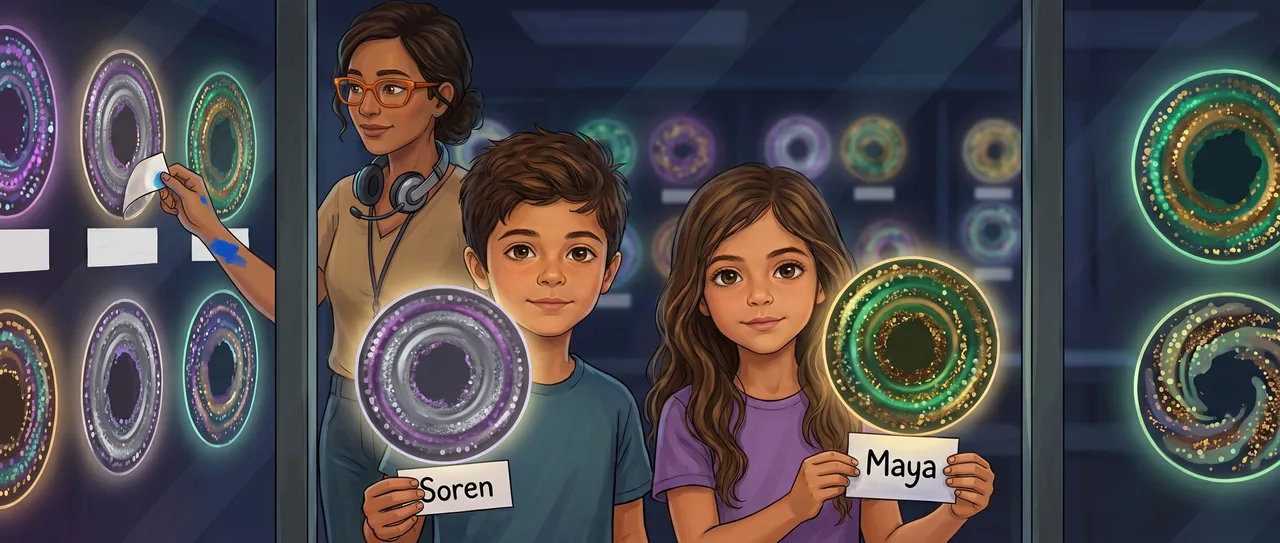
Maya leaned over the table. Behind the glass wall, twenty round displays glowed in the darkened lab. Each one looked like a tiny galaxy, dots and threads and colored islands arranged in a way that belonged to one person’s invisible life.
Two displays at the end had no names.
“That one’s mine,” Maya said.
Soren looked at the two blank disks. “You guessed before looking.”
“I looked fast.”
“That is different from looking enough.”
The educator gathered the three printed labels and tried to smile. She had a headset around her neck and a smear of blue marker on her wrist. “We can cover those two for now. I’ll reprint after the presentation.”
“No,” Maya said.
The educator blinked.
Maya pointed at the blank pair. “Those are ours.”
“They might be,” the educator said. “But the names are in the computer, and the computer is currently having a small theatrical crisis.” She slapped the printer again. It clicked once and went silent.
Soren stepped closer to the glass.
Weeks earlier, the lab had sent home little kits with swabs, tubes, and instructions written in cheerful bubbles. Swab your cheek. Rub the pad across your palm. Seal everything. Do not lick the barcode. Soren had written that last instruction in his notebook because it seemed like the sort of thing someone had learned the hard way.
Their families had filled out a form too. Not grades. Not height. Stranger things.
How were you born?
What did you mostly eat as a baby?
Where did you spend your first three years?
Maya had finished her form in four minutes. Soren had asked for exact dates.
Now the answers had become rings around the glowing centers. The center was the sequenced sample, the living city of bacteria and other microbes that lived on and in them. The outer rings showed the early pushes and invitations, the things that helped shape who arrived first and who found room.
On the wall key, green meant born through the birth canal. Purple meant born by surgery. Gold meant human milk. Silver meant formula. Brown flecks meant soil, plants, and pets. Gray blocks meant mostly indoor city spaces.
“Left one has purple,” Soren said.
Maya was already nodding. “That’s you.”
“Maybe.”
“You were sideways.”
“Breech,” Soren said. “And that is not the same as being sideways as a personality.”
Maya grinned. “Still you.”
Soren checked the ring. Purple first. Then silver. Then gray blocks stacked like apartment windows.
He took the folded copy of his family’s form from his back pocket. It had been folded so many times it felt soft as cloth. “C-section. Formula for the first two months. Sixth floor apartment. No pets until I was four.”
Maya tapped the glass in front of the left display. “There.”
“Wait.” Soren pointed at the center. “The center is the sample. Not the baby form.”
The educator looked toward the stairwell, then back at them. She was clearly deciding whether two eleven-year-olds were faster than a jammed printer.
“You can try,” she said. “But don’t read the centers like fortune-telling. Microbes are not destiny. They are communities.”
“That’s better,” Maya said.
“What is?”
“Communities can move in and out.”
Soren bent until his breath fogged the glass. Each center had names floating at the edges. Streptococcus. Corynebacterium. Bacteroides. Bifidobacterium. Some labels were bright. Some were pale. Some dots had no label at all, only numbers from the sequencing run.
The left disk had one pattern. The right had another. They were not opposites. They were not boy and girl, or neat and messy, or healthy and unhealthy. They were two different crowds that had learned two different places.
Soren pressed two fingers just below his ribs.
The lab seemed to grow hidden rooms. Under the clean counters and bright screens, under his shirt and skin, there were millions and millions of small lives with histories older than his memories. His first meals had mattered. The apartment carpet had mattered. The way he arrived in the world had mattered. Things he could not remember were not gone.
Maya was very still.
“What?” Soren asked.
“The right one has more brown in the outside ring,” she said. “Garden. Dog. Compost bucket my aunt kept forgetting to close.”
“That is definitely you.”
“And gold,” Maya said. “My mother wrote human milk until I bit her.”
The educator made a sound that was almost a laugh and almost panic. “Please do not include that in the mayor’s tour.”
Maya ignored her. “But look at the middle.”
Soren looked.
The right disk’s center did not look like a garden. Not exactly. It had bright clusters that were not on the brown ring. It had dark gaps. The left disk, his maybe-disk, had its own strange weather too.
“If the rings shaped it,” Maya said, “why don’t the centers match the rings?”
Soren liked questions that did not collapse when touched.
“Because shaped is not copied,” he said. “A river shapes a stone. The stone does not become a river.”
Maya turned to him. “That was good.”
“I know. I may write it down later.”
The educator had stopped checking the stairs.
Soren moved along the wall, reading the other displays without names. No two centers repeated. Even the ones with similar rings were different inside. One had a gold early-food ring and gray blocks like his, but its center flared in places his did not. Another had purple birth, brown flecks, and a center like a storm of tiny lanterns.
A small sign beside the wall read: Your microbiome can be unique enough to help identify you, much like a fingerprint. It changes during life, but early years can leave lasting patterns.
Soren read it twice.
He had always thought fingerprints were the outside of a person. Press a thumb in ink. Leave a mark on glass. Simple. Here was another print, made of living passengers, meals, floors, pets, medicine, air, and time.
Maya said, “If these are like fingerprints, why are names on them?”
The educator opened her mouth, then closed it.
From downstairs came a burst of voices. The mayor’s group had arrived early.
The educator rubbed the blue marker smear on her wrist. “Because exhibits need labels.”
“Do they?” Maya asked.
Soren went back to the two blank disks. He took the loose labels from the table. His name. Maya’s name. Three other names from the printer’s last gasp.
He held his label under the left display, where purple, silver, and gray circled the bright center.
Maya held hers under the right display, where green, gold, and brown flecks circled another bright center.
They did not stick them on.
The educator watched their hands.
“If people know these can identify them,” Soren said, “maybe the first thing they should see is the map without the name.”
Maya said, “Then the name is not the important part.”
The educator looked once toward the stairs. Then she took the labels from Soren, all five of them, and set them face down on the table.
The first adults entered the lab talking loudly. Their voices softened when they saw the wall.
The educator walked to the nearest finished display and peeled away its printed name.
Maya and Soren stood shoulder to shoulder as blank white rectangles covered the names, one after another, and colored constellations shone behind the glass.
Read the interactive version, listen to the narration, and earn a gold star →
A science-verified short story for curious kids · Curiosity Land