The Angle That Wouldn't Line Up
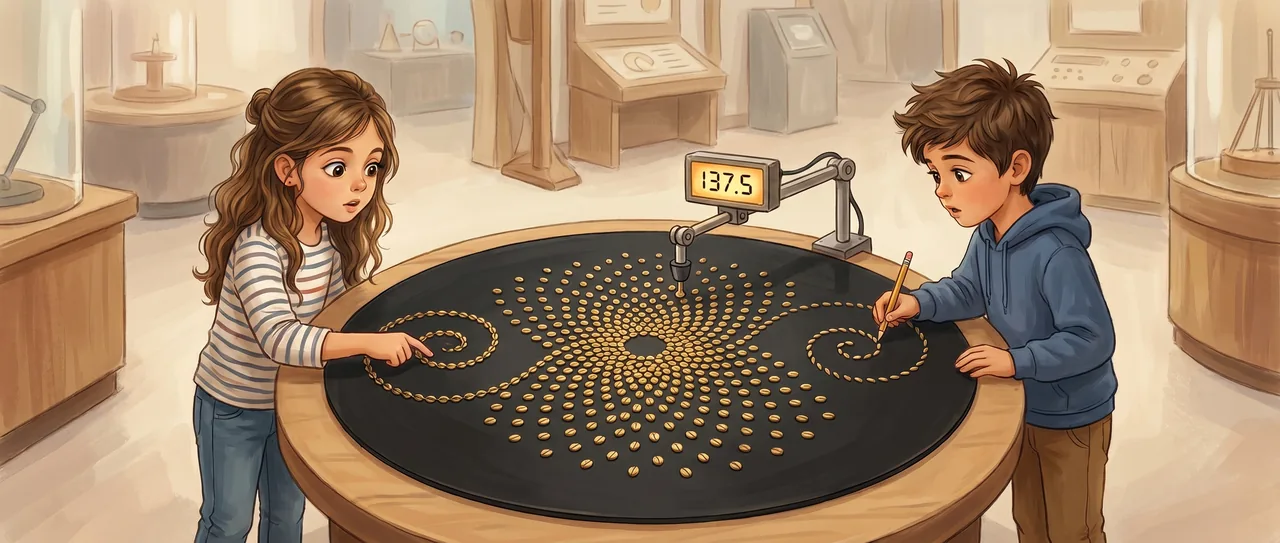
The museum had given Maya and Soren a circle, a bowl of brass seeds, and a machine that could place one seed at a time.
The circle was as wide as a bicycle wheel. The machine had a turning arm with a soft rubber tip. Each time Soren pressed the button, the arm rotated by whatever angle was typed into the little screen, slid outward a tiny bit, and dropped one brass seed onto the sticky black surface.
Above their table hung a banner that said, SPIRALS ARE EVERYWHERE.
Under the words were pictures of a sunflower, a pine cone, a nautilus shell, and a galaxy.
The exhibit manager rushed past with a roll of tape under one arm and a stack of signs under the other. Her hair had three pencils in it, all pointing different directions.
“Make it beautiful,” she said. “The donors arrive in forty minutes. Fibonacci spirals. You know. Nature loves a pattern.”
Then she was gone, calling to someone about the fog machine.
Maya looked at the banner.
“Too neat,” she said.
Soren had already opened the instruction card. “It says sunflower heads often have spiral counts that are Fibonacci numbers. Twenty-one one way, thirty-four the other. Or thirty-four and fifty-five. Bigger ones can have more.”
“Then we draw twenty-one spirals,” Maya said. “And fill them.”
They tried.
The machine could project guide lines onto the circle. Soren selected twenty-one curving paths. Maya placed the first seeds along one glowing line, then the next, then the next.
It looked wonderful for twelve seeds.
By thirty seeds, the center had become a knot. By sixty, there were fat empty moons between the lines. By eighty, Maya had her chin almost touching the table.
“Sunflowers do not do this,” she said.
Soren pressed stop. The arm froze above a crowded lump of brass.
“Maybe we need the other direction too,” he said.
They added thirty-four crossing spirals. The projected lines made a net, delicate and bright.
The seeds made a traffic jam.
Maya peeled one off. The sticky surface made a small disappointed sound.
“The spirals are the wrong thing,” she said.
“They are the thing on the sign.”
“They are the thing you see after.”
Soren looked at the sunflower picture again. He turned the card over. On the back was a smaller diagram, half covered by a museum sticker. It showed dots, not spirals. Each dot was a little farther from the center than the last. Each dot was turned from the one before it.
“No drawing the spiral first,” he said.
Maya snapped the projection off. The glowing net vanished.
The circle looked suddenly enormous and empty.
“What angle?” Soren asked.
Maya took a brass seed and held it above the center. “Not one that comes back too soon.”
Soren typed ninety degrees.
Click. Click. Click. Click.
The first four seeds made a square. The next four sat exactly behind them, farther out. Soon the circle had four straight roads, with deserts between.
“No,” Maya said.
Soren typed one hundred twenty degrees.
Three roads.
He typed one hundred forty-four degrees.
At first it looked better. Then five curved arms appeared, too proud of themselves, sweeping outward and leaving long empty lanes.
Maya tapped one lane. “It keeps remembering where it was.”
Soren wrote several numbers in his notebook, but he did not close the notebook, and he did not look finished. “Angles that are tidy fractions of a turn line up. Half a turn. Third of a turn. Fifth. Even almost fifth, if the almost is too simple.”
Maya reached over and typed one hundred thirty-seven.
The machine clicked forward.
Seed after seed dropped. The center stayed open enough. The new seeds kept finding spaces between old ones, never exactly above them, never exactly opposite them. The pattern did not look organized at first. It looked like a crowd deciding where to stand without talking.
“Add the half,” Soren said.
Maya typed one hundred thirty-seven point five.
The machine began again on a fresh circle.
Click.
Turn.
Outward.
Click.
Turn.
Outward.
The brass seeds gathered from the center in a way that made Maya stop leaning over the table. She stood straight.
Nothing lined up. Because nothing lined up, nothing wasted space.
After a hundred seeds, the spirals appeared.
They had not been drawn. They came out of the crowd. Maya could see one family curling left and another curling right, crossing without touching, like two secrets using the same hallway.
“Count,” Soren said.
Maya put one finger on a brass seed near the edge and followed a left-turning chain. “One, two, three...”
Soren followed a right-turning chain with the eraser end of his pencil.
They counted again because both of them wanted to be wrong in case wrong was more interesting.
“Twenty-one,” Maya said.
“Thirty-four,” Soren said.
The exhibit manager came back carrying a plastic nautilus shell and a cardboard galaxy on a stick.
“Oh good,” she said. “Very pretty. Can we put the shell here? The script says the same spiral is in shells, flowers, pine cones, hurricanes, galaxies, hair curls, cinnamon rolls.”
“No,” Maya said.
The manager blinked. One pencil slid farther out of her hair.
Soren turned the instruction card toward her. “The sunflower works because each new seed grows at an angle that packs the space. Pine cones can do that too, with scales. Shells grow by adding material along the edge. Galaxies have arms from stars and gas moving under gravity. They can be spiral shapes, but not because they are packing seeds.”
The manager looked at the banner. “The donors like cinnamon rolls.”
Maya moved the nautilus shell to the side of the table. She moved the galaxy beside it.
“Spirals can happen for different reasons,” Maya said. “That is better.”
The manager opened her mouth, closed it, and then looked down at the brass sunflower. The seeds shone in the museum lights, each one slightly turned away from the last.
“How did you make the spirals if you didn’t draw them?” she asked.
Soren pointed to the angle on the screen.
The manager read it aloud. “One hundred thirty-seven point five degrees.”
“Almost,” Soren said. “The real thing is tied to the golden ratio. The machine rounds it.”
Maya picked up a loose brass seed. “It is the angle that refuses all the easy lines.”
The manager looked at Maya, then at Soren, then at the crowd pattern that had become a flower.
“I have five minutes to rewrite a sign,” she said.
She took the shell, the galaxy, and the cinnamon roll picture away.
Visitors began to enter while Soren and Maya set the finished circle upright on its stand. A small child tried to count the spirals and lost the line. An older kid found one and shouted, then found the crossing one and went quiet.
Maya watched the quiet more than the shout.
Soren set a real pine cone beside the model. Its scales climbed in two directions at once. Maya turned it slowly. The pine cone did not care which spiral her eye chose first. Both were there.
The exhibit manager slid a new sign into the holder. It said, START WITH ONE SEED. TURN BY AN ANGLE THAT DOES NOT REPEAT. KEEP GOING.
Under that, in smaller letters, it said, SOME SPIRALS ARE PACKING. SOME SPIRALS ARE GROWTH. SOME SPIRALS ARE GRAVITY. LOOK CAREFULLY.
Maya read it and gave one quick nod.
Soren did not write anything. He put his notebook back in his pocket and picked up the bowl of leftover brass seeds.
“There is room for a bigger one,” he said.
Maya took the empty circle from beneath the table and locked it onto the machine.
This time neither of them projected guide lines.
Maya touched the start button. The arm turned, and the next brass seed clicked into the blank space between all the others.
Read the interactive version, listen to the narration, and earn a gold star →
A science-verified short story for curious kids · Curiosity Land