The And Fiber
The first catcher failed so loudly that everyone in the materials lab turned around.
The glass bead dropped from the ceiling rail, hit Maya and Soren’s nylon net, sank into it, and sprang back out like it had been insulted. It bounced once on the table, rolled under a stool, and vanished near the recycling bin.
Dr. Imani lowered her tablet. She had a silver streak in her hair shaped like a lightning bolt and the distracted look of someone trying to run six exhibits, three cameras, and one room full of children at the same time.
“That,” she said, “was excellent bouncing. It was not catching.”
“It stretched,” Soren said.
“It stretched too much,” Maya said. “It gave the bead back.”
On the whiteboard, Dr. Imani had drawn two columns. Strong. Stretchy. Under Strong, she had written steel wire, carbon fiber, aramid thread. Under Stretchy, she had written rubber, nylon, silicone cord.
“Engineering is choosing,” Dr. Imani said, already turning because someone at the far bench had wrapped copper wire around a sandwich. “Pick the property you need most.”
Maya stared at the columns. Her mouth made the shape it made when something had gone crooked in the world.
Soren found the bead with his foot and put it back in the foam cup marked Team Seven. Then he opened his paper notebook. The other students used wrist screens that blinked and chirped. Soren’s notebook made a soft papery sound, like leaves being careful.
“Strong did not work either,” he said.
Their first catcher had been aramid thread stretched tight across a bamboo hoop. The bead had hit it and stopped for almost no time at all. One thread snapped at the knot. The bead punched through the hole and clicked onto the floor.
Maya took the pencil from Soren’s hand and drew a line between Dr. Imani’s columns.
“Both,” she said.
Soren looked at the line. “We do not have both.”
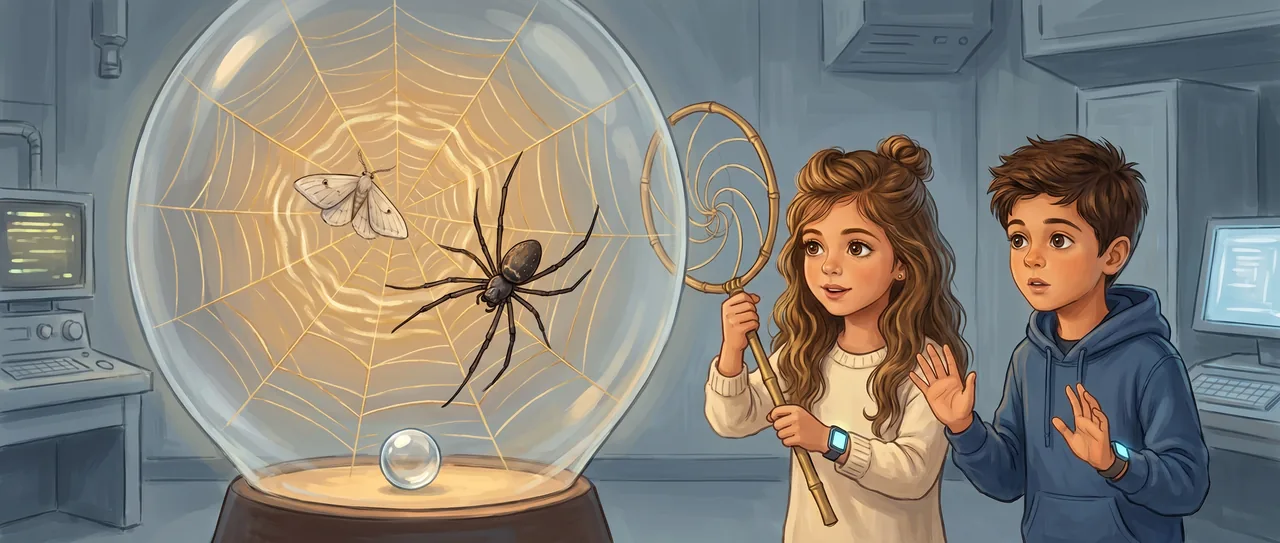
Across the lab, behind a wall of clean glass, an orb-weaver spider sat in the middle of a gold-tinged web strung between two black branches. The museum label said she was a golden silk orb-weaver. Her legs were long and jointed like dark punctuation marks. She was completely still, while every human in the room failed noisily.
Above the exhibit was another sign.
SPIDER SILK: STRONGER THAN STEEL BY WEIGHT. STRETCHES MORE THAN NYLON. TOUGHER THAN IT LOOKS.
Below that, smaller words said that no human-made fiber had yet matched its combination of strength and stretch at the same time.
Maya pointed with the pencil. “She has both.”
“We cannot put her in our hoop,” Soren said.
“I know that.”
“She would not like it.”
“I know that too.”
Dr. Imani passed behind them with a coil of tubing over one shoulder. Maya stopped her by stepping into the exact wrong place.
“Why is spider silk not in the drawer?” Maya asked.
Dr. Imani glanced toward the exhibit. Her face changed, not softer exactly, but more awake.
“Because we cannot manufacture it the way spiders do. Not yet. We can make strong fibers. We can make stretchy fibers. Making one fiber that does both that well is the hard part.”
“Why?” Soren asked.
Dr. Imani looked at the child with the copper sandwich, then at her tablet, then at Soren. “Proteins, structure, spinning conditions, patience, and a creature with eight legs that refuses to become a factory.”
“That is not a full answer,” Maya said.
“No,” Dr. Imani said. “It is a very crowded doorway.”
Then she hurried away to rescue the sandwich, which had begun to smoke gently.
Soren wrote doorway in his notebook and underlined it once.
Maya was still looking at the spider. “The board says choose. The spider does not choose.”
Soren tapped the hoop. “But the challenge says drawer materials only.”
“So we do not copy the fiber,” Maya said. “We copy the unfairness.”
Soren waited. He was good at waiting when Maya’s thoughts arrived in pieces.
“She gets to be strong and stretchy in the same thread,” Maya said. “We do not. So make the catcher be both without making the thread be both.”
Soren looked at the hoop, the nylon, the aramid, the silicone cord, the knots from their previous failures. “A structure instead of a material.”
Maya grinned. “Yes.”
They stripped their broken catcher down to the bamboo ring. Soren tied six aramid threads across it like spokes, but he did not pull them tight. Maya objected anyway.
“Too straight,” she said.
“They have to hold.”
“They have to wait first.”
That was not a normal sentence, so Soren tested it. He pressed the bead into the loose spokes. The threads sagged, then tightened together. The bead did not bounce as much.
“Waiting works,” he said.
Maya tied short loops of silicone cord between the spoke ends and the bamboo hoop. Soren added a soft nylon spiral from the middle outward, not sticky like a web, not even very neat, but able to spread a pull from one place into many places.
At the next table, a boy with perfect hair watched them. “That looks messy.”
“It is messy in a planned way,” Soren said.
The boy blinked at the notebook, the loose spokes, the odd spiral, and Soren’s serious face. “That is still messy.”
Maya did not look up. “So is a spiderweb if you think straight lines are the point.”
They carried the new catcher to the drop rail.
Dr. Imani came over with the tablet under her arm. “Team Seven. Attempt three. Materials, bamboo hoop, aramid thread, nylon filament, silicone cord. Goal, catch the glass bead without tear, escape, or bounce-out.”
“Escape?” Maya asked.
“The bead escaped last time.”
“It had help from physics,” Soren said.
Dr. Imani smiled despite herself. “Ready?”
Maya held one side of the hoop. Soren held the other. The hoop had to rest on the stand, not in their hands, but for one second before letting go they steadied it together. The loose aramid spokes hung like a shallow bowl. The silicone loops quivered. The nylon spiral looked too thin to matter.
“Ready,” Maya said.
Dr. Imani pressed the release.
The bead fell.
It struck the center. The nylon spiral dipped first. The aramid spokes took the pull and spread it outward. The silicone loops stretched, six small delays around the rim. The bead sank, slowed, sank more, and stopped at the bottom of the little bowl.
No snap.
No bounce.
No bright glass escape across the floor.
For a breath, nobody spoke.
Then the perfect-haired boy said, “That is not fair.”
Maya looked at the trapped bead. “Exactly.”
Soren touched one silicone loop. It was still trembling. He touched one aramid spoke. It was tight now, but unbroken.
Dr. Imani crouched beside the catcher. The tablet slid slightly under her arm, forgotten. “You made the structure do what the drawer could not do as a single fiber.”
“Not as well as the spider,” Soren said.
“No,” Dr. Imani said. “Not as well as the spider.”
She did not sound disappointed. She sounded as if the sentence had a ladder inside it.
Maya turned toward the glass exhibit. The orb-weaver had moved. A pale moth, released for feeding, had struck the outer web and stuck there. The web did not break. It stretched around the moth, shivering in rings, carrying the motion outward until the whole shining shape had answered.
The spider crossed toward the vibration.
Soren moved closer to the glass. The moth was much heavier than one strand should have been able to hold. The strand held anyway. Not stiff. Not loose. Not choosing.
He put his palm near the glass but did not touch it.
Maya stood beside him, still holding their bamboo hoop. In its center, the glass bead rested in the sagging spiral like a tiny moon in a net.
Read the interactive version, listen to the narration, and earn a gold star →
A science-verified short story for curious kids · Curiosity Land