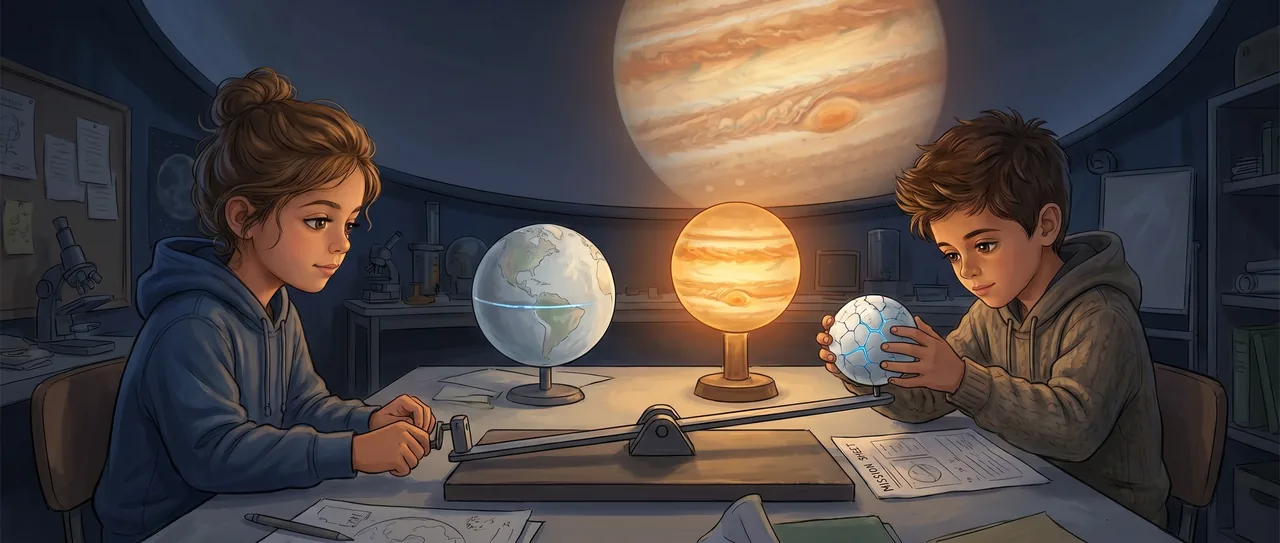
The Wrong Water World
The planetarium's newest exhibit was wrong in exactly the way everyone expected it to be right.
Earth was blue.
Not a little blue. Not a thin blue. It was painted like a marble dropped in a bucket of sky. Swirls of white clouds curled over oceans so bright that the land looked like it had been added later by someone shy.
Beside it sat Europa, no bigger than an orange, white and scratched with brownish lines. It looked like a dirty snowball that had rolled under a cabinet.
Maya stood with her hands on her hips.
"Wrong," she said.
Soren looked up from the stack of printed model sheets. He had already written three numbers on the corner of one page, then crossed out one of them because it bothered him.
"It is Earth," he said. "Earth is allowed to be blue. Most of the surface is ocean."
"Surface," Maya said.
Soren stopped moving his pencil.
The youth lab was quiet except for the projector fans in the dome above them. On the big screen, Jupiter waited as a banded giant, cream and rust and storm-red. Europa's path was a thin white curve around it. In twenty minutes the doors would open for flyby night, when everyone would come watch the spacecraft data arrive from a moon that looked small enough to lose in a pocket.
On the worktable were the pieces of the new exhibit: Earth, Europa, a heat lamp for Jupiter, a hand crank for orbits, and a sign that said, SOME WORLDS HIDE THEIR SEAS.
The sign was the problem.
Soren read the mission sheet again, softly, because reading aloud made numbers less slippery.
"Europa may have a global ocean under its ice crust. Scientists estimate it contains more water than all of Earth's oceans combined."
Maya tapped Earth with one fingernail. The blue paint clicked.
"Then why is this one shouting?"
"Because we made the surface," Soren said.
"Then make the inside."
That sounded simple for about four seconds.
Soren opened the scale program on the table screen. It showed Earth as a ball with a slider for ocean depth. He set the model size to match the painted sphere in front of them. Earth on the table was about the size of a large melon. The program drew the ocean as a line so thin it almost vanished.
Maya leaned close.
"Where did it go?"
"It didn't," Soren said. "It's there. The ocean is deep to us, but compared with the whole planet it is like..." He pinched his fingers until they nearly touched. "Less than paint."
Maya picked up the Earth model. Under the lab lights, the blue paint gleamed thickly over the Pacific.
"So this is lying by being pretty."
"It is exaggerating," Soren said.
"Same thing, but wearing a badge."
Soren did not argue. He set the Europa size on the screen. The orange-sized moon appeared as a gray circle. He added an ice crust, then the ocean layer beneath it. The program filled a thick ring under the ice with blue.
Maya's fingers went still on the Earth.
Soren checked the numbers again. Europa was much smaller than Earth. Its ocean was not on the outside. It was likely under miles of ice, kept liquid by the squeezing and stretching of Jupiter's gravity as Europa traveled its orbit. The exact thicknesses were still questions, but the strange part held steady: small moon, hidden ocean, more water than Earth keeps in all its seas.
"Do it again," Maya said.
Soren reset it. Earth first: huge ball, vanishing ocean skin. Europa second: small ball, blue layer under white ice.
Maya laughed once, not because it was funny.
"It's the wrong way around."
"No," Soren said, and his voice came out quieter than he meant. "It's the right way around. We were looking at the wrong part."
They had fifteen minutes.
Maya took the Earth model to the sink and began rubbing the thick blue paint with a wet cloth. It smeared at first, making the Atlantic look stormy. Then it faded. Land and sea blurred into a pale globe with only a shine where the oceans were.
Soren cut a strip of clear film thinner than onion skin and wrapped it around Earth. It buckled. He tried again, trimming one edge by less than a fingernail. This time it lay almost flat, a glossy skin that could only be seen when the light caught it.
"That's awful," Maya said.
"That's honest," Soren said.
"Honest is sometimes awful."
"Sometimes it is shiny."
She tilted Earth toward the lamp. A silver-blue flash ran across the model and disappeared.
For Europa, they used three shells. The center was black, because the rocky interior would not be the thing people came to touch. Around that Soren snapped on a clear blue layer. It was thick enough to see from across the table. Around the blue went the ice, a white shell with reddish-brown cracks copied from spacecraft images.
The first time Maya tried to close the ice over the ocean, it would not fit.
"Too much water," she said.
Soren checked the printed curve. "No. Too much glue on the seam."
"Same feeling."
They scraped the seam with a plastic blade. The blue layer slid inside with a soft click.
Now Europa looked like a small, scratched, unimportant moon again.
Maya frowned at it.
"Nobody will know."
Soren turned the model in his hand. "That's what the sign says."
"Signs are bossy."
"Cracks are better," he said.
Maya looked at him.
He held Europa under the lamp. Light passed through a hairline gap where the ice shell did not quite meet. A thread of blue appeared, bright as a secret.
Maya took the plastic blade and widened one crack carefully, not like damage, like a window. Soren made two more. They were narrow enough that Europa still looked icy from far away. Close up, the buried ocean shone through.
The table screen chimed. Ten minutes.
Maya set Earth and Europa side by side. Earth was larger, familiar, soft with cloud swirls and a thin flash for water. Europa was small and white, but when Jupiter's lamp turned behind it, blue filled the cracks.
Soren placed the volume cards beneath them. EARTH'S OCEANS. EUROPA'S ESTIMATED OCEAN: MORE.
Maya moved the cards.
"Not beneath," she said. "People read beneath and stop."
She put Earth's card on the surface of Earth, held down by a tiny magnet. Then she lifted Europa's ice shell and placed its card under the ice, touching the blue.
Soren watched her hands.
"They have to open it."
"Yes."
"Most people won't."
Maya looked at the small white moon. "Some will."
Soren took a blank question card from the stack. He almost wrote, Could anything live there? Then he stopped, because the mission sheet was careful. Europa might have the ingredients for life. Liquid water. Chemistry. Energy. Might was not a small word.
He wrote something else.
WHAT WOULD YOU NEED TO KNOW NEXT?
Maya read it and nodded.
"That one goes inside too."
Maya held Europa while Soren clipped the model onto its orbit arm. He turned the crank once. Earth spun in place, shining only when the light struck it. Europa traveled around Jupiter, white, cracked, quiet.
At the far side of its orbit, the lamp lined up behind it.
Blue fire appeared in every cut in the ice.
Maya did not say wrong this time.
Soren reached into the supply tray and took out a clear sample tube, the kind used for pretend comet dust and meteor powder in other exhibits. It had a white cap and no label.
Maya held out her hand. Soren gave her the tube. She pressed a tiny strip of tape around it and wrote one word in block letters.
LATER.
Soren clipped the empty sample tube beneath the moon.
Maya lowered the white shell over the blue layer.
The tube swung once, clear and dry, under Europa's ice.
Read the interactive version, listen to the narration, and earn a gold star →
A science-verified short story for curious kids · Curiosity Land