The Wrong Kind of Invisible
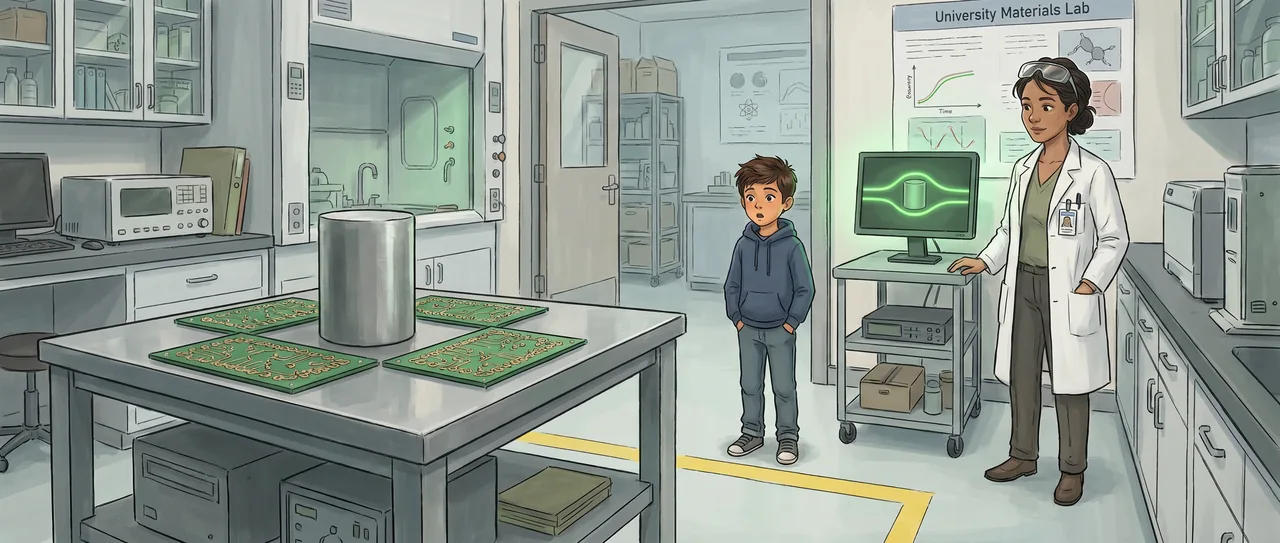
The invisible thing was sitting in the middle of the table, and Soren could see it perfectly.
It was a metal cylinder, dull gray, about as tall as his hand. Around it stood a ring made from flat green circuit boards. Each board was covered with copper shapes, tiny broken squares and loops, printed in rows so neat they made Soren’s teeth feel lined up.
A sign above the table said MICROWAVE CLOAK.
The lab manager said, "Please do not touch the cloak. The demonstration begins in twelve minutes."
She had safety glasses pushed up into her hair, a badge clipped crookedly to her coat, and the voice of someone who had already answered the same question forty times.
Soren looked at the cylinder again.
"It is not invisible," he said.
"Not to you," the lab manager said, without turning around. She was crouched behind a cart, untangling a cable with one hand and holding a tablet in the other. "To microwaves. If the scanner behaves. Which it is not doing, because today is a day with visitors."
Soren stayed behind the yellow tape on the floor. That was where visitors belonged. He did not mind lines if they had reasons.
On the table, a black horn pointed at the cylinder. Another black horn sat on a sliding rail on the far side. The first horn sent microwaves. The second listened. A screen showed what the listening horn heard as it moved.
Right now the screen showed a dark smear behind the cylinder.
"That is a shadow," Soren said.
"Yes," the lab manager said. "Thank you, shadow department."
She pulled one cable free, made a face at it, and plugged it back in.
The smear stayed.
Soren put his hands in his pockets so they would not do anything unauthorized. His paper notebook pressed against his wrist. Everyone else in the lab had phones out, but phones made it too easy to take a picture and too hard to keep the part that mattered.
The lab manager stood and checked the time.
"Good enough," she said.
Soren stared at the screen.
The smear was not good enough. It was the exact shape of something not being hidden.
"May I ask one thing?" he asked.
"One," she said.
"Did it work before?"
"Yesterday. Beautifully. Smooth wavefront. Barely any scattering. Donors love smooth wavefronts."
"What changed?"
"Nothing." She paused. "We packed it away. We set it up again. That is not nothing, but it should be nothing."
Soren looked at the ring of green boards.
Each board had copper markings printed on it. Not wires for electricity to travel through, exactly. More like little traps for the wave. The poster said the pieces were smaller than the microwave wavelength, so the wave did not meet them one by one. It met the whole pattern as if it were a material with strange rules.
Soren had read that part twice before the demonstration room opened.
The lab manager glanced toward the hallway, where voices were gathering.
"Fine," she said. "You have one minute. Do not cross the tape. Talk only."
Soren leaned as far as the tape allowed.
The copper shapes were almost the same on every board, but not quite. Some loops opened to the left. Some opened to the right. Near the front of the cloak, the gaps made a curve around the cylinder, like fish turning around a stone in a stream.
On one board, the fish were facing the wrong way.
Soren blinked and counted from the seam. He counted again because being wrong was faster than being careful, and he did not want faster.
"That panel," he said. "The third one from the transmitter side. I think it is backward."
The lab manager looked.
"They are symmetric," she said.
Soren did not answer at once. He compared the copper gaps to the ones beside it. The square board was symmetric. The printed pattern was not.
"The board is symmetric," he said. "The little broken rings are not. If the wave cares about the gaps, then that tile is lying."
The lab manager’s fingers stopped moving.
She stepped over the tape herself, bent close, and made a small sound through her nose.
"Oh," she said.
She flipped a switch to standby, lifted the panel, turned it around, and set it back into the ring. Then she stepped away and pointed at Soren.
"You still did not touch anything," she said.
"I stayed yellow," Soren said.
"Good. Staying yellow is important."
She turned the transmitter on.
The listening horn began to slide along its rail. On the screen, a green line crawled from left to right. The metal cylinder sat on the table, solid and gray and completely visible.
The green line reached the place where the cylinder should have blocked it.
It bent.
Not like a ball bouncing. Not like water splashing. The line separated into two smooth shoulders, one above the cylinder and one below, curling around the empty-looking ring of boards. Behind the cylinder, the two shoulders joined again.
The dark smear thinned. Then it vanished into the brightness around it.
The cylinder was still there.
The wave had gone around the place where there was no permission to go through.
Soren’s mouth opened a little. He shut it. Then it opened again.
A group of visitors came in, loud with coats and wet shoes and the smell of outside. A small child pointed at the table.
"I can see it," the child said.
A few people laughed.
The lab manager lifted both hands. "Correct. Your eyes are not microwave receivers. This cloak is built for waves about the length of your finger, not for visible light. Visible light has much shorter wavelengths, so the structures would have to be much, much smaller. Labs can make some cloaks for certain colors or infrared wavelengths, but not a magic blanket from a storybook."
She looked at Soren, then at the backward panel that was no longer backward.
"And if one tiny pattern faces the wrong way," she said, "the wave notices."
Soren looked at the ring again.
From across the room, the boards looked identical. Up close, every copper gap had a job. The cloak did not work by being smooth and ordinary. It worked because thousands of strange little shapes were strange in the right direction.
The lab manager began the demonstration. She showed the bare cylinder first. The screen made a shadow. She put the cloak back around it. The shadow opened and healed.
People made the sound people made when they had expected a trick and found a measurement instead.
Soren did not watch their faces. He watched the screen.
The horn could not see the metal cylinder. His eyes could. Both were telling the truth.
After the visitors moved to the next table, the lab manager waved Soren toward the side door.
"You want to see where the smaller ones are made?" she asked. "From outside the glass. No touching, no breathing on anything expensive, no asking me a question while I am opening a door. I drop things when questioned."
"I can wait," Soren said.
"Suspicious, but appreciated."
The cleanroom window looked into a white room full of machines with round chambers and silver arms. A person in a hooded suit carried a case as carefully as if it contained an egg with a city inside.
"For infrared and visible light," the lab manager said, "the patterns can be smaller than bacteria. Sometimes smaller than a virus. At that size, you do not build with scissors and copper tape. You carve, grow, etch, and hope dust does not decide to become part of your experiment."
Soren pressed his fingertips against his own sleeve instead of the glass.
"If you can make a wave go around a thing," he asked, "can you make it go around a hole?"
The lab manager smiled without answering. Her tablet beeped. She looked down and groaned.
"I have to go rescue a laser alignment before someone blames the laser for being straight," she said. "Stay on this side."
She hurried away.
Behind the cleanroom glass, a masked technician tilted a pale wafer under a lamp, and a thin violet stripe slid across Soren’s sleeve.
Read the interactive version, listen to the narration, and earn a gold star →
A science-verified short story for curious kids · Curiosity Land