The Wrong Kind of Garden
On the morning the city opened the Monarch Mile, Maya’s perfect garden failed.
It was supposed to be the first bright stitch in a line of rooftop gardens, parking-lot planters, school fences, and road medians, all meant to guide monarch butterflies north. The roof of the library had been planted in purple coneflower, blazing star, goldenrod, and little solar flowers that opened and closed to show the soil moisture underneath.
The city ecologist loved those solar flowers. She had arranged them in rings for the camera drones.
Maya did not love the rings.
Rings were for people looking down.
Butterflies came in sideways.
The first monarch arrived while the mayor was still practicing where to stand. It lifted over the library wall, orange and black, ragged on one wing, and everyone on the roof made the soft sound people make when something small crosses a great distance.
The butterfly passed over the coneflowers. It passed over the blazing star. It passed over the mayor’s orange ribbon.
Then it dropped off the roof.
Maya ran.
“Maya,” the city ecologist called, “we need you for the student photo.”
“Wrong direction,” Maya said.
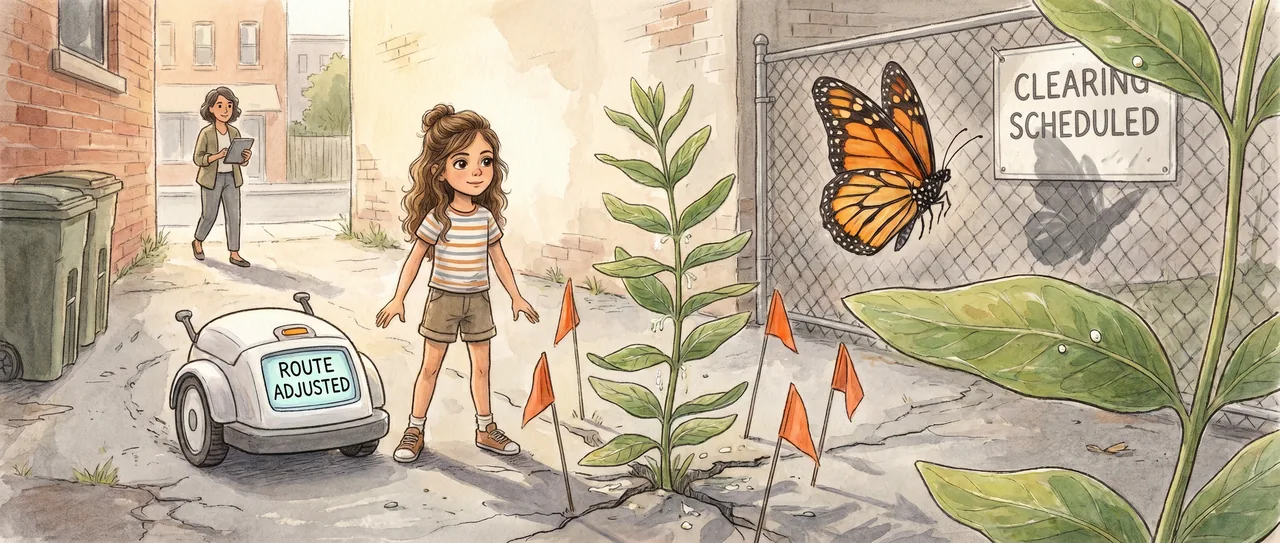
She took the stairs two at a time, crossed the lobby, pushed through the glass doors, and came out beside the alley behind the library. Heat shimmered from the pavement. The service lot was not part of the Monarch Mile. It was cracked asphalt, old gravel, and a chain-link fence with a sign that said CLEARING SCHEDULED.
The monarch was there.
It clung to a plant with dusty green leaves and pinkish flower buds shaped like little fists.
Milkweed.
Not the tidy kind from nursery trays. This milkweed had shouldered up through a split in the pavement as if the city had tried to zip the earth shut and the earth had objected.
Maya crouched.
The monarch curled its black feet around the underside of a leaf. Its abdomen touched once, twice, three times.
Eggs.
Maya leaned closer until her nose nearly brushed the leaf. A white dot, smaller than a sesame seed, stood on the underside like a tiny moon.
Behind her, the city ecologist arrived, breathing hard and carrying a tablet full of schedules.
“There you are,” she said. “The drones missed you. We have sixty seconds before the speech.”
“Monarchs do not need speeches,” Maya said.
“They need habitat, which is what we built upstairs.”
“No.” Maya pointed at the leaf. “They need this.”
The city ecologist squinted. “We planted milkweed in the west beds.”
“It is not up yet.”
“It will be.”
“The monarch is here now.”
The ecologist looked at the plant, then at the CLEARING SCHEDULED sign. “That lot is on the mower route. It has to be cleared before the weekend market. We cannot leave random weeds in a public access lane.”
“Only random if you are not a monarch.”
The ecologist’s mouth opened, then closed. She was not unkind. She was busy in the way adults became busy when too many important things were stacked in the same morning. “Maya, the monarch population dropped more than eighty percent in about twenty years. We are trying to fix that with connected gardens, not arguments in alleys.”
“This is connected.”
“It is one plant.”
Maya looked past the milkweed to the alley wall, where dandelions pushed yellow heads between brick and tar. A bee worked one flower so hard that its whole body disappeared in pollen. Above the dumpster, a moth rested like a torn gray scrap.
One plant was never one plant.
The city ecologist tapped her tablet. “The system certifies habitat by nectar count, bloom coverage, and pesticide-free status. This lot has not been scanned. It is scheduled for mowing at eleven.”
“What about eggs?” Maya asked.
“Eggs are not in the quick score.”
“They should be.”
The ecologist gave her a look that meant later. Adults had many looks that meant later. Later was where living things went when schedules were full.
Up on the roof, applause began.
The ecologist hurried away.
Maya stayed crouched in the alley.
She had helped build the school’s pollinator score for the Monarch Mile. She knew the program because she had argued with it for three weeks. It loved big flowers. It loved tidy rectangles. It gave extra points for bloom color diversity, which made the roof look wonderful from a drone.
The monarch did not care about the drone.
Maya pulled the field lens from her pocket and clipped it over her wrist screen. The lens was scratched from being dropped in mulch, but it still magnified well enough. She slid it under the leaf without touching the egg.
The screen showed the tiny ridges on the shell.
She scanned the plant stem. The screen matched the leaf veins, the opposite leaves, the milky sap beading at a torn edge.
Common milkweed.
Host plant.
Maya opened the habitat score. The lot glowed dull gray.
Low bloom coverage.
Low design value.
Uncertified.
The mower shells were parked two blocks away. They would roll out after the speeches, polite and electric, trimming the city into neatness.
Maya dug into the settings. She could not change the whole city route. She could submit a patch review if she had evidence of an active pollinator life stage. The instructions were written for adults in sentences long enough to get lost inside.
She skipped to the boxes.
Species observed.
Host plant present.
Eggs or larvae present.
No spray record within thirty days.
The lot had a spray record.
Maya stared at the red mark.
The service lane had been misted two weeks ago along the wall for mosquitoes. Not the plant itself, maybe, but close enough for the system to frown.
Milkweed loss. Sprays. Warm springs pulling wings north before the leaves were ready. The three things were not separate. They had met here, in a crack behind the library, under a sign.
The screen asked for a mitigation plan.
Maya hated that phrase. It sounded like folding a blanket over a fire.
She looked at the lot again. The milkweed grew in a strip the mower could avoid. The spray nozzles along the wall were old city units, replaced on most streets by mosquito traps and bat boxes, but nobody had updated the service lane.
She selected temporary no-mow buffer.
She selected suspend misting units.
She selected hand removal only beyond one meter.
The screen asked for boundary markers.
Maya ran to the ribbon stand by the library doors. A box of orange opening-day flags sat beside the steps. She took an armful and sprinted back before anyone could decide whether she was allowed.
She pushed the first flag into a crack near the milkweed. Then another. Then another, making a crooked oval around the plant and the smaller shoots nearby. The flags shook in the alley wind.
Her wrist screen chimed.
Insufficient nectar score.
Maya made a sound that startled the bee off the dandelion.
“Fine,” she said.
She changed the season setting from summer corridor to spring breeding wave. The program resisted with three warning boxes. She swiped them away and fed it the migration data from the city’s own roof camera, one monarch, direction north, date stamped. She added the temperature record from the warm wall, five degrees higher than the west beds. She marked the dandelions, the henbit, the early violets in the fence shadow.
Small nectar sources.
Untidy nectar sources.
Nectar sources that arrived on time.
The gray lot flickered yellow.
Then green.
A mower shell rolled into the mouth of the alley.
It was waist-high, white, and shaped like a beetle. It hummed politely. Its front light swept over the pavement, over the flags, over Maya’s shoes.
Maya stood between it and the milkweed.
The mower stopped.
Its screen blinked.
HABITAT PATCH UNDER REVIEW.
Maya held her wrist screen against the mower’s reader.
The mower blinked again.
ACTIVE MONARCH BREEDING SITE.
ROUTE ADJUSTED.
It backed up with the quiet dignity of a machine that had been corrected by evidence.
The city ecologist appeared at the alley entrance with half the rooftop crowd behind her. The mayor still held the uncut ribbon.
Maya expected the ecologist to look annoyed.
Instead, the ecologist looked at the flags, the plant, the retreating mower, and then at her own tablet. Her eyebrows climbed.
“You changed the score weight,” she said.
“For spring.”
“You added eggs.”
“They are the point.”
The monarch lifted from the milkweed and crossed the alley. For a moment its shadow opened and closed over the CLEARING SCHEDULED sign.
The city ecologist crouched, careful not to touch the leaf. “There are two eggs.”
“Three,” Maya said.
The ecologist moved her head. “Three.”
The rooftop crowd had gone quiet in a different way now. Not speech quiet. Listening quiet.
The ecologist tapped her tablet. “If this patch qualifies, other service strips might qualify. Rail edges. Drainage ditches. Empty lots before redevelopment.”
Read the interactive version, listen to the narration, and earn a gold star →
A science-verified short story for curious kids · Curiosity Land